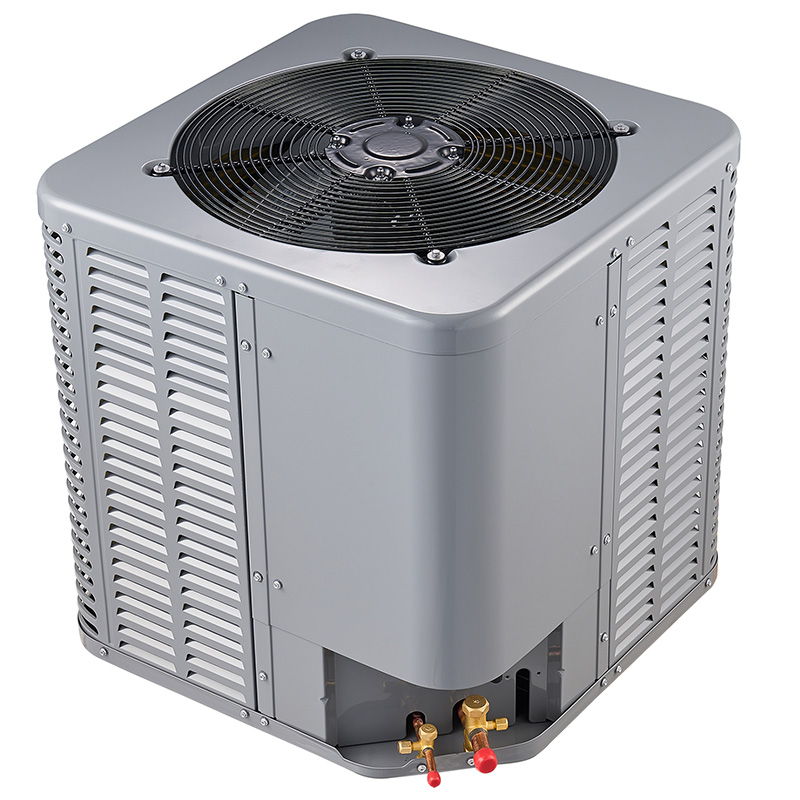
MrCool Signature 4 Ton Central Heat Pump System with Multi-Position Air Handler – 14.3 SEER2, R454B
View on AC Direct see your lowest price →Check current price on AC Direct →
Key features
- 4-ton capacity suited to larger homes, approximately 2,000 to 2,400 sq ft depending on load
- 14.3 SEER2 efficiency rating meets current federal minimums for split-system heat pumps
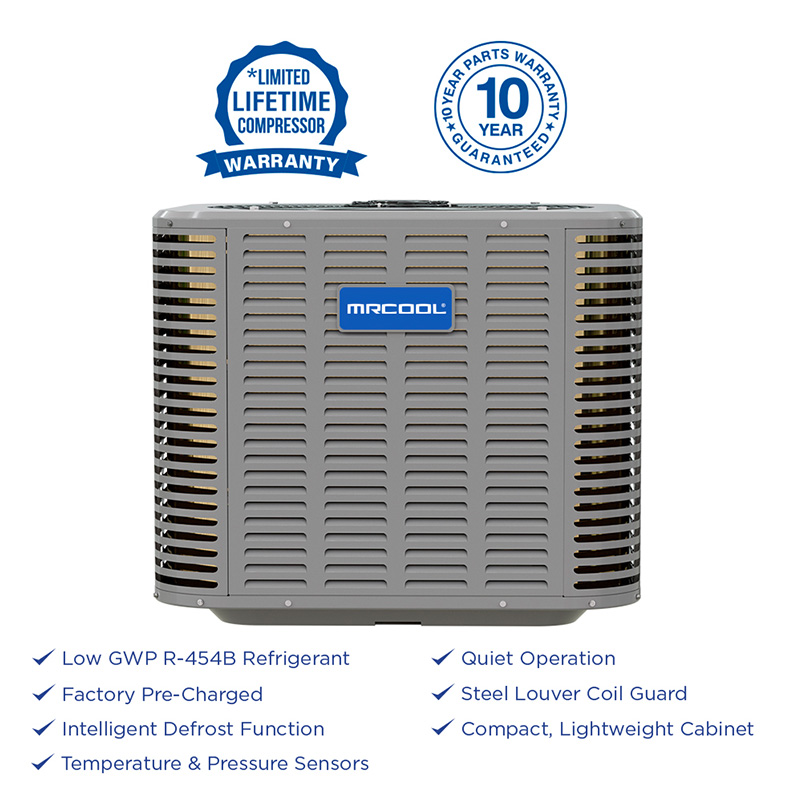
- R-454B refrigerant is the current low-GWP successor to R-410A, regulatory-compliant going forward
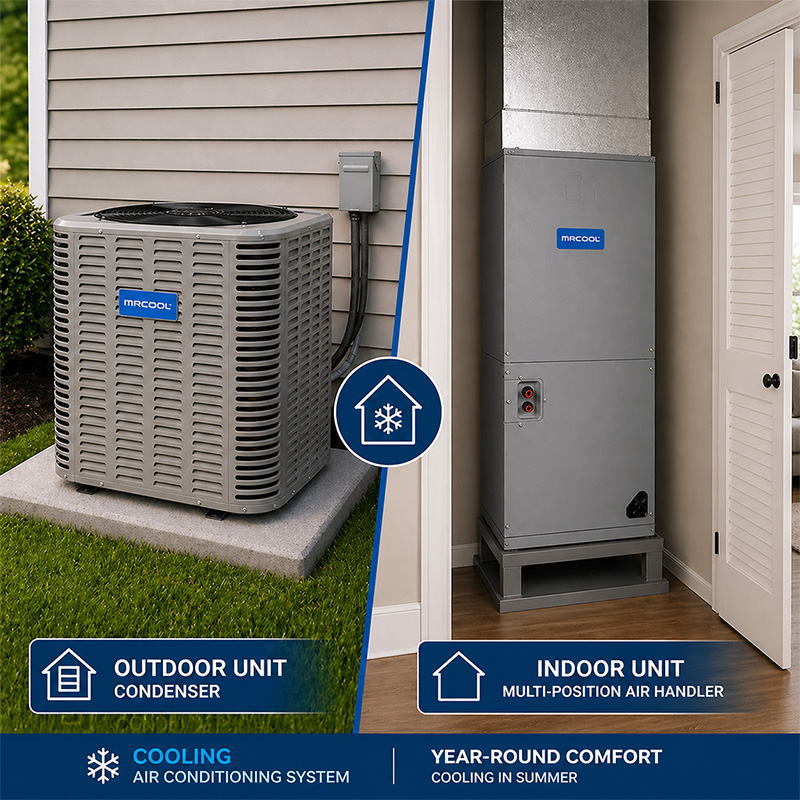
- Multi-position air handler supports upflow, downflow, and horizontal configurations
- Ducted split-system design requires professional installation and refrigerant line evacuation
- Part of MrCool's Signature series, positioned as the brand's contractor-grade central product line
About this system
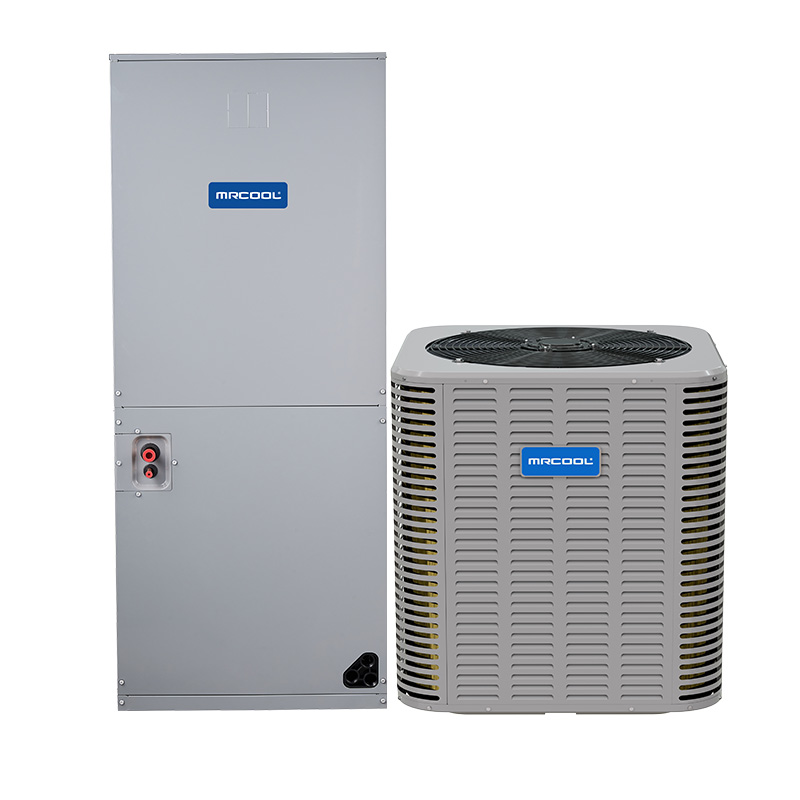
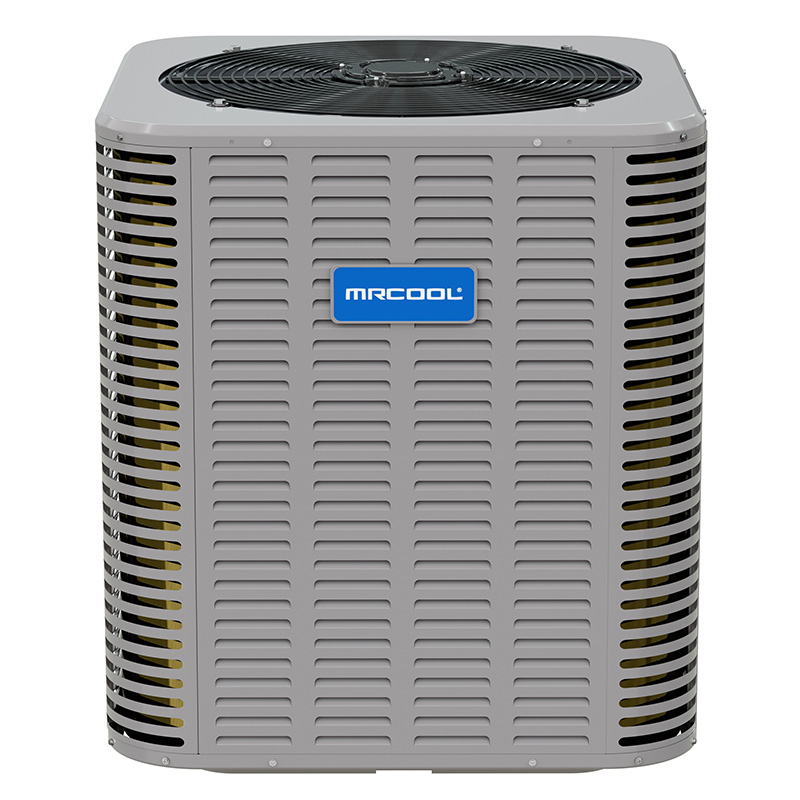
The MrCool Signature 4-Ton Central Heat Pump System pairs a split-system heat pump condensing unit with a multi-position air handler, covering homes in roughly the 2,000 to 2,400 square foot range depending on climate and insulation. At 14.3 SEER2, this system meets the federally mandated minimum efficiency floor that took effect in 2023, which means operating costs are competitive with other entry-tier central systems but well below what a 17 or 18 SEER2 variable-speed unit would deliver over a decade. The R-454B refrigerant is the industry’s current low-GWP replacement for R-410A, so the system is regulatory-compliant for the foreseeable future.
The multi-position air handler is a practical feature for installers and remodelers: the cabinet can be configured for upflow, downflow, or horizontal airflow, which reduces the need to special-order a unit matched to a specific mechanical room layout. Unlike MrCool’s well-known DIY ductless line, this is a conventional ducted split system that requires a licensed HVAC technician to evacuate the refrigerant lines, make electrical connections, and commission the unit. Homeowners drawn to MrCool expecting a pre-charged, self-install experience will find this product does not work that way. It suits buyers who want a recognized brand at a lower price point than Carrier or Trane and are comfortable hiring a local contractor for installation and any future service calls.
The MrCool Signature 4-Ton Heat Pump offers a genuine price advantage over name-brand ducted systems at the same efficiency tier, and the multi-position air handler adds real installation flexibility. The trade-off is meaningful: MrCool's service network is thin, warranty claims have a documented history of being disputed, and owners who hit early failures may struggle to find a local technician willing to work on the equipment.
Overall score is the average of the five ratings above.
What we like
- Lower purchase price compared to similarly specified Carrier, Trane, or Lennox entry-level ducted heat pumps
- Multi-position air handler reduces installation constraints in tight or irregular mechanical rooms
- R-454B refrigerant is forward-compatible with current and near-future regulations
- 5th-generation platform shows roughly 85 percent first-year reliability, a marked improvement over earlier generations
- 14.3 SEER2 meets federal minimums, keeping equipment costs in check without over-engineering for efficiency
Trade-offs
- Warranty claims are documentation-heavy, and owners consistently report the company looking for reasons to deny coverage
- Few local HVAC contractors stock MrCool parts or are familiar with the Signature line, making repairs harder to arrange
- Customer service complaints include long hold times and resolution primarily through email-based troubleshooting rather than dispatched technicians
- Single-stage operation at 14.3 SEER2 means meaningfully higher long-run energy costs compared to two-stage or variable-speed alternatives at higher efficiency tiers
What homeowners and pros say about MRCOOL
On home improvement forums and big-box retailer review pages, MrCool earns strong marks primarily for its DIY ductless mini-split line, where self-install is the main selling point. The Signature central series occupies a different space and draws a more mixed response. Owners who had a smooth installation and no early failures report satisfaction with the price-to-performance ratio. However, the brand’s documented failure modes in central systems include loose refrigerant couplings near the air handler, early compressor issues in a subset of units, and coil integrity concerns that surface within the first two heating and cooling seasons. MrCool’s 5th-generation platform reduced first-year failure rates to roughly 85 percent reliability, a real improvement over earlier generations that saw failure rates approaching 25 percent, but that still means a meaningful fraction of units require service shortly after installation.
HVAC professionals tend to be cautious about the Signature line. The core concerns contractors raise are parts availability, the documentation-intensive warranty process that owners report is prone to denial, and customer service that resolves most issues through email rather than dispatched support. For homeowners, the practical implication is that if a component fails outside the installation window, finding a local technician willing to diagnose and repair the system can be difficult. Buyers who go in with eyes open, confirm local contractor support in advance, and keep meticulous installation records are best positioned to get value from this system. Those who expect the brand support experience of a Carrier or Trane dealer relationship are likely to be disappointed.
Sources: Better Business Bureau MRCOOL reviews, PickHVAC MRCOOL review, AHRI Directory of Certified Product Performance, U.S. DOE appliance and equipment efficiency standards.
What it costs to run
At 14.3 SEER2, cooling this 4-ton system for a typical 1200-hour cooling season at the U.S. average electricity rate of $0.17/kWh works out to roughly $685 per year in cooling, about $46 less per year than a minimum-efficiency 13.4 SEER2 unit of the same size. Your real cost depends on your climate and local rate.
Method: (48,000 BTU/hr ÷ 14.3 SEER2) × 1200 hours ÷ 1000 × $0.17/kWh. Rate source: U.S. EIA average; cooling hours: moderate-climate estimate.
How it compares
| Brand | Comparable model | SEER2 | Stage | Price position |
|---|---|---|---|---|
| MrCool | Signature 4-Ton Central Heat Pump with Multi-Position Air Handler | 14.3 | Single-stage | Value pick |
| Carrier | Performance 14 Heat Pump (25HCE4) | 14.3 | Single-stage | Moderately higher than MrCool, with substantially broader contractor and parts support |
| Trane | XR14c Heat Pump | 14.3 | Single-stage | Moderately higher than MrCool, backed by Trane's extensive dealer network |
| Lennox | Merit ML14XP1 Heat Pump | 14.3 | Single-stage | Comparable to Carrier and Trane at this tier, notably higher than MrCool |
Competitor rows are comparable single-stage units at similar efficiency; price is relative position, not a quote.
Questions about this system
Can I install this MrCool Signature heat pump myself the way I would install a MrCool DIY mini-split?
No. Unlike the pre-charged DIY ductless line, the Signature central system requires a licensed HVAC technician to pull a vacuum on the refrigerant lines, charge the system with R-454B, and make the electrical connections. Attempting a DIY installation will almost certainly void the warranty and may violate local codes.
What happens if the unit breaks down and my local HVAC company does not service MrCool equipment?
This is a real risk with MrCool's ducted line. The brand's service network is thin outside of markets where it has strong distributor relationships, and many independent HVAC technicians are unfamiliar with the Signature series. Before purchasing, it is worth calling two or three local contractors to confirm they are willing to service MrCool equipment and can source parts.
Is the warranty easy to use if something goes wrong?
Based on documented owner experiences, no. Warranty claims require thorough paperwork and proof of professional installation, and owners report that MrCool frequently disputes coverage. You should register the unit immediately after installation, keep all invoices, and photograph the installation before closing up the air handler.
Why does this system use R-454B instead of R-410A?
R-410A is being phased out under EPA regulations because of its high global warming potential. R-454B is the lower-GWP replacement most residential equipment manufacturers have adopted; it requires the same general installation practices as R-410A but uses slightly different handling procedures and is not interchangeable with the older refrigerant.
How does 14.3 SEER2 compare to what I should actually consider for my climate?
14.3 SEER2 is the regulatory minimum for a split-system heat pump in most U.S. regions as of 2023, so it is legal and functional everywhere, but it is the least efficient new equipment you can buy. In climates with long cooling seasons or high electricity rates, moving to a 16 or 17 SEER2 system could meaningfully reduce annual operating costs and may pay back the price difference within several years.
Specifications
| Cooling capacity | 4 Ton |
| Efficiency | 14.3 SEER2 |
| Configuration | Multi-Position |
| Refrigerant | R-454B |