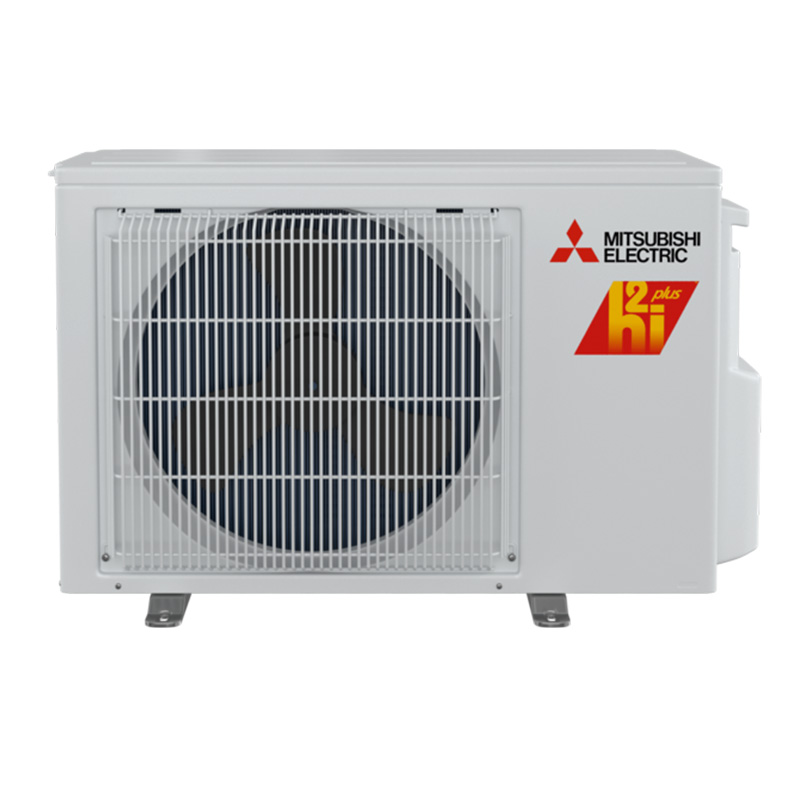
Mitsubishi 6000 BTU Mini Split Heat Pump AC Condenser | Heats Down To -22° F & Beyond | R454B (MUZ-FX06NLHZ)
View on AC Direct see your lowest price →Check current price on AC Direct →
Key features
- 6,000 BTU single-zone mini-split condenser for spaces up to roughly 250 sq ft
- Cold-climate heat pump rated to operate down to -22°F outdoor temperature
- Uses R-454B refrigerant, a lower global warming potential alternative to R-410A
- Ductless design eliminates duct losses and allows zone-specific temperature control
- Compatible with Mitsubishi MSZ series indoor air handlers for a matched system
- Eligible for 12-year parts and compressor warranty when installed by a Diamond certified contractor
About this system
The Mitsubishi MUZ-FX06NLHZ is a 6,000 BTU single-zone mini-split condenser designed for small spaces where precision comfort matters most. Think a detached garage, a sunroom addition, a studio apartment, or a bedroom that a central system never quite handles well. Paired with a compatible Mitsubishi MSZ indoor air handler, it delivers both heating and cooling without ductwork, running on the newer R-454B refrigerant, which has a lower global warming potential than the R-410A it replaces across much of the industry.
What sets this unit apart from budget mini-splits is its cold-climate heat pump rating, which Mitsubishi advertises down to -22 degrees Fahrenheit. That means residents in northern states, mountain towns, and Canadian border regions can use this as a primary heat source through genuinely harsh winters rather than a shoulder-season supplement. The FX series sits in Mitsubishi’s working lineup alongside the more recognized Hyper Heat branding, and it carries the brand’s reputation for quiet, efficient, long-lived operation when it is properly installed and maintained annually.
The MUZ-FX06NLHZ is a well-built, cold-climate capable mini-split that excels in small single-zone applications where quiet operation and all-season reliability outweigh upfront cost concerns. Mitsubishi's premium pricing and the requirement for a Diamond contractor install to unlock the full warranty make total ownership cost higher than budget alternatives, but the documented 15-to-20-year lifespan and genuine cold-weather performance justify that gap for buyers who plan to stay in their homes. It is not the right choice if you expect hands-off ownership without annual maintenance or if slow warranty service response would be a serious hardship.
Overall score is the average of the five ratings above.
What we like
- Genuine -22°F low ambient heating keeps small spaces warm through severe winters without backup heat
- Mitsubishi's reputation for quiet operation is well-documented by owners and industry reviewers
- R-454B refrigerant is more environmentally responsible than the R-410A systems it competes with
- Ductless installation avoids the efficiency losses of leaky duct systems and allows per-room control
- Owners consistently report 15 to 20 year lifespans with regular annual maintenance
Trade-offs
- Premium brand pricing means higher upfront cost than comparable Daikin, Fujitsu, or LG units
- Full 12-year warranty requires installation by a Mitsubishi Diamond certified contractor, adding labor cost
- Warranty support and technical response have drawn complaints about slow turnaround times per BBB reports
- A minority of owners report early compressor failures, and labor costs are not covered under warranty
What homeowners and pros say about Mitsubishi
Homeowners who have lived with Mitsubishi mini-splits long-term consistently point to quiet operation and durability as the brand’s strongest attributes, and those observations hold up for the FX series. EnergySage reviewers and owner communities frequently cite units running well beyond a decade with minimal issues when coils and blower wheels are cleaned on schedule. That last part matters: the indoor evaporator coil and blower are the documented weak points, not from a design flaw but from simple neglect. Owners who skip annual cleaning report performance degradation, while those who maintain the system describe it as nearly invisible in daily life. The Better Business Bureau picture is more complicated, with a recurring theme of slow warranty response times and cases where compressor failures left homeowners waiting on authorization while labor costs accrued out of pocket, since labor is not covered under the standard warranty terms.
On the trade side, HVAC professionals generally regard Mitsubishi as a well-engineered product that rewards proper installation and ongoing care. The Diamond contractor requirement is polarizing: some installers see it as a reasonable quality gate, others view it as a barrier that inflates labor costs. For the FX06NLHZ specifically, the cold-ambient heating story is credible and well-regarded among contractors working in cold climates who have seen budget heat pumps fail to deliver at low outdoor temperatures. The shift to R-454B refrigerant is a practical consideration for service technicians, since not all shops have updated their equipment for A2L refrigerant handling yet, and finding a qualified service tech in rural areas may take more effort than it would for an R-410A system.
Sources: EnergySage Mitsubishi heat pump review, AHRI Directory of Certified Product Performance, U.S. DOE appliance and equipment efficiency standards, Mitsubishi Electric product specifications.
How it compares
| Brand | Comparable model | SEER2 | Stage | Price position |
|---|---|---|---|---|
| Mitsubishi | MUZ-FX06NLHZ (FX Series) | Not published in provided specs | Variable-speed inverter | Premium tier |
| Daikin | Aurora RXL09QMVJU (9k; RXL series scales down to small zones) | 20+ SEER2 depending on configuration | Variable-speed inverter | Slightly lower than Mitsubishi at similar efficiency tier |
| Fujitsu | AOU7RGLX (Halcyon 7k cold-climate series) | ~19-20 SEER2 range | Variable-speed inverter | Comparable to Mitsubishi, occasionally less depending on dealer |
| LG | LMU090HV (Art Cool or LSN series small-zone) | ~20 SEER2 range | Variable-speed inverter | Moderate, typically less expensive than Mitsubishi for similar BTU output |
Competitor rows are comparable single-stage units at similar efficiency; price is relative position, not a quote.
Questions about this system
Do I really need a Diamond certified Mitsubishi contractor, or can any licensed HVAC tech install this?
Any licensed HVAC technician can physically install the unit, and it will operate. However, Mitsubishi's 12-year parts and compressor warranty only activates when a Diamond certified contractor performs the installation and registers the system. If a non-Diamond tech installs it, you fall back to the standard shorter warranty period, so the certification requirement has real financial stakes.
Is 6,000 BTU actually enough, or will I need to upsize?
At 6,000 BTU, this unit is sized for spaces roughly 150 to 250 square feet under average insulation conditions. Very poorly insulated spaces, rooms with large glass areas, or spaces in extremely hot climates may need the next size up. A proper Manual J load calculation by your installer is the reliable way to confirm sizing before you buy.
How does the -22°F rating work in practice, and will heating capacity drop in extreme cold?
The -22°F figure means the unit will continue to produce heat at that outdoor temperature rather than shutting down, which is the key advantage over standard heat pumps that typically cut out around 0 to 5 degrees Fahrenheit. However, heat output does decrease as outdoor temps fall, so at extreme low temperatures the unit will be working harder and producing less BTU than it does at moderate conditions. Mitsubishi publishes capacity curves in the technical specs, and your installer can review those for your specific climate.
What does annual maintenance actually involve, and what happens if I skip it?
At minimum, the indoor air handler's blower wheel and evaporator coil need cleaning once a year. Dust and biological buildup on the coil reduce heat transfer efficiency noticeably and can eventually contribute to drainage problems. Skipping maintenance is one of the documented reasons owners see performance drops over time, and it can also complicate warranty claims if a failure is linked to neglected upkeep.
R-454B is new to me. Will refrigerant and parts be available long-term, and does it change maintenance costs?
R-454B is part of the industry's transition away from R-410A under updated EPA and HFC phase-down regulations, so it is positioned as a forward-looking refrigerant rather than a transitional one. As the installed base of R-454B equipment grows, supply availability should improve. Maintenance procedures are similar to R-410A systems, but your technician must be certified to handle A2L class refrigerants, which R-454B is classified as, so not every technician will be equipped to service it in the near term.
Specifications
| Refrigerant | R-454B |
| Model | FX06NLHZ |