Daikin 7.5 Ton AC And 225000 BTU Gas/Electric Commercial Package Unit – 16 SEER2, Two Stage, 81% AFUE, R32
View on AC Direct see your lowest price →Check current price on AC Direct →
Key features
- 7.5-ton cooling capacity with 90,000 BTU output for medium-to-large commercial spaces
- 16 SEER2 two-stage compressor for load-matched cooling and improved humidity control
- 225,000 BTU gas heating section rated at 81% AFUE
- R-32 refrigerant with lower global warming potential than R-410A
- Self-contained package unit design with pre-charged refrigerant circuit
- 12-year parts warranty available with registration within 60 days of installation
About this system
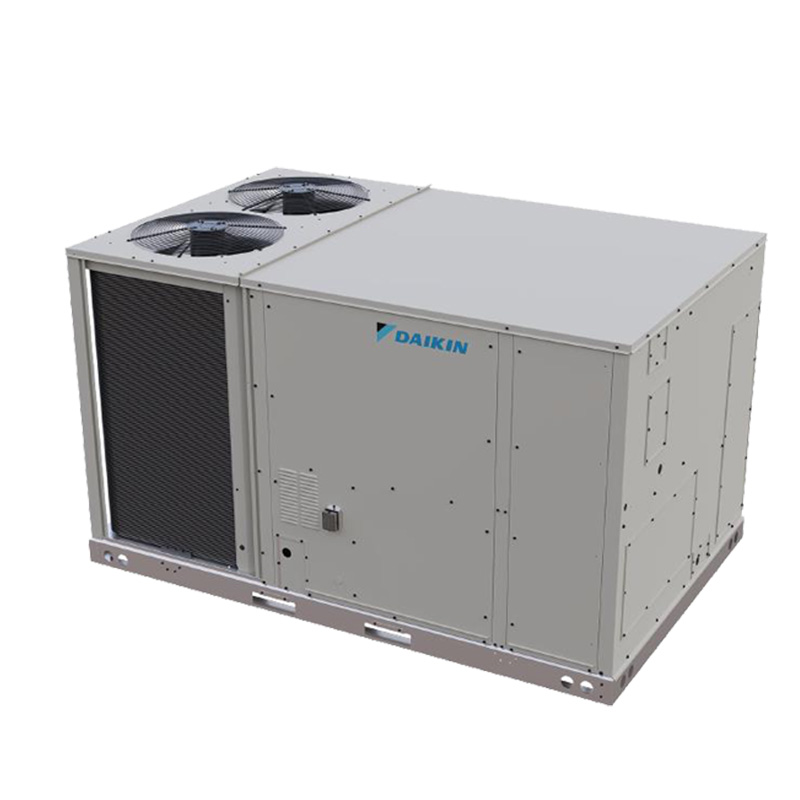
The Daikin 7.5-ton gas/electric commercial package unit is a rooftop or ground-mounted all-in-one system designed for medium-to-large commercial spaces: retail buildings, warehouses, restaurants, schools, and light industrial facilities that need both air conditioning and gas heat in a single cabinet. At 225,000 BTU of heating and 90,000 BTU of cooling, this unit is sized for spaces roughly in the 3,000 to 5,000 square-foot range depending on insulation, climate, and internal heat loads. The self-contained package format simplifies installation compared to split systems because refrigerant lines, coils, and controls all ship pre-assembled and pre-charged.
The 16 SEER2 rating puts this unit at the lower boundary of what qualifies as high-efficiency in commercial packaged equipment for 2023 federal minimums, so it is a solid performer without reaching premium-tier efficiency. Two-stage cooling is a genuine operational advantage: the compressor runs at reduced capacity during moderate load conditions, cutting energy use and improving humidity control compared to single-stage designs. The 81% AFUE gas furnace section is straightforward and functional but trails modern 90-plus percent AFUE alternatives in heating efficiency. R-32 refrigerant carries a lower global warming potential than the R-410A it replaces, and it is the direction the industry is heading under current and forthcoming EPA phasedown rules.
Daikin targets this product at building owners and facilities managers who want a proven, long-life platform with commercial-grade components. The trade-off is upfront cost that sits at the premium end of the commercial package market, and a support ecosystem that generates consistent complaints around parts lead times and warranty claim handling. Buyers who have an established relationship with a Daikin commercial dealer are likely to have a smoother ownership experience than those relying on general HVAC contractors with limited Daikin exposure.
This Daikin commercial package unit delivers reliable two-stage cooling and a solid 16 SEER2 rating in a durable, long-life cabinet, making it a capable choice for commercial buyers willing to pay a premium. The 81% AFUE heating section and documented concerns around parts availability and control board reliability are real factors to weigh. It earns its price for buyers with access to qualified Daikin commercial service, but less so for those in markets with thin dealer support.
Overall score is the average of the five ratings above.
What we like
- Two-stage compressor improves efficiency and humidity control over single-stage commercial units
- R-32 refrigerant is future-compatible with EPA phasedown requirements
- Daikin's commercial build quality is consistently rated for long service life by industry experts
- Self-contained package design reduces installation complexity versus split systems
- 12-year parts warranty is competitive in the commercial packaged equipment segment
Trade-offs
- 81% AFUE gas heat trails competing units with 90-plus percent AFUE furnace sections
- Electronic control boards are the most documented failure mode, sometimes causing error codes or unresponsive units
- Parts availability and warranty claim handling draw consistent complaints from owners and technicians
- Premium pricing means the value proposition weakens if local Daikin dealer support is limited
What homeowners and pros say about Daikin
Among HVAC professionals who work on commercial rooftop equipment, Daikin’s package units are generally respected for build durability and component quality, and the brand consistently appears alongside Carrier and Trane when industry experts and Consumer Reports rank systems by expected lifespan. That reputation for longevity is the most common reason a commercial contractor recommends Daikin to a facilities client. The flip side is the service experience: electronic control board and circuit board errors are the most cited failure mode in the field, and technicians frequently note that getting replacement parts through Daikin’s distribution chain can involve frustrating lead times, especially for less common boards. Compressors losing cooling capacity and units developing rattling or humming on start and stop cycles are also documented patterns, particularly as units age.
On owner review platforms, the picture is notably polarized. Daikin scores approximately 1.4 out of 5 on PissedConsumer, a channel that skews heavily toward complaint-driven submissions across a relatively small number of commercial and residential reviews, with pricing and warranty claim handling as the dominant grievances. That score should be read alongside the consistent industry expert and Consumer Reports recognition for above-average durability, which reflects a longer-term performance view rather than short-term service interactions. For this specific 7.5-ton unit, the practical takeaway is that buyers who invest in a service agreement with a Daikin-authorized commercial dealer before problems arise tend to report far fewer ownership headaches than those who encounter a warranty issue without an established service relationship in place.
Sources: PissedConsumer Daikin reviews, AHRI Directory of Certified Product Performance, U.S. DOE appliance and equipment efficiency standards, Daikin product specifications.
What it costs to run
At 16 SEER2, cooling this 7.5-ton system for a typical 1200-hour cooling season at the U.S. average electricity rate of $0.17/kWh works out to roughly $1148 per year in cooling, about $222 less per year than a minimum-efficiency 13.4 SEER2 unit of the same size. Your real cost depends on your climate and local rate.
Method: (90,000 BTU/hr ÷ 16 SEER2) × 1200 hours ÷ 1000 × $0.17/kWh. Rate source: U.S. EIA average; cooling hours: moderate-climate estimate.
How it compares
| Brand | Comparable model | SEER2 | Stage | Price position |
|---|---|---|---|---|
| Daikin | DCC090XXX3VXXX (7.5-Ton Gas/Electric Package) | 16 | Two-stage | Premium end of the commercial package market |
| Carrier | WeatherMaster 50XC (7.5-Ton Gas/Electric Package) | 16 | Two-stage | Similar premium pricing, typically within a narrow range of the Daikin |
| Trane | Precedent YSC090 (7.5-Ton Gas/Electric Package) | 16 | Two-stage | Comparable premium tier, often priced similarly or slightly above the Daikin |
| Lennox | LGH090H4M (7.5-Ton Gas/Electric Rooftop Package) | 16 | Two-stage | Premium pricing, generally in the same tier as the Daikin with some regional variation |
Competitor rows are comparable single-stage units at similar efficiency; price is relative position, not a quote.
Questions about this system
Does the 12-year parts warranty apply automatically, or do I need to register it?
Registration is required and must be completed within 60 days of installation to activate the 12-year parts warranty. Missing that window typically drops coverage to a shorter base warranty, so confirm with your installer that registration is submitted before the deadline.
How much square footage can this 7.5-ton unit realistically handle?
A rough commercial rule of thumb puts 7.5 tons in the 3,000 to 5,000 square-foot range, but actual sizing depends on ceiling height, insulation quality, local climate, occupancy load, and equipment heat gain. A load calculation using Manual N or equivalent commercial methods is necessary before purchasing.
Why does this unit use R-32 refrigerant instead of R-410A?
R-32 has roughly one-third the global warming potential of R-410A and is part of Daikin's broader transition away from higher-GWP refrigerants ahead of EPA phasedown schedules. Technicians working on this unit will need R-32 certification and compatible recovery equipment, which is worth confirming with your service provider before install.
What is the most common service problem owners and technicians report with Daikin commercial units like this?
Electronic control board and circuit board errors are the most frequently documented failure mode, sometimes leaving the unit unresponsive or displaying fault codes that require a technician to clear. Compressor performance degradation and increasing operational noise over time are also reported. Parts lead times are a recurring complaint when components do need replacement.
Is 81% AFUE adequate for commercial heating, or should I be looking at higher-efficiency options?
81% AFUE meets code minimums in most U.S. climate zones and is functional for mild-to-moderate heating climates, but in colder northern climates or buildings with high heating demand, a unit with a 90-plus percent AFUE furnace section will meaningfully reduce annual gas costs. The payback period for the higher-efficiency alternative depends on local gas rates and annual heating hours.
Specifications
| Cooling capacity | 7.5 Ton |
| Efficiency | 16 SEER2 |
| Furnace output | 225000 BTU |
| Furnace efficiency | 81% AFUE |
| Refrigerant | R-32 |