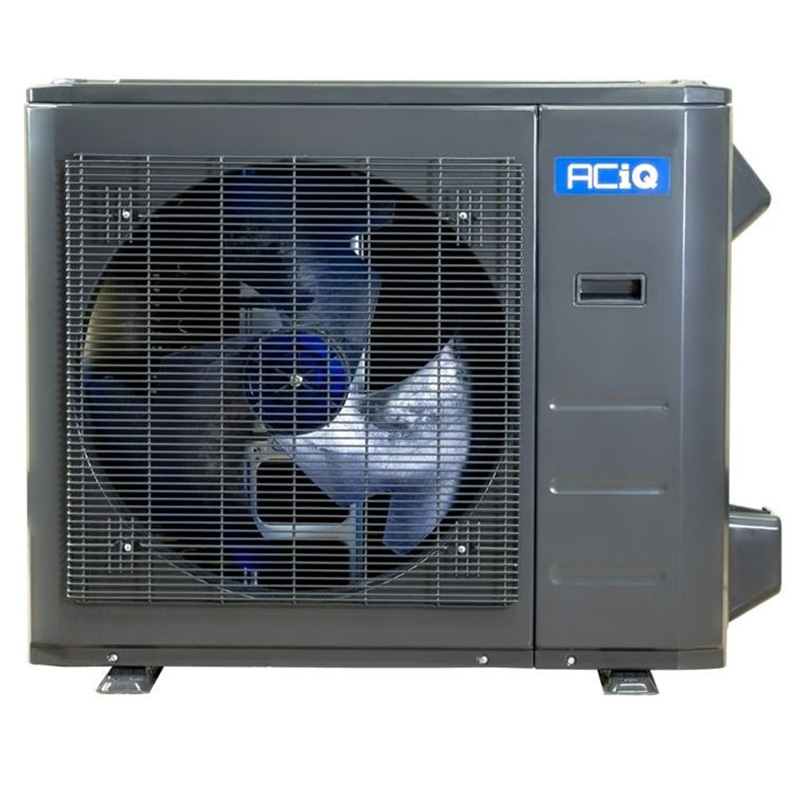
ACiQ 4 Ton Heat Pump AC Condenser | 16 SEER2 High Efficiency Inverter R454B (ACIQ-48-EHPD)
View on AC Direct see your lowest price →Check current price on AC Direct →
Key features
- 16 SEER2 efficiency rating with inverter-driven variable-speed compressor
- R-454B low-GWP refrigerant, compliant with current and anticipated EPA regulations
- 4-ton capacity suited to larger homes, typically 2,000 to 2,600 sq ft depending on load
- Continuous capacity modulation for steadier temperatures and lower indoor humidity
- 12-year parts warranty included, with no dealer markup built into the purchase price
- Direct-to-consumer pricing undercuts name-brand inverter heat pumps at similar efficiency
About this system
The ACiQ 4-Ton 16 SEER2 Inverter Heat Pump Condenser (ACIQ-48-EHPD) is a variable-speed, R-454B refrigerant system sized for larger homes in the roughly 2,000 to 2,600 square foot range, depending on climate zone and insulation quality. The inverter-driven compressor modulates output continuously rather than cycling on and off at full capacity, which translates to steadier indoor temperatures, lower humidity levels during cooling season, and meaningfully quieter operation compared to single-stage or two-stage units. R-454B is a low-global-warming-potential refrigerant that meets current EPA requirements and positions this system ahead of older R-410A equipment for regulatory longevity.
At 16 SEER2, this unit sits in the mid-efficiency tier, comfortably clearing the federal minimums for most U.S. climate regions and qualifying for consideration under many utility rebate programs, though buyers should verify local thresholds before purchasing. The system is sold direct through AC Direct without dealer markup, which is how ACiQ keeps its price below comparable inverter heat pumps from established brands. The trade-off is that installation and ongoing service depend entirely on independent HVAC contractors rather than a factory-authorized dealer network, so vetting your installer matters more here than it would with a brand that maintains regional service infrastructure.
The ACIQ-48-EHPD offers a legitimate inverter heat pump at a price point that is difficult to match among established brands, and the 12-year warranty provides meaningful coverage for a system whose long-term track record is still being established. Buyers who can confidently source a qualified independent installer and accept some uncertainty around parts availability and manufacturer identity will find real value here; those who prioritize a proven service network or independent reliability rankings should weigh that gap carefully.
Overall score is the average of the five ratings above.
What we like
- Variable-speed inverter compressor delivers quieter operation and more consistent comfort than single-stage alternatives
- 16 SEER2 efficiency clears federal minimums and may qualify for utility rebates in many regions
- R-454B refrigerant is forward-compatible with current and upcoming environmental regulations
- 12-year parts warranty is competitive and comes without the dealer-markup premium attached to name-brand coverage
- Direct pricing typically undercuts Carrier, Trane, and Lennox inverter heat pumps at similar efficiency tiers
Trade-offs
- Manufacturer identity is undisclosed, making parts cross-referencing and service history verification harder than with a named brand
- Consumer Reports has not yet ranked ACiQ due to insufficient long-term field data, so reliability is not independently confirmed
- No factory-authorized dealer network means the quality of installation and service depends entirely on the independent contractor you hire
- As a newer brand, long-term compressor and coil durability in the field remains unproven compared to brands with decades of documented performance data
What homeowners and pros say about ACiQ
Early owners of ACiQ systems report quiet operation and consistent cooling and heating performance in online reviews, with responsive customer support from AC Direct cited as a positive when questions arise. Because ACiQ is a relatively new brand, Consumer Reports has not yet assigned it a reliability score due to insufficient long-term data in the field, and that absence is the most important caveat any honest assessment has to carry. The specific failure modes that surface in owner forums and contractor discussions are the ones common to inverter heat pumps broadly: capacitor failures on condenser units exposed to high ambient temperatures, refrigerant coil leaks at fittings or the evaporator, and uncertainty about long-term compressor durability given the brand has not accumulated the years of field data that Carrier or Trane can point to. None of these are unique to ACiQ, but without the independent data to show they are occurring at lower rates than industry averages, a buyer is accepting some unknown risk.
HVAC contractors who have installed ACiQ equipment generally note that the units arrive well-packaged and match their rated specifications, but some express frustration that the undisclosed manufacturing origin complicates parts sourcing when something outside the standard warranty process is needed. The direct-sale model also means contractors have no ongoing dealer relationship with the brand, which can affect how motivated a busy shop is to prioritize service on a brand that did not come through their normal supply chain. For homeowners who do the work of finding a knowledgeable independent installer and keep their 12-year warranty documentation in order, the value proposition is real; for those who want the reassurance of a fully mapped service ecosystem, the gap between ACiQ and an established name brand is still meaningful.
Sources: Consumer Reports heat pump ratings, HVACDirect on the ACiQ brand, AHRI Directory of Certified Product Performance, U.S. DOE appliance and equipment efficiency standards.
What it costs to run
At 16 SEER2, cooling this 4-ton system for a typical 1200-hour cooling season at the U.S. average electricity rate of $0.17/kWh works out to roughly $612 per year in cooling, about $119 less per year than a minimum-efficiency 13.4 SEER2 unit of the same size. Your real cost depends on your climate and local rate.
Method: (48,000 BTU/hr ÷ 16 SEER2) × 1200 hours ÷ 1000 × $0.17/kWh. Rate source: U.S. EIA average; cooling hours: moderate-climate estimate.
How it compares
| Brand | Comparable model | SEER2 | Stage | Price position |
|---|---|---|---|---|
| ACiQ | ACIQ-48-EHPD | 16 | Variable / Inverter | Value pick |
| Carrier | Infinity 16 Heat Pump (25VNA0) | 16-17 | Variable | Significantly higher than ACiQ |
| Trane | XR16 Heat Pump (4TWR6) | 16 | Single-stage | Moderately higher than ACiQ |
| Lennox | Merit ML16XP1 Heat Pump | 16 | Single-stage | Moderately higher than ACiQ |
Competitor rows are comparable single-stage units at similar efficiency; price is relative position, not a quote.
Questions about this system
Will a standard HVAC contractor be able to install and service this unit, or does it require a specialist?
Any licensed HVAC technician certified to handle R-454B refrigerant can install and service this system, but because ACiQ is sold direct rather than through a dealer network, there are no factory-authorized service providers to call. You will need to source and vet an independent contractor yourself, and it is worth confirming upfront that they have experience with inverter-driven heat pumps and access to R-454B equipment.
Who actually manufactures this unit, and does it matter for parts availability?
ACiQ is AC Direct's house brand and the actual manufacturer has not been publicly disclosed, though forum speculation links it to the broader ICP and Carrier manufacturing family, which is unconfirmed. This matters practically because cross-referencing OEM parts or warranty history is harder when the underlying manufacturer is unknown, and some independent technicians may find it less familiar than a named brand they service regularly.
Does 16 SEER2 qualify for federal tax credits or utility rebates?
The federal Inflation Reduction Act heat pump tax credit (25C) requires a minimum efficiency that varies by system type and climate region, and 16 SEER2 meets or exceeds the threshold for many ducted heat pump applications as of current guidance. Utility rebate eligibility is program-specific, so you should check your local utility's current requirements before purchasing to confirm this unit qualifies.
Is R-454B refrigerant going to be easy to find for future service calls?
R-454B is an A2L low-GWP refrigerant that was introduced specifically to replace R-410A as that refrigerant is phased down under EPA regulations, so availability is expected to improve as more equipment ships with it. In the near term, not every service technician will stock it, and handling A2L refrigerants requires updated equipment and certification, so confirming your contractor is equipped for it before scheduling service is a practical step.
How does the inverter compressor affect my electricity bill compared to a standard two-stage unit?
A variable-speed inverter compressor runs at partial capacity for most of its operating hours rather than cycling between full-on and full-off, which generally results in lower energy consumption during the long shoulder seasons when full capacity is not needed. Real-world savings depend heavily on your climate, home insulation, and usage patterns, but inverter systems consistently outperform two-stage units in measured efficiency under part-load conditions, which is how most homes operate the majority of the time.
Specifications
| Cooling capacity | 4 Ton |
| Efficiency | 16 SEER2 |
| Refrigerant | R-454B |