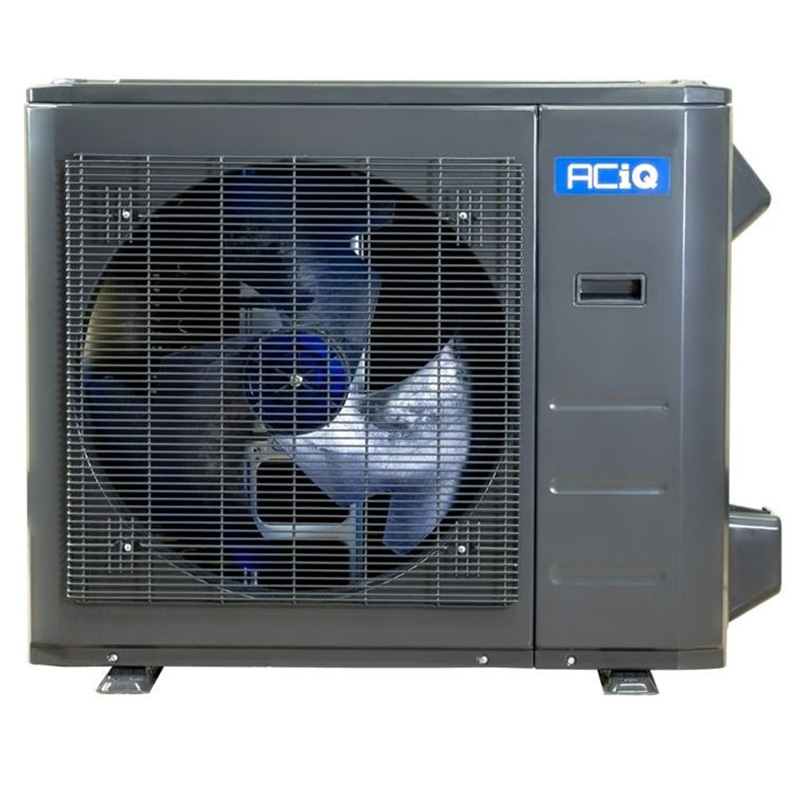
ACiQ 5 Ton Heat Pump AC Condenser | 15.2 SEER2 High Efficiency Inverter R454B (ACIQ-60-EHPD)
View on AC Direct see your lowest price →Check current price on AC Direct →
Key features
- 15.2 SEER2 inverter compressor for variable-capacity operation
- R-454B refrigerant, compliant with current EPA phase-down requirements
- 5-ton capacity suited to larger homes with existing ducted systems
- 12-year parts warranty included, no dealer markup required to activate
- Sold factory-direct, bypassing traditional dealer channel pricing
- Quiet inverter operation compared to single-stage cycling condensers
About this system
The ACiQ ACIQ-60-EHPD is a 5-ton inverter-driven heat pump condenser rated at 15.2 SEER2, using the newer R-454B refrigerant that meets current EPA guidelines and positions the system well ahead of the industry’s ongoing R-410A phase-down. At 5 tons, this unit is sized for larger homes, typically in the 2,400 to 3,000 square foot range depending on climate zone, insulation quality, and local heat load. The inverter compressor modulates output continuously rather than cycling on and off at full capacity, which generally means lower energy bills, quieter operation, and reduced temperature swings compared to single-stage equipment.
ACiQ is AC Direct’s house brand, priced below comparable inverter systems from Carrier, Trane, and Lennox by skipping the dealer markup entirely and selling factory-direct. The 15.2 SEER2 rating lands in the mid-efficiency tier, comfortably above the federal minimums for most climate zones but below the upper-tier 17+ SEER2 systems that carry significantly higher price tags. For a buyer who wants inverter technology and R-454B refrigerant at a realistic budget, this condenser is a credible option, provided they understand the trade-offs around brand transparency and service network that come with buying direct from a newer label.
The ACiQ 5-ton heat pump delivers genuine inverter technology and a solid mid-efficiency rating at a price that undercuts name brands by a meaningful margin. The 12-year warranty and R-454B refrigerant are real advantages, but buyers should go in clear-eyed about the brand's short track record, the undisclosed manufacturer, and the fact that servicing a direct-sold unit requires finding a contractor who is comfortable working outside a dealer network.
Overall score is the average of the five ratings above.
What we like
- Inverter compressor provides true variable-capacity operation, not just two-stage cycling
- R-454B refrigerant is current-generation and avoids the obsolescence risk tied to R-410A equipment
- 12-year parts warranty ships standard without requiring dealer registration or markup
- Factory-direct pricing undercuts Carrier, Trane, and Lennox units at similar efficiency tiers
- Early owner reports consistently note quieter operation compared to previous single-stage units
Trade-offs
- Manufacturer identity is not disclosed, making parts sourcing and service history harder to cross-reference
- No dealer network means installation and warranty service depend entirely on finding a willing independent contractor
- Consumer Reports has not yet ranked ACiQ due to insufficient long-term reliability data
- Long-term compressor and coil durability at 5-ton inverter load remains unproven given the brand's age
What homeowners and pros say about ACiQ
Early owners of ACiQ equipment, including those running larger 5-ton configurations, tend to report that the inverter systems run noticeably quieter than the single-stage units they replaced, and that ACiQ’s customer support has been responsive when questions arise. Consumer Reports has not yet assigned ACiQ a reliability rating because the brand is too new to have accumulated the long-term failure data that rating requires, so positive early sentiment should be read as exactly that, early and not yet validated by years of field performance. The specific failure modes worth watching in any inverter heat pump of this type include capacitor degradation under heavy cycling load, refrigerant coil leaks at the brazed joints, and long-term compressor durability, which is the component that inverter technology stresses differently than single-stage designs. None of these have been documented as brand-specific ACiQ patterns yet, but the data horizon is short.
Independent HVAC contractors who have worked on ACiQ equipment generally note that the build quality appears comparable to mid-tier name-brand equipment, with the caveat that the undisclosed manufacturer makes it harder to anticipate parts lead times or cross-reference service bulletins. For a 5-ton heat pump installation, that ambiguity matters more than it would on a smaller residential unit, since parts delays on a large system serving a big home can mean extended downtime. Buyers who prioritize peace of mind over upfront savings will find the documented dealer networks and long reliability histories of Carrier and Trane worth the premium. Buyers who have a trusted independent contractor and are comfortable with some uncertainty in exchange for a lower purchase price and a genuine 12-year parts warranty will find the ACiQ a competitive option at this efficiency tier.
Sources: Consumer Reports heat pump ratings, HVACDirect on the ACiQ brand, AHRI Directory of Certified Product Performance, U.S. DOE appliance and equipment efficiency standards.
What it costs to run
At 15.2 SEER2, cooling this 5-ton system for a typical 1200-hour cooling season at the U.S. average electricity rate of $0.17/kWh works out to roughly $805 per year in cooling, about $108 less per year than a minimum-efficiency 13.4 SEER2 unit of the same size. Your real cost depends on your climate and local rate.
Method: (60,000 BTU/hr ÷ 15.2 SEER2) × 1200 hours ÷ 1000 × $0.17/kWh. Rate source: U.S. EIA average; cooling hours: moderate-climate estimate.
How it compares
| Brand | Comparable model | SEER2 | Stage | Price position |
|---|---|---|---|---|
| ACiQ | ACIQ-60-EHPD | 15.2 | Variable/Inverter | Value pick |
| Carrier | Performance 17 Heat Pump (25HPB6) | 17.0 | Variable | Significantly higher than ACiQ |
| Trane | XR15 Heat Pump (4TWR5) | 15.0 | Single-stage | Moderately higher than ACiQ |
| Lennox | Merit ML15XP1 Heat Pump | 15.2 | Single-stage | Moderately higher than ACiQ |
Competitor rows are comparable single-stage units at similar efficiency; price is relative position, not a quote.
Questions about this system
Will a standard HVAC contractor install and service this unit, or do I need a specialist?
Most licensed HVAC contractors can install this condenser, but because ACiQ is sold direct rather than through a dealer network, you will need to confirm in advance that the contractor is willing to work with non-dealer equipment and comfortable handling R-454B refrigerant, which requires updated tools. Some contractors decline direct-sold brands as a policy, so it is worth calling ahead before purchasing.
Who actually manufactures this unit, and does it share parts with a better-known brand?
ACiQ does not publicly disclose the manufacturer. Forum speculation links it to the ICP and Carrier family of factories, but this is unconfirmed. The practical consequence is that cross-referencing parts to a known parent brand is not straightforward, which can complicate sourcing if a specific component needs replacement years down the road.
How does 15.2 SEER2 compare to what the federal minimum requires for my region?
As of 2023, federal SEER2 minimums range from 13.4 to 15.2 depending on region and system size, so this unit sits at or near the top of the baseline tier rather than in the premium efficiency range. For a 5-ton system in a hot climate, moving to a 17 or 18 SEER2 unit would reduce operating costs further, but the payback period depends heavily on local electricity rates and how many hours the system runs annually.
Does the 12-year warranty require a dealer to register it, and what does it cover?
ACiQ's 12-year warranty is advertised as not requiring dealer registration or markup to activate, which is a real advantage over brands that tie warranty length to dealer installation. The coverage applies to parts; labor costs for a warranty repair are typically the homeowner's responsibility and depend on the contractor's rates.
Is R-454B refrigerant harder to find or more expensive to recharge than R-410A?
R-454B is a lower-GWP replacement refrigerant that is increasingly available as the industry moves away from R-410A, but it is not yet as universally stocked as R-410A is today. Contractors will need certified equipment to handle it, and recharge costs may be somewhat higher in the near term as supply chains fully catch up. That said, choosing R-454B now avoids the longer-term obsolescence risk that R-410A equipment carries as regulations tighten.
Specifications
| Cooling capacity | 5 Ton |
| Efficiency | 15.2 SEER2 |
| Refrigerant | R-454B |