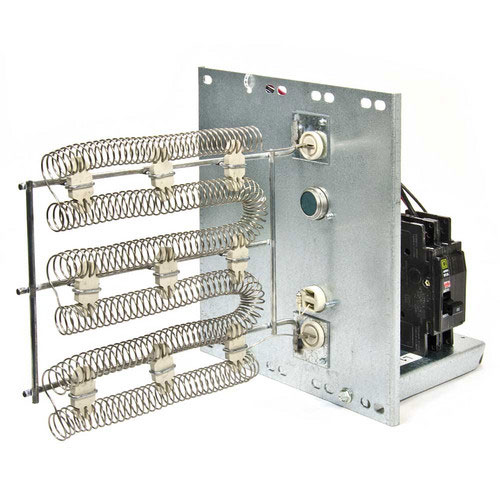
Goodman 5kW Heating Element for Air Handlers and Package Units (HKR-05)
View on AC Direct see your lowest price →Check current price on AC Direct →
Key features
- 5 kW (17,065 BTU) electric resistance heat output
- Designed for use with compatible Goodman air handlers and package units
- Functions as supplemental backup heat in heat-pump configurations
- No refrigerant, compressor, or combustion components — close to 100% conversion efficiency
- Fits standard Goodman heating element slots; verify model compatibility before ordering
- Lower upfront hardware cost compared to full system heating upgrades
About this system
The Goodman HKR-05 is a 5-kilowatt electric resistance heating element designed to drop into compatible Goodman air handlers and package units, providing supplemental or primary heat in mild-to-moderate climates. At roughly 17,065 BTU of heat output, it is best suited as a backup heat source in heat-pump systems or as primary heat in smaller spaces where winters are short and relatively mild. It is not a refrigerant-based or fuel-burning component, so there is no SEER2 or AFUE rating to evaluate here — efficiency is essentially fixed at close to 100 percent conversion of electricity to heat, which is typical of all resistance elements.
This part makes sense for homeowners or contractors who need to add low-cost heating capacity to an existing Goodman air handler without replacing the entire system. It is also a straightforward replacement option when an existing element burns out. Because it runs on electric resistance rather than a heat pump refrigeration cycle, operating costs are higher per BTU than a heat pump would produce, but the hardware cost and installation complexity are substantially lower. Anyone in a region with high electricity rates who plans to use this as a primary heat source through cold winters should weigh that ongoing cost carefully before purchasing.
The HKR-05 is a practical, low-cost way to add or restore supplemental electric heat to a compatible Goodman system, and its simplicity means there is very little to go wrong with the element itself. Operating costs are higher than a heat pump would produce per BTU, so it works best as a backup rather than a primary heat source in cold climates. For mild-climate homeowners or those replacing a failed element, the value case is straightforward.
Overall score is the average of the five ratings above.
What we like
- Very low hardware cost compared to alternative heating upgrades
- Simple resistance design with no refrigerant or combustion components to service
- Near-100% conversion of electricity to heat — no efficiency loss in the element itself
- Straightforward drop-in installation for compatible Goodman air handlers and package units
- Reliable as a secondary or emergency heat source in heat-pump systems
Trade-offs
- Electric resistance heating carries significantly higher operating costs per BTU than a heat pump in most utility markets
- Only compatible with select Goodman units — model verification is required before purchase
- Not a practical primary heat source in climates with extended cold winters without a corresponding heat pump
- Adds electrical load that may require panel or breaker assessment before installation
What homeowners and pros say about Goodman
Homeowners and HVAC technicians who discuss Goodman equipment generally agree on a few consistent themes. On ConsumerAffairs, Goodman scores around 2.5 out of 5, though that platform attracts a disproportionate share of frustrated owners; the recurring concern there is repair costs that begin climbing after roughly year 7. Google dealer reviews land closer to 3.8 out of 5 across hundreds of reviews per location, where the most common praise is straightforward affordability relative to Trane, Lennox, and Carrier. For a simple resistance heating element like the HKR-05, the component itself is far less likely to generate complaints than the broader system it lives inside.
Where Goodman system owners do report trouble, the documented failure points are worth knowing. Dual-run capacitors are the most frequently cited weak spot across Goodman equipment, though that is a quick, low-cost repair typically in the 300 to 600 dollar range and not relevant to a resistance element. Evaporator coil leaks show up in a meaningful share of owner reviews on the air-handler side, and Goodman compressors tend to average 10 to 14 years of service compared to 15 to 20 years for premium-brand compressors. None of those failure modes apply directly to the HKR-05 heating element itself, which is a passive resistive component with fewer moving parts than almost anything else in the system. The honest assessment is that the element is a sensible, budget-conscious choice when the compatibility check clears and the electrical infrastructure supports it.
Sources: ConsumerAffairs Goodman owner reviews, AHRI Directory of Certified Product Performance, U.S. DOE appliance and equipment efficiency standards, Goodman product specification sheets.
How it compares
| Brand | Comparable model | SEER2 | Stage | Price position |
|---|---|---|---|---|
| Goodman | HKR-05 | N/A | N/A (resistance element) | Value pick |
| Carrier | KFCEH Series electric heat kit | N/A | N/A (resistance element) | Moderately higher than Goodman |
| Trane | Bayehtk Series electric heat kit | N/A | N/A (resistance element) | Moderately higher than Goodman |
| Lennox | CBX Series electric heat kit | N/A | N/A (resistance element) | Moderately to substantially higher than Goodman |
Competitor rows are comparable single-stage units at similar efficiency; price is relative position, not a quote.
Questions about this system
Will this heating element work with my specific Goodman air handler model?
Not all Goodman air handlers accept every element size. You need to cross-reference your air handler's model number against Goodman's compatibility chart before ordering. Installing an element in a non-compatible unit can cause tripped breakers, control board faults, or a fire hazard.
How much will this add to my monthly electricity bill?
A 5 kW element running continuously draws 5 kilowatt-hours per hour. At a national average near 16 cents per kWh, that is roughly 80 cents per hour of runtime. In mild climates where the element runs a few hours a day as backup heat, the added cost is manageable; in cold climates with long runtimes, it adds up quickly compared to a heat pump.
Can I install this myself or do I need a licensed HVAC technician?
Replacing a heating element involves working inside an air handler with live 240-volt circuits. Most jurisdictions require a licensed electrician or HVAC technician for this work, and improper installation can void Goodman's warranty. A professional also ensures the breaker size and wiring gauge are rated for the added load.
Is 5 kW enough to heat my home, or do I need a larger element?
As a rough guide, 5 kW covers supplemental heat for roughly 500 to 800 square feet in mild climates when used alongside a heat pump. If this is your only heat source or your home is larger or in a colder region, you should have a load calculation done to determine whether a 10 kW or larger element, or a different system entirely, is more appropriate.
What is the warranty on the HKR-05, and what does it cover?
Goodman typically offers a limited parts warranty on heating elements, but the exact term and coverage depend on whether the unit is registered and installed by a licensed contractor. Check Goodman's current warranty documentation for this specific part number, because accessory and component warranties often differ from the coverage on complete systems.