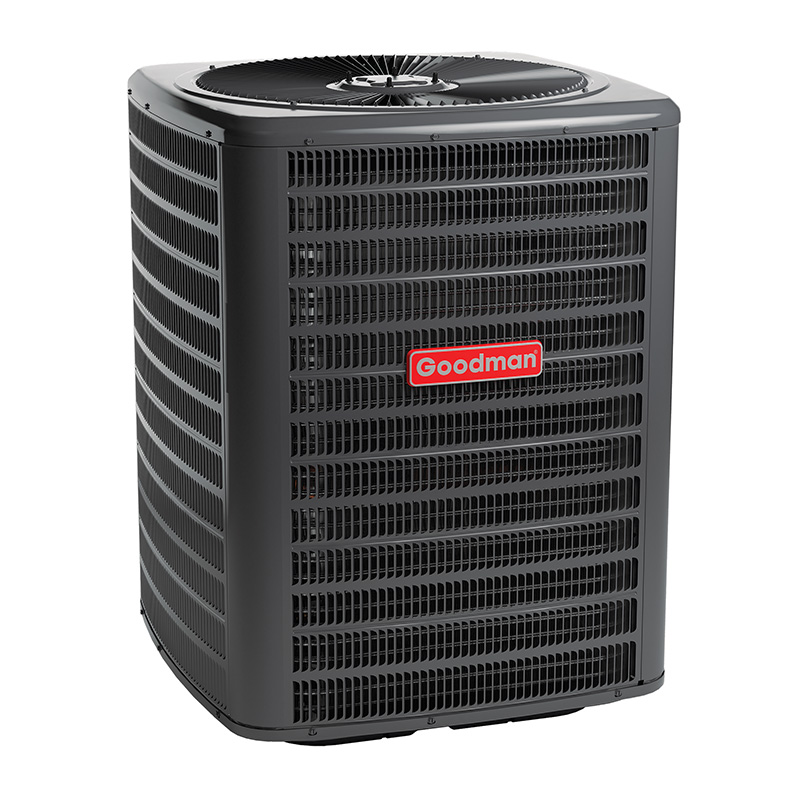
Goodman 3 Ton 15.2 SEER2 R32 Heat Pump Condenser (GLZS4BA3610)
View on AC Direct see your lowest price →Check current price on AC Direct →
Key features
- 3-ton capacity, suited for homes roughly 1,500 to 2,100 sq ft depending on load
- 15.2 SEER2 efficiency rating meets federal standards for most U.S. regions
- R-32 refrigerant: lower global warming potential than R-410A, increasingly industry standard
- Heat pump operation provides both cooling and heating from a single outdoor unit
- Single-stage scroll compressor design for straightforward serviceability
- Condenser-only unit requires a matched Goodman or compatible indoor coil/air handler
About this system
The Goodman GLZS4BA3610 is a 3-ton, 15.2 SEER2 heat pump condenser running on R-32 refrigerant, a lower-global-warming-potential refrigerant that is becoming the new standard as R-410A is phased out. At this efficiency tier, it clears the federal minimum for most U.S. climate zones and sits comfortably in the mid-efficiency range, making it a practical choice for homeowners who want a meaningful step up from bare-minimum equipment without paying for top-tier variable-speed hardware. The 3-ton capacity targets homes roughly in the 1,500 to 2,100 square-foot range, though actual sizing depends on insulation, ceiling height, window area, and local climate.
This condenser is designed to pair with a compatible Goodman air handler or furnace coil in a split-system configuration. Because it is a condenser-only unit, the total system efficiency you see in the field depends heavily on the matched indoor coil and the quality of the installation. Homeowners replacing an existing system may find this unit a cost-effective way to upgrade cooling and heating capacity simultaneously, especially in moderate climates where a heat pump covers the bulk of year-round comfort needs. Those in climates with extended sub-freezing winters should factor in a backup heat source, as heat pump output drops in very cold conditions.
The GLZS4BA3610 offers a reasonable entry point into mid-efficiency heat pump ownership at a price point noticeably below comparable Carrier, Trane, and Lennox units. It delivers on paper efficiency numbers and R-32 future-proofing, but documented failure modes and a compressor lifespan that tends to trail premium brands mean long-term ownership costs deserve serious consideration. For budget-conscious buyers who invest in a quality installation and plan for routine maintenance, it can serve well; for those prioritizing long-term reliability over upfront savings, premium alternatives merit a look.
Overall score is the average of the five ratings above.
What we like
- Priced roughly 15 to 25 percent below comparable Trane, Carrier, and Lennox heat pumps
- R-32 refrigerant is forward-looking as R-410A is phased out industry-wide
- 15.2 SEER2 meets current federal efficiency requirements across most climate regions
- Dual-run capacitor failures, the most common reported issue, are typically a low-cost repair in the $300 to $600 range
- Wide dealer and parts network makes service access relatively straightforward in most markets
Trade-offs
- Compressor lifespan averages 10 to 14 years versus 15 to 20 years reported for premium brands
- Evaporator coil leaks appear in a meaningful share of owner reviews and can be a costly mid-life repair
- A minority of owners report refrigerant leaks in the first year, often tied to installation or charge quality
- Single-stage operation is less energy-efficient and less comfortable during part-load conditions compared to two-stage or variable-speed alternatives
What homeowners and pros say about Goodman
Among homeowners, Goodman earns the clearest praise for one thing: the purchase price. On Google dealer review pages, where the brand averages around 3.8 out of 5 across hundreds of location-level reviews, affordability is the word that comes up most. The flip side surfaces on complaint-weighted platforms like ConsumerAffairs, where Goodman sits near 2.5 out of 5 and the recurring story is repair costs that start to accumulate after roughly year seven. For this specific 3-ton heat pump, the documented failure modes to keep in mind are dual-run capacitor failure (the most commonly reported issue, and usually a manageable repair), evaporator coil leaks that show up in a meaningful share of long-term owner accounts, and compressor longevity that tends to fall in the 10-to-14-year range rather than the 15-to-20 years owners of premium brands report.
HVAC technicians tend to have a nuanced take on Goodman. Many will install it without hesitation for price-sensitive customers while being direct about the trade-offs: the equipment is serviceable and parts are easy to find, but the outcome depends enormously on who puts it in and how well it is commissioned. A properly sized, carefully installed, and annually maintained GLZS4BA3610 will perform closer to its rated specs and last longer than one that was rushed or mismatched. Techs also note that the R-32 refrigerant in this unit requires confirming your service provider has the right equipment, which is worth a quick phone call before scheduling any future service calls.
Sources: ConsumerAffairs Goodman owner reviews, AHRI Directory of Certified Product Performance, U.S. DOE appliance and equipment efficiency standards, Goodman product specification sheets.
What it costs to run
At 15.2 SEER2, cooling this 3-ton system for a typical 1200-hour cooling season at the U.S. average electricity rate of $0.17/kWh works out to roughly $483 per year in cooling, about $65 less per year than a minimum-efficiency 13.4 SEER2 unit of the same size. Your real cost depends on your climate and local rate.
Method: (36,000 BTU/hr ÷ 15.2 SEER2) × 1200 hours ÷ 1000 × $0.17/kWh. Rate source: U.S. EIA average; cooling hours: moderate-climate estimate.
How it compares
| Brand | Comparable model | SEER2 | Stage | Price position |
|---|---|---|---|---|
| Goodman | GLZS4BA3610 | 15.2 | Single-stage | Value pick |
| Carrier | Comfort 15 (25HCB636A) | 15 | Single-stage | Roughly 20 to 25 percent more than the Goodman |
| Trane | XR15 (4TWR5036H) | 15.2 | Single-stage | Roughly 20 to 30 percent more than the Goodman |
| Lennox | Merit ML17XP1 (ML17XP1-036) | 17 | Single-stage | Roughly 25 to 35 percent more than the Goodman |
Competitor rows are comparable single-stage units at similar efficiency; price is relative position, not a quote.
Questions about this system
Does the GLZS4BA3610 come with a warranty, and what does it actually cover?
Goodman offers a 10-year parts limited warranty when the unit is registered within 60 days of installation by a licensed contractor, dropping to 5 years if unregistered. The warranty covers parts but not labor, refrigerant, or diagnostic costs, so out-of-pocket repair expenses can still be substantial even within the warranty period.
Is R-32 refrigerant harder or more expensive to service than R-410A?
R-32 requires technicians to use equipment rated for its slightly higher operating pressures and to follow A2L refrigerant handling protocols, since it is mildly flammable. Most service companies are already training on R-32 as it becomes the industry standard, but in some rural markets you may want to confirm your service provider is equipped for it before purchasing.
What indoor unit does this condenser need to work with?
The GLZS4BA3610 requires a matched indoor air handler or furnace with an evaporator coil that is rated for R-32 and sized appropriately for 3-ton capacity. Goodman publishes matched system combinations on its product pages, and using a mismatched coil can void the warranty and reduce rated efficiency.
How does this unit perform in cold weather, and do I need a backup heat source?
Like most single-stage heat pumps, heating capacity and efficiency drop as outdoor temperatures fall below roughly 35 to 40 degrees Fahrenheit. In climates where temperatures regularly dip below that threshold for extended periods, pairing this unit with electric strip heat or a gas furnace in a dual-fuel setup is strongly recommended to maintain comfort and avoid excessive runtime.
The reviews mention capacitor failures as common. How worried should I be?
Dual-run capacitor failure is the most frequently reported Goodman service call, but it is also one of the least expensive HVAC repairs, typically running $300 to $600 with a service call included. Having a technician check and test capacitors during annual maintenance can catch degrading ones before they cause a no-cool situation, and some homeowners on service agreements have them replaced proactively.
Specifications
| Cooling capacity | 3 Ton |
| Efficiency | 15.2 SEER2 |
| Refrigerant | R-32 |
| Model | GLZS4BA3610 |