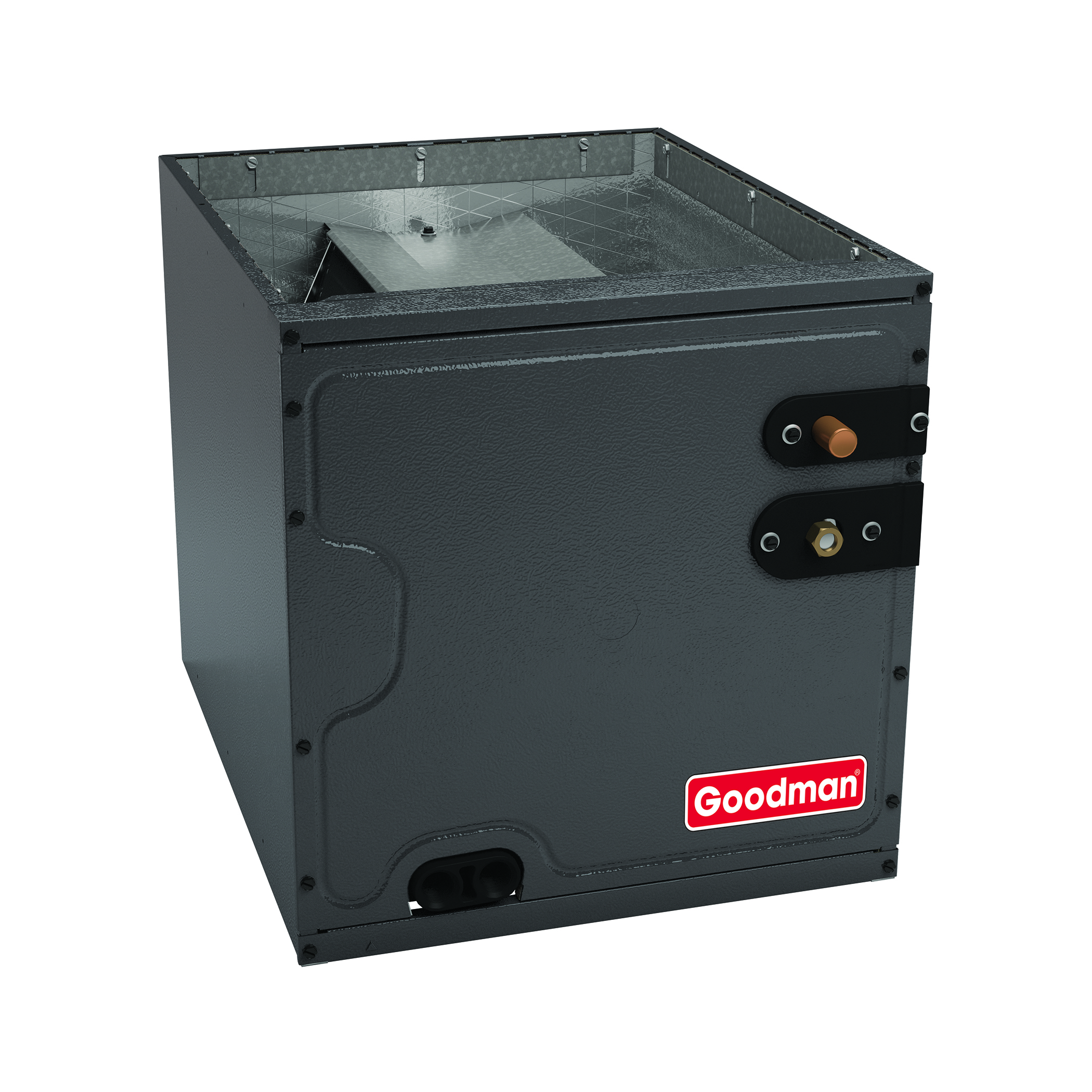
Goodman 1.5 Ton R32 Evaporator Coil With Internal TXV Upflow / Downflow (CAPTA1818B3)
View on AC Direct see your lowest price →Check current price on AC Direct →
Key features
- 1.5-ton capacity for smaller residential spaces and light-load applications
- R-32 refrigerant compatible, a lower-GWP alternative to R-410A
- Internal TXV for more precise refrigerant metering versus fixed-orifice designs
- Upflow and downflow configuration flexibility for varied installation orientations
- Uncased or cabinet-ready design intended to be matched with a compatible air handler or furnace
- Goodman value-tier pricing, typically 15 to 25 percent below Carrier, Trane, and Lennox equivalents
About this system
The Goodman CAPTA1818B3 is a 1.5-ton R-32 evaporator coil designed for upflow and downflow air handler or furnace configurations. It ships with an internal thermostatic expansion valve (TXV), which meters refrigerant more precisely than a fixed orifice and helps the system respond to varying load conditions across the cooling season. R-32 is a next-generation refrigerant with a lower global warming potential than R-410A, and this coil positions a 1.5-ton system for compatibility with the refrigerant transition already underway in new residential equipment.
At 1.5 tons, this coil is sized for smaller conditioned spaces, typically in the range of 600 to 900 square feet depending on local climate, insulation, and window load. It is a components-only purchase, meaning it pairs with a separately sourced condenser and air handler or furnace. Buyers need to confirm physical cabinet compatibility, refrigerant line sizing, and that the matched outdoor unit is also R-32 rated before purchase. Because this is a coil only, there is no SEER2 rating tied to this part alone; the system efficiency is determined by the matched assembly.
This coil suits replacement projects or new installations where a contractor or experienced DIYer is assembling a split system on a budget. It is not a plug-and-play product. Proper brazing, leak testing, evacuation, and refrigerant charge are required, and Goodman’s own documentation and dealer reviews consistently note that installation quality is the dominant factor in long-term performance and coil longevity.
The CAPTA1818B3 is a serviceable, budget-conscious evaporator coil for 1.5-ton R-32 systems, and its internal TXV is a genuine functional advantage over simpler metering devices. The Goodman brand's documented history of evaporator coil leaks and the fact that performance depends heavily on installation quality mean buyers should weigh upfront savings against potential mid-lifecycle repair costs, especially past year seven.
Overall score is the average of the five ratings above.
What we like
- R-32 refrigerant compatibility aligns with the current industry transition away from R-410A
- Internal TXV improves refrigerant metering efficiency compared to fixed orifice alternatives
- Upflow and downflow flexibility makes it adaptable to more installation layouts
- Value-tier pricing offers meaningful savings versus comparable Carrier, Trane, or Lennox coils
- Widely available through HVAC distributors, making replacement parts and service access straightforward
Trade-offs
- Goodman's documented evaporator coil leak history is a real concern for this specific component type
- No standalone efficiency rating; system SEER2 depends entirely on the matched outdoor unit and air handler
- Installation quality is the single largest performance variable, raising risk for less experienced installers
- ConsumerAffairs scores around 2.5 out of 5 for Goodman overall, with repair cost complaints accelerating after year seven
What homeowners and pros say about Goodman
Homeowners discussing Goodman equipment online tend to split along a familiar line: those who bought primarily on price and got several years of functional service before a repair, and those who encountered coil leaks or other issues early and feel the savings evaporated quickly. Goodman’s ConsumerAffairs score sits around 2.5 out of 5, a channel that skews toward dissatisfied owners, and the recurring pattern in those reviews is repair costs climbing after roughly year seven. Google dealer reviews tell a more balanced story, averaging around 3.8 out of 5 across multi-hundred review samples, where affordability is the most cited positive and service responsiveness varies by dealer. For an evaporator coil specifically, the documented Goodman failure mode most relevant here is coil leaks, which show up in enough owner accounts to treat as a real probability rather than an edge case.
HVAC technicians who work on Goodman systems frequently point out that the brand’s performance ceiling depends almost entirely on the installer. A well-brazed, properly evacuated, correctly charged system can deliver years of reliable service at a lower initial cost than premium brands. A rushed or imprecise install, however, tends to surface as a refrigerant leak within the first year, matching the documented early-failure pattern Goodman owners report. Capacitor failures are the most commonly cited repair across the Goodman lineup, typically a low-cost fix, but coil-related repairs are more involved and the labor cost alone can offset early savings. Compressor longevity on matched Goodman systems tends to run 10 to 14 years on average versus 15 to 20 for premium brands, which is worth factoring into a long-term cost comparison alongside the lower purchase price of this coil.
Sources: ConsumerAffairs Goodman owner reviews, AHRI Directory of Certified Product Performance, U.S. DOE appliance and equipment efficiency standards, Goodman product specification sheets.
How it compares
| Brand | Comparable model | SEER2 | Stage | Price position |
|---|---|---|---|---|
| Goodman | CAPTA1818B3 | N/A (coil only) | N/A (coil component) | Value pick |
| Carrier | Comfort Series CNPVP evaporator coil (1.5 ton) | N/A (coil only) | N/A (coil component) | Moderately higher than Goodman, consistent with Carrier's premium positioning |
| Trane | Vortica II evaporator coil (1.5 ton) | N/A (coil only) | N/A (coil component) | Higher than Goodman, reflects Trane's above-average reliability reputation and brand premium |
| Lennox | C33 evaporator coil (1.5 ton) | N/A (coil only) | N/A (coil component) | Among the highest in the segment, in line with Lennox's premium brand positioning |
Competitor rows are comparable single-stage units at similar efficiency; price is relative position, not a quote.
Questions about this system
Can I pair this coil with my existing R-410A condenser?
No. The CAPTA1818B3 is designed for R-32 refrigerant, which is not interchangeable with R-410A. Using it with an R-410A outdoor unit would require a condenser replacement as well, since the refrigerants operate at different pressures and have different oil compatibility requirements.
Does the internal TXV actually make a difference compared to a piston-style metering device?
Yes, in a practical sense. A TXV adjusts refrigerant flow in response to changing superheat conditions, which helps maintain efficiency across a wider range of outdoor temperatures and partial-load situations. A fixed piston is simpler and cheaper but less adaptive, and can lead to reduced efficiency and potential compressor stress at the extremes of operating conditions.
What is the warranty on this coil, and what does it actually cover?
Goodman typically offers a 10-year parts limited warranty on registered residential equipment, but coverage terms require product registration within a set window after installation and apply to the part itself, not labor. Confirm current warranty terms at the time of purchase, since labor to replace a leaking coil is a significant out-of-pocket cost not covered by the parts warranty.
How common are refrigerant leaks on Goodman evaporator coils, and when do they tend to show up?
Evaporator coil leaks appear in a meaningful share of Goodman owner reviews, making this a documented rather than theoretical concern. Leaks that surface within the first year are most commonly traced to installation issues such as improper brazing or charge. Leaks that develop later, often after year five to seven, are typically related to formicary corrosion or manufacturing variance in the coil itself.
Is this coil suitable for a DIY installation?
Functionally it can be installed by a skilled DIYer with HVAC experience, but R-32 refrigerant handling legally requires EPA 608 certification in the United States. Beyond certification, proper brazing, system evacuation, and verified refrigerant charge are critical steps where errors directly cause the early leaks and reliability problems that show up in Goodman reviews. Professional installation is strongly advisable.
Specifications
| Cooling capacity | 1.5 Ton |
| Configuration | Upflow |
| Refrigerant | R-32 |