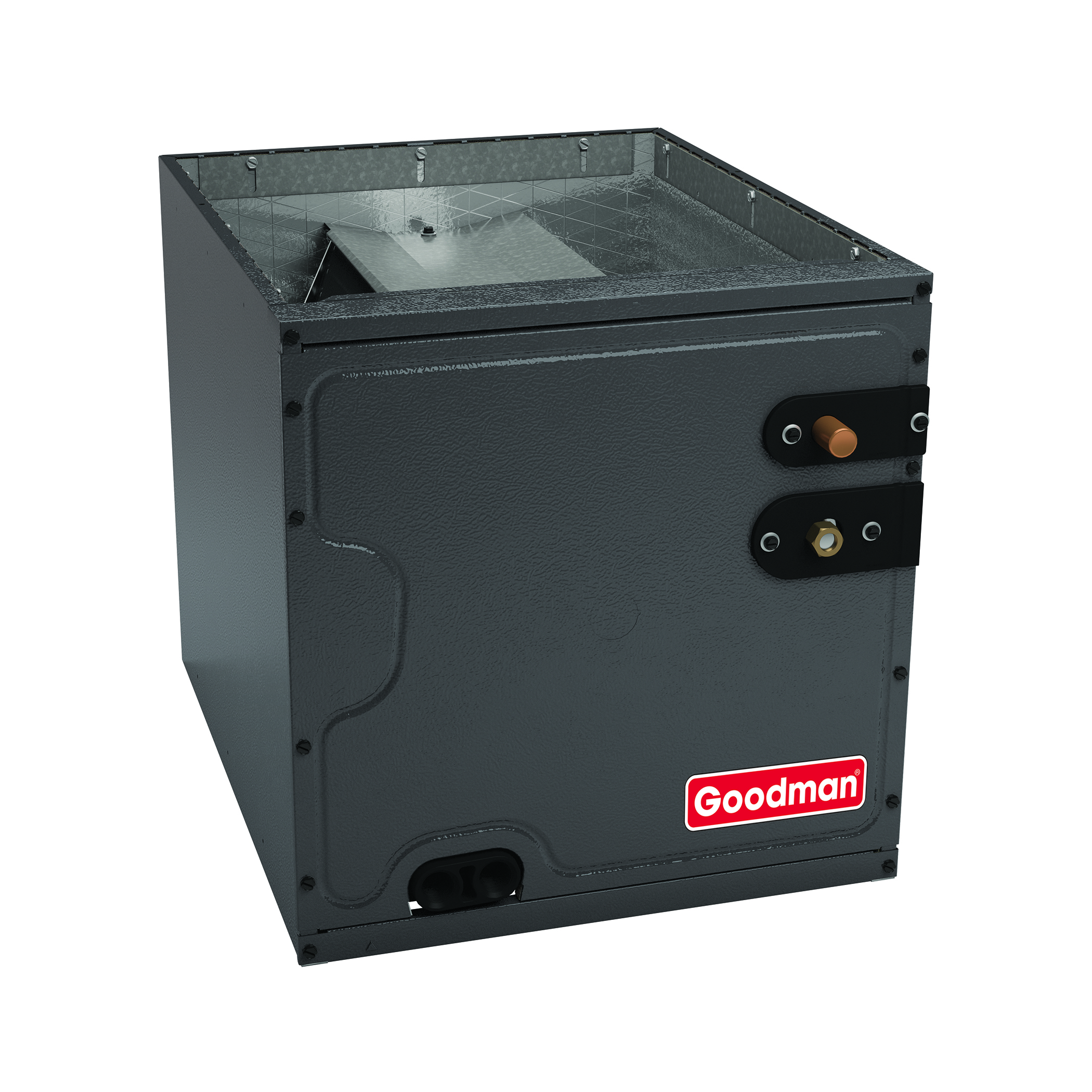
Goodman 2 Ton R32 Evaporator Coil With Internal TXV Upflow / Downflow (CAPTA2422B3)
View on AC Direct see your lowest price →Check current price on AC Direct →
Key features
- 2-ton capacity, upflow or downflow installation orientation
- R-32 refrigerant, a lower-GWP alternative to R-410A
- Internal TXV for more consistent refrigerant metering across load conditions
- Designed to match Goodman and Amana split-system condensing units
- Cased cabinet for easier drop-in installation and reduced air bypass
- AHRI matching required with outdoor unit to establish certified system efficiency
About this system
The Goodman CAPTA2422B3 is a 2-ton upflow/downflow evaporator coil designed to work with a matched outdoor condensing unit as part of a split-system air conditioner or heat pump. It uses R-32 refrigerant, a lower-global-warming-potential fluid that is increasingly common in new residential equipment, and includes an internal thermostatic expansion valve (TXV) to regulate refrigerant flow more precisely than a fixed orifice. The upflow/downflow configuration makes it a practical fit for a furnace closet or utility room where the air handler sits vertically, pushing conditioned air either up into overhead ductwork or down into a floor plenum depending on how it is installed.
At 2 tons, this coil is sized for smaller homes, typically in the 800 to 1,100 square foot range depending on climate, insulation, and local Manual J results. The internal TXV is worth noting because it helps the system maintain efficiency across varying outdoor temperatures rather than relying on a fixed metering device. As a coil-only component, this unit carries no standalone SEER2 rating; the efficiency of the finished system depends on which outdoor unit it is paired with. Buyers should confirm the coil is on the AHRI certificate for their specific outdoor unit before purchasing to ensure rated performance and utility rebate eligibility.
The CAPTA2422B3 is a solid budget-tier evaporator coil for homeowners who want a functional, code-compliant R-32 system without paying premium-brand prices, provided it is installed by a qualified technician and paired with a verified AHRI match. Goodman coils carry a documented history of evaporator coil leaks in a meaningful share of units, which is the most relevant reliability concern for this specific component. If your installation budget is tight or your contractor has limited Goodman experience, that trade-off deserves serious weight.
Overall score is the average of the five ratings above.
What we like
- Priced 15 to 25 percent below comparable Carrier, Trane, and Lennox coils
- Internal TXV supports more precise refrigerant metering than a fixed orifice
- R-32 refrigerant is more environmentally friendly and is increasingly supported by HVAC supply houses
- Upflow/downflow flexibility suits a wider range of utility room configurations
- Cased design simplifies installation and reduces air bypass around the coil
Trade-offs
- Evaporator coil leaks are a documented and recurring failure mode in Goodman owner reviews, which is a direct concern for this exact component
- No standalone efficiency rating; system SEER2 depends entirely on outdoor unit match and install quality
- A minority of owners report refrigerant leaks within the first year, typically linked to installation or initial charge issues
- Long-term repair costs tend to climb after year 7 according to ConsumerAffairs feedback, which affects total cost of ownership
What homeowners and pros say about Goodman
Homeowners who have installed Goodman equipment, and the technicians who service it, tend to land in the same place: the price advantage is real, and when the installation is done right, many units run without major issues for the first several years. Goodman holds roughly a 3.8 out of 5 on Google dealer reviews, where the most frequent praise is straightforward affordability. The flip side shows up on complaint-weighted channels like ConsumerAffairs, where the brand sits around 2.5 out of 5, and the recurring theme is repair costs that begin climbing after about year 7.
For an evaporator coil specifically, the documented failure mode that matters most is the one directly relevant to this component: evaporator coil leaks appear in a meaningful share of Goodman owner reviews, which is a more pointed concern than the capacitor failures or compressor longevity questions that apply to the outdoor unit. Capacitor failures, the most commonly reported issue across Goodman systems overall, typically run between 300 and 600 dollars and are a quick fix. Compressors on Goodman outdoor units tend to average 10 to 14 years versus 15 to 20 for premium brands. A minority of owners also report refrigerant leaks in the first year, which technicians generally attribute to installation or initial charge quality rather than the equipment itself. That last point underscores what experienced installers consistently say about Goodman: the brand performs at its ceiling when the technician is skilled and attentive, and below its floor when the install is rushed or corners are cut on the refrigerant charge.
Sources: ConsumerAffairs Goodman owner reviews, AHRI Directory of Certified Product Performance, U.S. DOE appliance and equipment efficiency standards, Goodman product specification sheets.
How it compares
| Brand | Comparable model | SEER2 | Stage | Price position |
|---|---|---|---|---|
| Goodman | CAPTA2422B3 | N/A (coil only; system SEER2 depends on matched outdoor unit) | N/A (coil component) | Value pick |
| Carrier | CAPFA Series (CAPFA2424A6) | N/A (coil only; rated as part of matched system) | N/A (coil component) | Typically 15 to 25 percent more than this Goodman coil |
| Trane | Hyperion TAM4 Series (2-ton) | N/A (coil only; rated as part of matched system) | N/A (coil component) | Typically 20 to 30 percent more than this Goodman coil |
| Lennox | C33 Series Evaporator Coil (2-ton) | N/A (coil only; rated as part of matched system) | N/A (coil component) | Typically 20 to 30 percent more than this Goodman coil |
Competitor rows are comparable single-stage units at similar efficiency; price is relative position, not a quote.
Questions about this system
What outdoor units is the CAPTA2422B3 certified to work with?
You need to verify an AHRI-certified match between this coil and your specific outdoor condensing unit before purchasing. Goodman publishes a matchup guide, and your contractor can look up certified combinations at the AHRI directory to confirm rated efficiency and rebate eligibility.
Is R-32 refrigerant harder to service than R-410A?
R-32 requires technicians to hold the same EPA Section 608 certification as R-410A, but it is mildly flammable (A2L classification), so not all technicians are currently equipped or trained to handle it. Confirm your installer is comfortable with A2L refrigerants before committing to this coil.
What does the internal TXV actually do, and does it matter on a 2-ton system?
The TXV meters refrigerant flow in response to actual load conditions, which keeps the system operating closer to its rated efficiency across a wider range of outdoor temperatures compared to a fixed-orifice metering device. On a 2-ton residential system it can meaningfully reduce short-cycling and improve humidity control.
Given that evaporator coil leaks are a documented issue with Goodman, what should I watch for?
Watch for reduced cooling capacity, ice forming on the coil or refrigerant lines, or a hissing sound near the air handler. Annual maintenance checks that include a visual inspection and nitrogen pressure test can catch small leaks before they become a full refrigerant loss event.
Can this coil be used in a horizontal application, such as in an attic?
The CAPTA2422B3 is rated for upflow and downflow orientations; it is not rated for horizontal installation. If your air handler sits on its side in an attic or crawlspace, you would need a coil model specifically rated for horizontal or multi-position use.
Specifications
| Cooling capacity | 2 Ton |
| Configuration | Upflow |
| Refrigerant | R-32 |