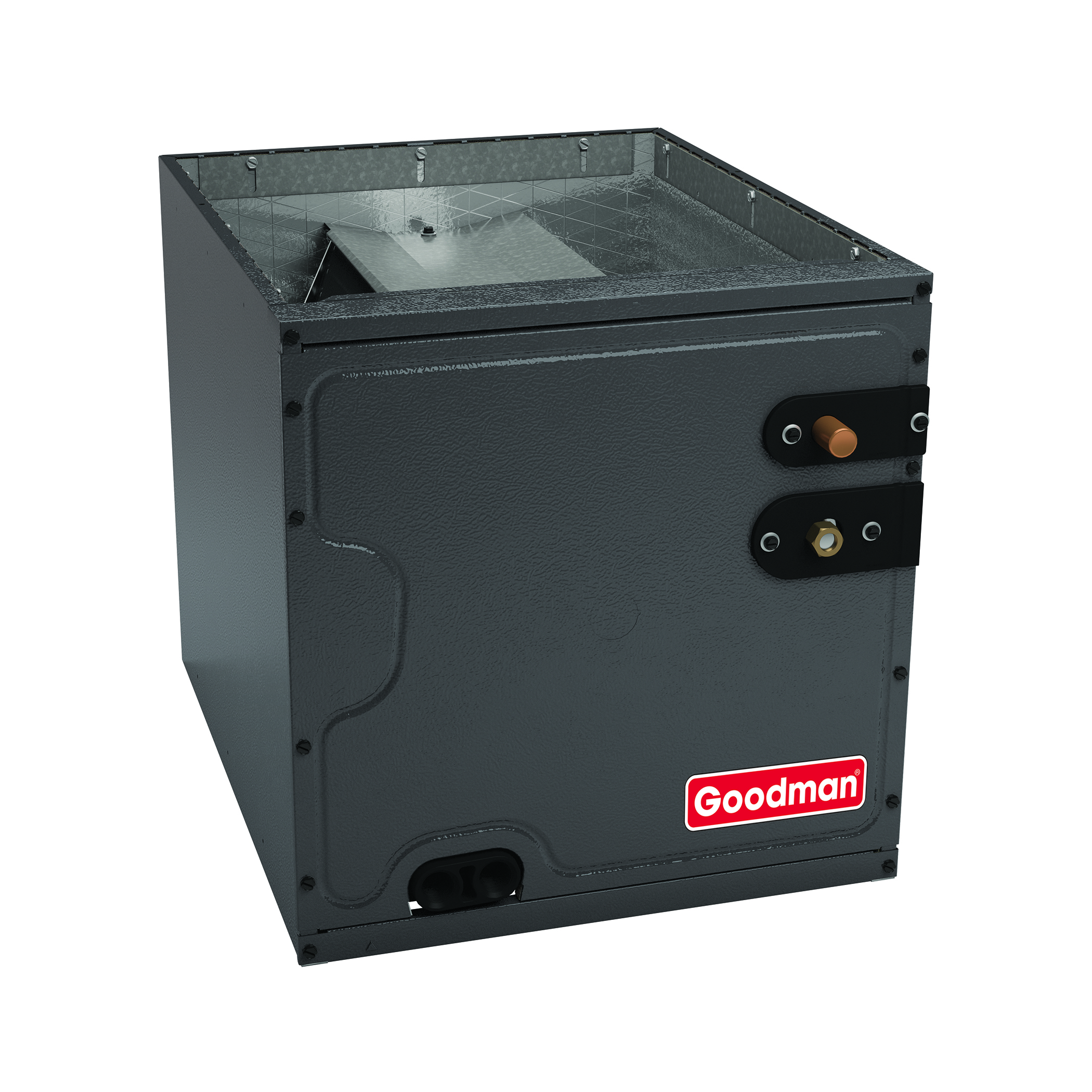
Goodman 3.5 Ton R32 Evaporator Coil With Internal TXV Upflow / Downflow (CAPTA4230D3)
View on AC Direct see your lowest price →Check current price on AC Direct →
Key features
- 3.5-ton capacity, upflow or downflow installation in a single cabinet
- R-32 refrigerant compatible, supporting lower-GWP system builds
- Factory-installed internal TXV for consistent refrigerant metering without field additions
- Designed to match Goodman and select compatible R-32 split systems
- Cabinet construction allows installation in air handlers oriented either direction
- Coil-only component; system SEER2 rating depends on the matched condensing unit
About this system
The Goodman CAPTA4230D3 is a 3.5-ton upflow/downflow evaporator coil designed for R-32 refrigerant systems. It pairs with a compatible R-32 condensing unit and air handler to form a split cooling system, and the factory-installed internal TXV (thermostatic expansion valve) means refrigerant metering is already built in rather than added at the job site. That detail matters: a TXV maintains more consistent superheat across a range of operating conditions compared to a fixed orifice, which can translate to steadier dehumidification and better coil protection over time.
At 3.5 tons, this coil is sized for homes roughly in the 1,700 to 2,200 square foot range, though actual load depends heavily on climate, insulation, and window area. The upflow/downflow configuration gives installers flexibility to mount the unit in a basement air handler (upflow) or attic application (downflow) without ordering a separate coil. R-32 is a lower global-warming-potential refrigerant increasingly favored as the industry phases away from R-410A, so pairing this coil with a current R-32 system positions the installation for compliance with tightening environmental regulations. This is a coil-only component, not a complete system, so efficiency ratings like SEER2 depend entirely on the matched outdoor unit.
This product suits homeowners replacing an aging coil in an existing R-32-compatible system, or contractors building out a new split system on a budget. It is not the right fit if your air handler or condensing unit still runs R-410A without a retrofit kit, and it is worth confirming equipment compatibility before ordering.
The CAPTA4230D3 is a solid, straightforward evaporator coil that delivers Goodman's well-known cost advantage and checks the R-32 compatibility box for forward-looking installs. Its built-in TXV removes one field variable, but the brand's documented history of evaporator coil leaks in a meaningful share of owner reports is a real consideration at this price point. For budget-conscious buyers who hire a skilled installer and keep up with maintenance, it represents reasonable value; those prioritizing long-term leak resistance may want to weigh a step up.
Overall score is the average of the five ratings above.
What we like
- Priced 15 to 25 percent below comparable Carrier, Trane, and Lennox coils, lowering total system cost
- Factory TXV reduces installation variables and supports more consistent superheat control
- Upflow/downflow flexibility reduces the need to stock or order separate coil orientations
- R-32 refrigerant compatibility aligns with industry direction and upcoming regulatory requirements
- Widely available through HVAC distributors, making sourcing and replacement parts generally accessible
Trade-offs
- Evaporator coil leaks appear in a meaningful share of Goodman owner reviews, which is the exact failure mode most relevant to this specific component
- A minority of owners report refrigerant leaks in the first year, often tied to install or charge quality, meaning installer skill matters significantly
- No standalone efficiency rating; SEER2 performance is entirely dependent on the matched outdoor unit and install quality
- Brand reliability ratings are modest (roughly 2.5 on ConsumerAffairs, around 3.8 on Google dealer reviews), with repair costs climbing notably after year 7
What homeowners and pros say about Goodman
Homeowners who have gone through a coil replacement or new system build with Goodman equipment generally land in one of two camps. Those who are happy point to the upfront savings and note that their system has run without incident, which aligns with Google dealer review scores sitting around 3.8 out of 5. The affordability is real and widely acknowledged. The other camp, represented more heavily in complaint-skewed channels like ConsumerAffairs where Goodman scores closer to 2.5 out of 5, tends to surface after year 7, when repair costs start to accumulate and the value equation gets harder to defend. For a coil specifically, the documented failure mode most worth watching is refrigerant leaks: evaporator coil leaks appear in a meaningful share of owner accounts, and a minority of owners report refrigerant loss in the first year, which technicians typically attribute to charge or installation issues rather than defective hardware.
HVAC pros have a nuanced take on Goodman equipment in general, and coil components are no exception. The consensus among technicians is that Goodman’s performance leans heavily on install quality, which they cite as the single biggest factor in how long a system lasts. A cleanly installed, correctly charged Goodman coil with an internal TXV like this one can perform reliably for years. The concern pros raise is that Goodman’s lower price point sometimes attracts the lowest bidder on both the equipment and the labor side, and a rushed or undertorqued installation is where early leaks and callbacks originate. For a buyer who vets their contractor carefully and budgets for annual maintenance, the CAPTA4230D3 is a reasonable coil at a real price advantage. For someone prioritizing long-term leak resistance above all else, the premium brands carry a stronger track record in that specific area.
Sources: ConsumerAffairs Goodman owner reviews, AHRI Directory of Certified Product Performance, U.S. DOE appliance and equipment efficiency standards, Goodman product specification sheets.
How it compares
| Brand | Comparable model | SEER2 | Stage | Price position |
|---|---|---|---|---|
| Goodman | CAPTA4230D3 | Matched-system dependent | N/A (coil only) | Value pick |
| Carrier | Performance Series CNPVP Evaporator Coil | Matched-system dependent | N/A (coil only) | Moderately higher than Goodman, mid-tier positioning |
| Trane | Spine Fin 4TXCC Evaporator Coil | Matched-system dependent | N/A (coil only) | Higher than Goodman, premium-tier positioning |
| Lennox | Merit Series C33 Evaporator Coil | Matched-system dependent | N/A (coil only) | Higher than Goodman, mid-to-premium positioning |
Competitor rows are comparable single-stage units at similar efficiency; price is relative position, not a quote.
Questions about this system
Does this coil work with my existing R-410A air handler, or do I need new equipment?
The CAPTA4230D3 is designed for R-32 refrigerant and is not a drop-in replacement for an R-410A system without verified compatibility or a retrofit kit. R-32 operates at different pressures than R-410A, so you should confirm with your HVAC contractor that your air handler and condensing unit are rated for R-32 before ordering this coil.
The internal TXV is already installed. Does that mean the installer doesn't need to do refrigerant charging?
The TXV handles metering once the system is running, but the installer still needs to properly evacuate the system and charge it to the manufacturer's specified refrigerant weight. A TXV does not substitute for a correct charge; it just manages flow more consistently once the refrigerant level is right.
What SEER2 rating will my system achieve with this coil?
This coil does not carry a standalone SEER2 rating. The efficiency of your complete system depends on the specific condensing unit it is matched with, your air handler's blower performance, and the quality of the installation. Check the ARI or AHRI directory for certified matched-system ratings using your specific outdoor unit.
Goodman reviews mention coil leaks. Is this something I should plan for?
Evaporator coil leaks are one of the documented failure modes in Goodman owner feedback, so it is a legitimate concern with this component specifically. Keeping up with annual maintenance, ensuring the coil is properly supported and not vibrating, and having a technician check for refrigerant loss at service visits can help catch issues early while the warranty is still active.
Can one contractor install this in an upflow orientation and later a different contractor reconfigure it to downflow?
The cabinet is designed to support both orientations, but any reconfiguration requires a qualified HVAC technician to safely recover refrigerant, re-pipe as needed, and recommission the system. It is not a simple physical flip, and the work should be permitted and inspected per local code.
Specifications
| Cooling capacity | 3.5 Ton |
| Configuration | Upflow |
| Refrigerant | R-32 |