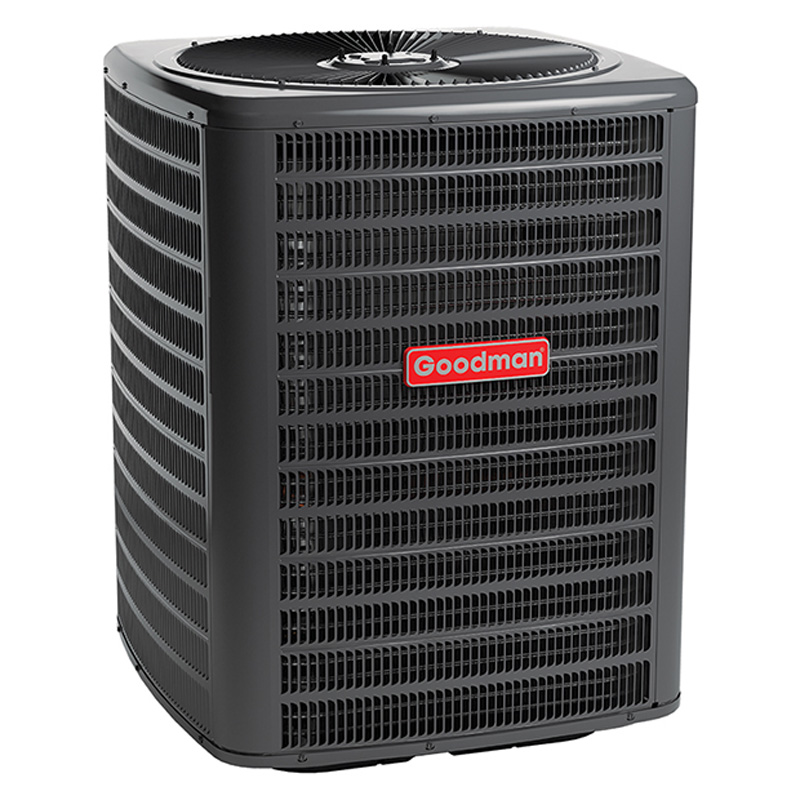
Goodman 4 Ton 13.4 SEER2 R32 Cooling Only Condenser (GLXS3BN4810)
View on AC Direct see your lowest price →Check current price on AC Direct →
Key features
- 4-ton single-stage cooling-only condenser, sized for larger residential applications
- 13.4 SEER2 efficiency rating, meets current federal minimum standards
- R-32 refrigerant with a lower global warming potential than R-410A
- Designed for split-system pairing with a compatible indoor coil and air handler
- Single-stage scroll compressor for straightforward, low-complexity operation
- Factory-installed filter drier helps protect the refrigerant circuit during installation
About this system
The Goodman GLXS3BN4810 is a 4-ton, single-stage cooling-only condenser rated at 13.4 SEER2 and designed to work with a separately purchased air handler and coil. It runs on R-32 refrigerant, a lower-GWP alternative to the R-410A found in older systems, which positions it well ahead of future refrigerant regulations. At 4 tons it is sized for roughly 1,800 to 2,400 square feet depending on local climate, insulation quality, and internal heat loads, though proper Manual J load calculation should always determine final sizing.
This unit sits at the entry level of current efficiency requirements. A 13.4 SEER2 rating clears the federal minimums for most U.S. climate regions but leaves meaningful room below mid-tier and premium options that reach 16 to 20 SEER2. The trade-off is straightforward: lower upfront cost, higher operating cost over time compared to a more efficient unit. Homeowners in moderate climates or those replacing an aging system on a tight budget are the clearest fit. Single-stage operation means the compressor runs at full capacity or not at all, which is less comfortable and less efficient than two-stage or variable-speed alternatives but also simpler and less expensive to service.
Because this is a condenser-only unit, buyers must confirm compatibility with their existing or planned indoor coil and air handler. Goodman recommends pairing it with a matching Goodman or Amana coil to ensure system efficiency ratings hold and to keep the warranty intact. The R-32 charge also requires that servicing technicians confirm their equipment and certifications cover this refrigerant, which is still less universally stocked than R-410A at smaller shops.
The GLXS3BN4810 delivers a functional, code-compliant 4-ton cooling solution at a price point well below comparable Trane, Lennox, and Carrier hardware. It is a workable budget choice for homeowners who prioritize lower first cost and have a skilled installer, but the baseline efficiency, single-stage operation, and Goodman's documented mid-life repair pattern mean total cost of ownership deserves careful consideration before purchase.
Overall score is the average of the five ratings above.
What we like
- Priced roughly 15 to 25 percent below comparable Carrier, Trane, and Lennox units
- R-32 refrigerant is forward-compatible with tightening environmental regulations
- Single-stage design keeps service calls straightforward and parts widely available
- Meets current federal SEER2 minimums, so it is a legal drop-in replacement in all regions
- Factory filter drier adds a layer of protection for the refrigerant circuit on initial startup
Trade-offs
- 13.4 SEER2 is entry-level efficiency; monthly operating costs will be higher than mid- or high-efficiency alternatives over a 10-plus year lifespan
- Single-stage compressor provides less humidity control and temperature consistency than two-stage or variable-speed systems
- Goodman compressors average 10 to 14 years versus 15 to 20 for premium brands, increasing the likelihood of a costly mid-ownership repair
- R-32 is not yet universally stocked, and some smaller HVAC shops may lack the equipment or training to service it promptly
What homeowners and pros say about Goodman
Homeowners who have installed Goodman equipment tend to split into two camps. Those who had a skilled contractor handle the job and kept up with basic maintenance often report years of uneventful operation, and that experience tracks with the brand’s Google dealer review average of around 3.8 out of 5. The praise in those reviews consistently circles back to price: buyers feel they got a functional system without paying a premium-brand premium. The concern is what shows up later. ConsumerAffairs scores Goodman at roughly 2.5 out of 5, a channel that skews toward people who had a problem, and the recurring story there is repair bills climbing after the seven-year mark. That is consistent with what the documented failure data shows: dual-run capacitors fail with some regularity and are a manageable fix, but evaporator coil leaks are more disruptive and more costly, and compressor lifespan averaging 10 to 14 years means some owners face a major repair or early replacement compared to premium-brand hardware.
HVAC technicians tend to view Goodman as a serviceable brand whose outcome depends heavily on the installer. A rushed or under-trained install, an imprecise refrigerant charge, or a poorly matched indoor coil can accelerate the failure modes the brand is already known for. With R-32 now in play on units like the GLXS3BN4810, technicians also flag that not every shop is fully equipped for that refrigerant yet, which can complicate an otherwise routine service call. The consensus among experienced installers is that Goodman earns its price point when conditions are right but rewards buyers who choose their contractor carefully and budget for the possibility of a capacitor or coil repair somewhere in the back half of the system’s life.
Sources: ConsumerAffairs Goodman owner reviews, AHRI Directory of Certified Product Performance, U.S. DOE appliance and equipment efficiency standards, Goodman product specification sheets.
What it costs to run
At 13.4 SEER2, cooling this 4-ton system for a typical 1200-hour cooling season at the U.S. average electricity rate of $0.17/kWh works out to roughly $731 per year in cooling, about $0 less per year than a minimum-efficiency 13.4 SEER2 unit of the same size. Your real cost depends on your climate and local rate.
Method: (48,000 BTU/hr ÷ 13.4 SEER2) × 1200 hours ÷ 1000 × $0.17/kWh. Rate source: U.S. EIA average; cooling hours: moderate-climate estimate.
How it compares
| Brand | Comparable model | SEER2 | Stage | Price position |
|---|---|---|---|---|
| Goodman | GLXS3BN4810 | 13.4 | Single-stage | Value pick |
| Carrier | Comfort 24ACC636A003 | 13.4 | Single-stage | Roughly 15 to 25 percent more than this Goodman |
| Trane | XR13c (4TTR3048) | 13.4 | Single-stage | Typically 20 to 30 percent more than this Goodman |
| Lennox | Merit ML14XC1 (4-ton) | 13.8 | Single-stage | Generally 20 to 30 percent more than this Goodman |
Competitor rows are comparable single-stage units at similar efficiency; price is relative position, not a quote.
Questions about this system
What air handler and coil does this condenser need to be paired with?
Goodman recommends pairing the GLXS3BN4810 with a compatible Goodman or Amana indoor coil and air handler to preserve the rated 13.4 SEER2 efficiency and keep the warranty intact. Using a mismatched indoor unit can void the efficiency rating and, in some cases, the equipment warranty, so confirm ARI-matched combinations with your installer before purchasing.
Is R-32 refrigerant harder to service than R-410A?
R-32 requires technicians to use equipment rated for its slightly higher pressure characteristics and to confirm their certifications cover it. It is increasingly common but not yet as universally stocked as R-410A, particularly at smaller regional shops. Ask your contractor directly whether they carry R-32 and have serviced it before, since a refrigerant leak repair could be delayed if they need to source the refrigerant separately.
What are the most common repairs owners report on Goodman condensers like this one?
Dual-run capacitor failures are the most frequently reported issue and are typically a quick, low-cost repair in the 300 to 600 dollar range. Evaporator coil leaks appear in a meaningful share of longer-term owner reviews, and a minority of owners report refrigerant leaks in the first year, which is usually tied to installation or initial charge quality rather than a defective unit.
How long should I expect this unit to last?
Goodman compressors average roughly 10 to 14 years based on documented owner experience, compared to 15 to 20 years for premium-brand compressors. Install quality is the single biggest factor in longevity, so a proper refrigerant charge, correct airflow setup, and a clean electrical connection at startup can meaningfully extend that window.
Will this condenser qualify for a federal tax credit?
As of 2025 federal Inflation Reduction Act guidelines, split-system central air conditioners generally need to meet a higher efficiency threshold than 13.4 SEER2 to qualify for the 25C energy efficiency tax credit. You should verify current IRS requirements and consult your tax advisor before assuming this unit qualifies, as the GLXS3BN4810 at 13.4 SEER2 is unlikely to clear the credit threshold.
Specifications
| Cooling capacity | 4 Ton |
| Efficiency | 13.4 SEER2 |
| Refrigerant | R-32 |
| Model | GLXS3BN4810 |