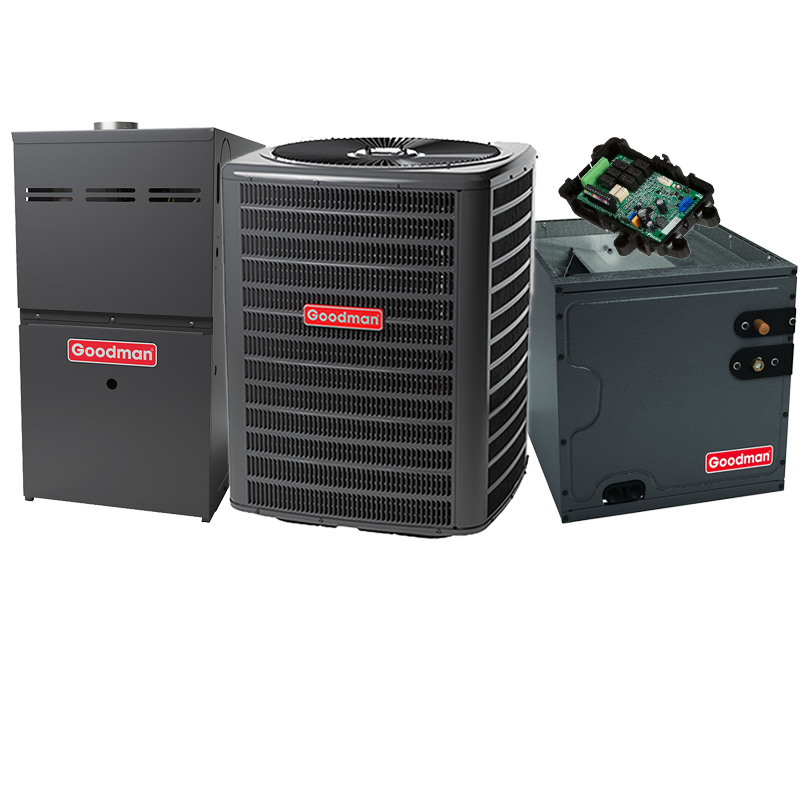
Goodman 3 Ton 14 SEER2 80000 BTU 80% Two-Stage Gas Furnace With R32 Air Conditioner Condenser And Coil System – Upflow
View on AC Direct see your lowest price →Check current price on AC Direct →
Key features
- 3-ton cooling capacity with 14 SEER2 efficiency rating
- 80,000 BTU two-stage gas furnace rated at 80% AFUE
- R-32 refrigerant with lower global warming potential than R-410A
- Upflow configuration for basement or closet installations with overhead ductwork
- Two-stage heating reduces short-cycling and improves temperature consistency
- Matched coil and condenser bundled to simplify equipment selection and ordering
About this system
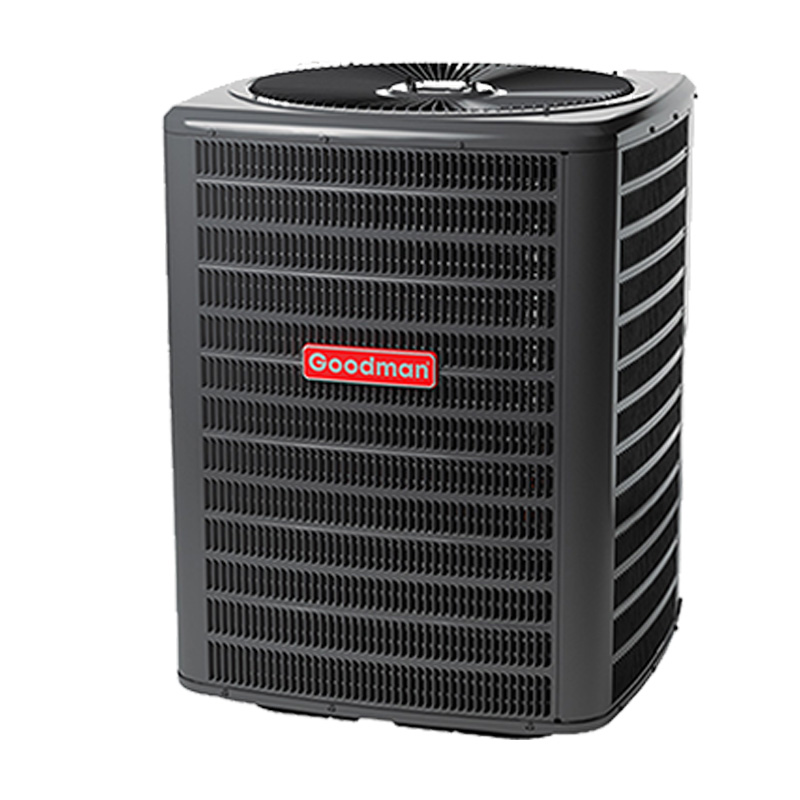
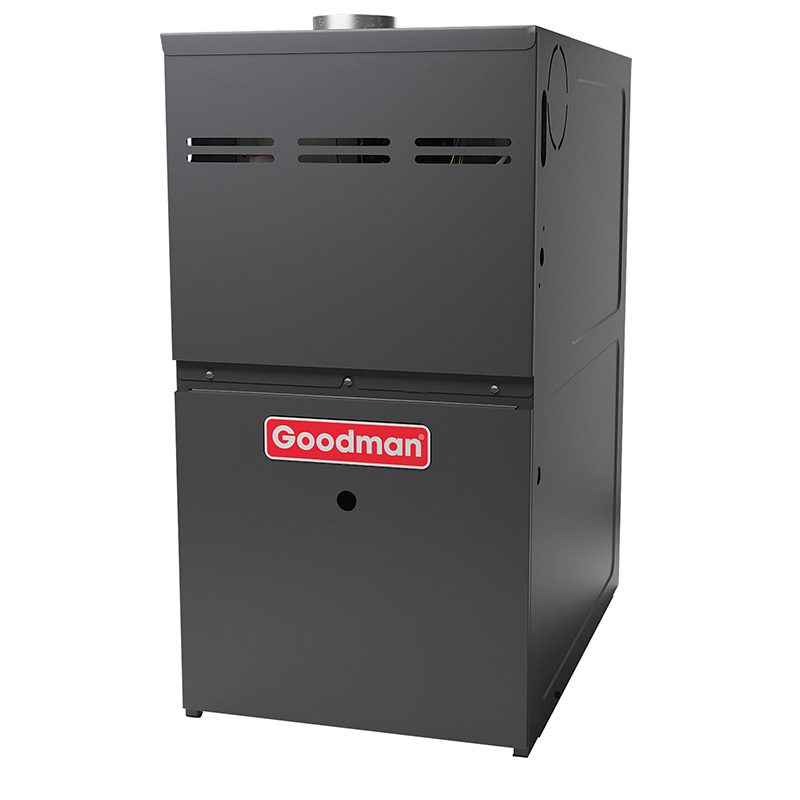
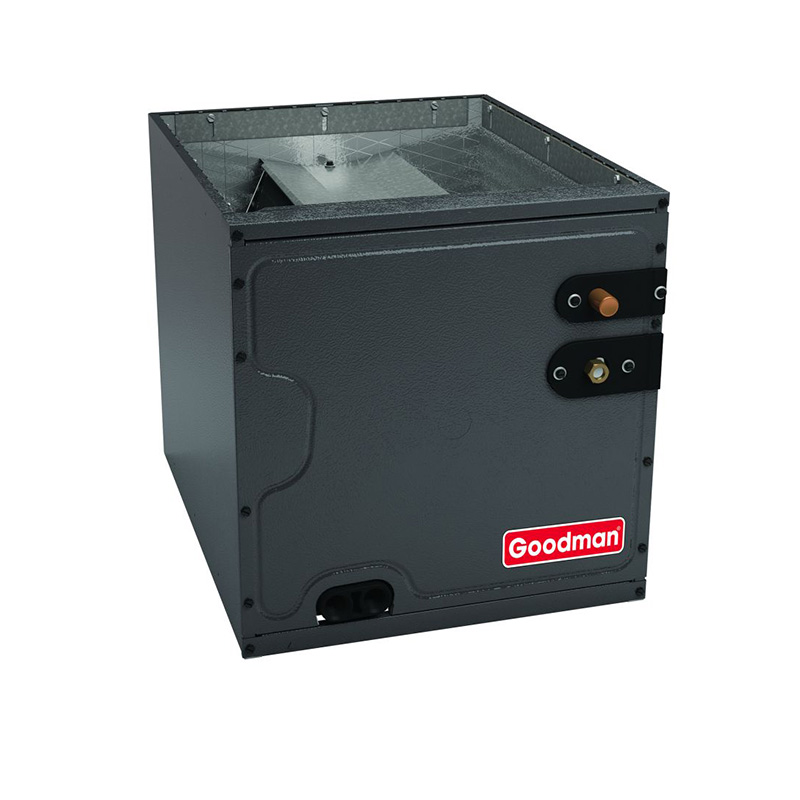
This Goodman bundle pairs a 3-ton, 14 SEER2 R-32 air conditioner condenser and matching evaporator coil with an 80,000 BTU, 80% AFUE two-stage gas furnace in an upflow configuration. The combination covers a typical 1,400 to 2,000 square foot home in a moderate climate, and the upflow setup suits the most common residential ductwork arrangement where the furnace sits in a basement or closet and blows conditioned air upward into overhead ducts. R-32 refrigerant replaces the older R-410A standard and carries a lower global warming potential, which is increasingly required by regional regulations and is worth noting when your service technician quotes refrigerant costs down the road.
The two-stage furnace is a meaningful step up from single-stage models. It runs at a reduced capacity on milder days, cycling less aggressively, which tends to produce more even temperatures across rooms and reduces the blasts of cold air at startup. The 80% AFUE rating means 80 cents of every fuel dollar becomes heat, a baseline-efficiency figure that keeps upfront equipment cost down but will cost more to operate annually compared to 96% or 97% AFUE condensing furnaces in cold climates. Buyers in mild-to-moderate heating climates or those prioritizing purchase price over long-run gas savings are the natural audience here. The 14 SEER2 cooling efficiency meets 2023 federal minimums for most northern U.S. regions and sits just below the minimums now required in the Southwest and Southeast, so confirm local code compliance before purchasing.
This Goodman bundle delivers a complete, code-meeting split system at a price point that undercuts comparable Carrier, Trane, and Lennox packages by a meaningful margin, making it a reasonable choice for budget-conscious buyers who understand what they are trading away. The two-stage furnace is a genuine comfort upgrade, but the 80% AFUE rating and baseline 14 SEER2 cooling efficiency leave real money on the table for anyone in a cold climate or a high-cooling-demand region over the system's lifespan. Long-term cost of ownership depends heavily on install quality and how quickly compressor and coil issues emerge, both areas where Goodman's track record is more mixed than its premium competitors.
Overall score is the average of the five ratings above.
What we like
- Purchase price runs 15 to 25 percent below comparable Trane, Lennox, and Carrier systems
- Two-stage furnace operation provides more even heat distribution than single-stage alternatives
- R-32 refrigerant is forward-looking and aligns with tightening environmental regulations
- Matched system bundle simplifies compatibility decisions for homeowners and installers
- Dual-run capacitor failures, the most common service call, are typically a low-cost repair in the $300 to $600 range
Trade-offs
- 80% AFUE furnace is the lowest efficiency tier available and increases annual gas costs versus 96%+ condensing models
- 14 SEER2 cooling is at or below the minimum efficiency threshold in several southern and southwestern U.S. states
- Compressor lifespan averages 10 to 14 years versus 15 to 20 years reported for premium brands, raising replacement risk earlier
- Evaporator coil leaks appear in a notable share of owner reviews and can become a costly mid-life repair
What homeowners and pros say about Goodman
Homeowners and dealers discussing Goodman equipment online tend to split along predictable lines. On Google dealer reviews, where the audience skews toward people who just had a system installed, Goodman averages around 3.8 out of 5, and affordability is the word that comes up most consistently. Buyers report feeling they received a functioning, complete system at a price that left room in the budget for a quality installation. On ConsumerAffairs, a platform where unhappy owners are more likely to post, Goodman sits closer to 2.5 out of 5, and the pattern in those complaints is consistent: the system worked fine for several years and then repair costs started climbing, with some owners describing a compressor replacement or persistent refrigerant issues arriving around year 7 to 10.
HVAC technicians who work on Goodman equipment regularly point to a few specific failure modes. Dual-run capacitors are the most frequently cited service call, widely described as a minor annoyance rather than a catastrophe given the typical $300 to $600 repair cost. More concerning to some pros are the evaporator coil leak reports that surface in a notable share of owner reviews and the fact that Goodman compressors tend to reach end of life in the 10 to 14 year range rather than the 15 to 20 years common with Trane, Carrier, and Lennox compressors. A minority of owners have also reported refrigerant leaks in year one, which technicians generally attribute to improper charging at installation rather than a manufacturing defect. The consistent takeaway across both groups is that a skilled installer who pressure-tests the system and verifies the refrigerant charge can significantly reduce early-failure risk on a Goodman, while a rushed or cut-rate installation amplifies every latent weakness in the equipment.
Sources: ConsumerAffairs Goodman owner reviews, AHRI Directory of Certified Product Performance, U.S. DOE appliance and equipment efficiency standards, Goodman product specification sheets.
What it costs to run
At 14 SEER2, cooling this 3-ton system for a typical 1200-hour cooling season at the U.S. average electricity rate of $0.17/kWh works out to roughly $525 per year in cooling, about $23 less per year than a minimum-efficiency 13.4 SEER2 unit of the same size. Your real cost depends on your climate and local rate.
Method: (36,000 BTU/hr ÷ 14 SEER2) × 1200 hours ÷ 1000 × $0.17/kWh. Rate source: U.S. EIA average; cooling hours: moderate-climate estimate.
How it compares
| Brand | Comparable model | SEER2 | Stage | Price position |
|---|---|---|---|---|
| Goodman | 3-Ton 14 SEER2 / 80K BTU 80% Two-Stage Bundle (this system) | 14 | Two-stage furnace / single-stage cooling | Value pick |
| Carrier | Performance Series 24ACC636 condenser with 58TP furnace | 14-15 | Two-stage | Typically 20 to 30 percent higher than this Goodman bundle |
| Trane | XR14c condenser with S8X2 furnace | 14-15 | Two-stage | Typically 25 to 35 percent higher than this Goodman bundle |
| Lennox | Merit ML14XC1 condenser with ML180 furnace | 14-15 | Single-stage cooling / two-stage furnace | Typically 20 to 30 percent higher than this Goodman bundle |
Competitor rows are comparable single-stage units at similar efficiency; price is relative position, not a quote.
Questions about this system
Is 14 SEER2 legal to install in my state?
Federal rules that took effect in 2023 set regional minimums: 14 SEER2 is generally acceptable in northern states but falls below the 15 SEER2 minimum now required for new installations in the Southeast and Southwest regions. Check your state or county energy code before purchasing, because an undersized-efficiency unit may not pass inspection in your area.
Will this furnace work with my existing ductwork?
This is an upflow unit, meaning the air handler section draws return air from the bottom and discharges conditioned air upward through supply ducts above it. If your current system is a downflow or horizontal configuration, this bundle is not a direct drop-in replacement without significant ductwork modification. Confirm your existing furnace orientation before ordering.
What does two-stage heating actually mean in daily use?
The furnace has two firing levels, roughly 65 percent and 100 percent of rated capacity. On most days it runs at the lower stage, which means longer, quieter cycles that distribute heat more evenly and reduce temperature swings between thermostat calls. The full 80,000 BTU stage kicks in during the coldest weather when demand requires it.
How does R-32 refrigerant affect future service costs compared to R-410A?
R-32 is a single-component refrigerant, which makes it easier to reclaim and recharge than R-410A blends, and supply is growing as manufacturers transition to it. At this writing, R-32 service pricing is comparable to R-410A in most markets, though your technician will need EPA Section 608 certification and R-32 compatible equipment to work on it.
What are the most likely repair costs I should budget for over the first ten years?
Based on Goodman's documented failure patterns, dual-run capacitor replacement is the most common service call and typically runs $300 to $600 with labor. Evaporator coil leaks appear in a meaningful share of owner reports and can cost significantly more depending on whether the coil needs replacement. A small number of owners have reported refrigerant leaks within the first year, which is usually traceable to installation error rather than the equipment itself, underscoring why installer quality matters as much as the hardware.
Specifications
| Cooling capacity | 3 Ton |
| Efficiency | 14 SEER2 |
| Furnace output | 80000 BTU |
| Configuration | Upflow |
| Refrigerant | R-32 |