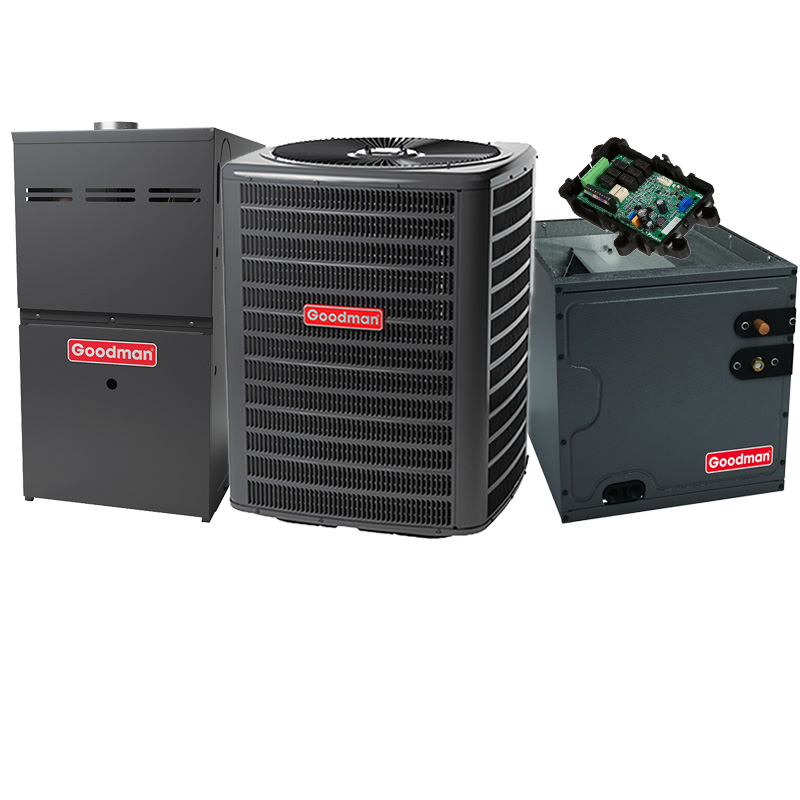
Goodman 5 Ton 13.8 SEER2 80000 BTU 80% Two-Stage Gas Furnace With R32 Air Conditioner Condenser And Coil System – Upflow
View on AC Direct see your lowest price →Check current price on AC Direct →
Key features
- 5-ton capacity with 13.8 SEER2 efficiency rating
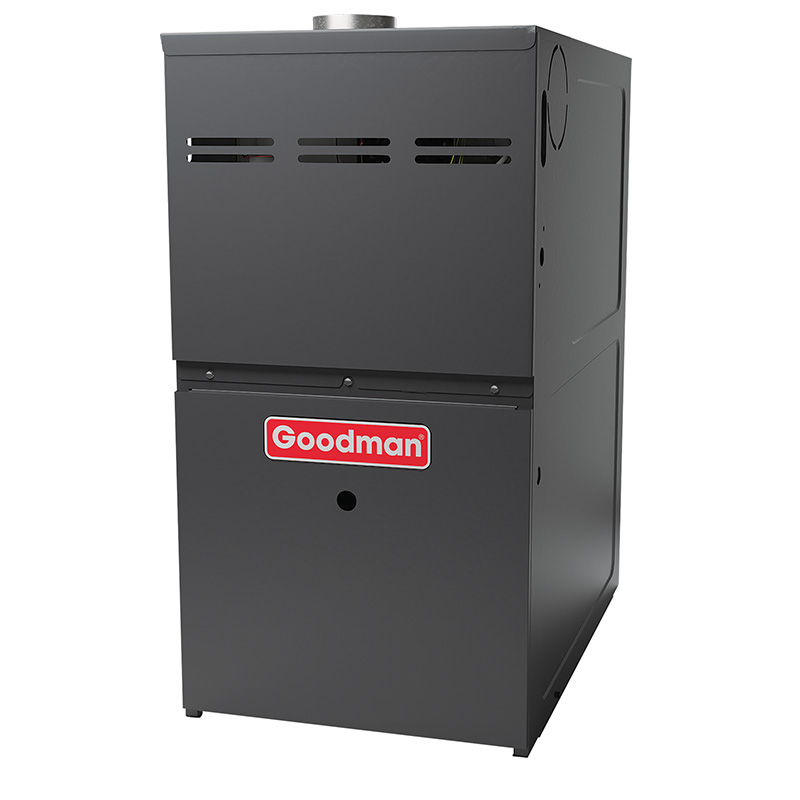
- 80,000 BTU two-stage gas furnace at 80% AFUE
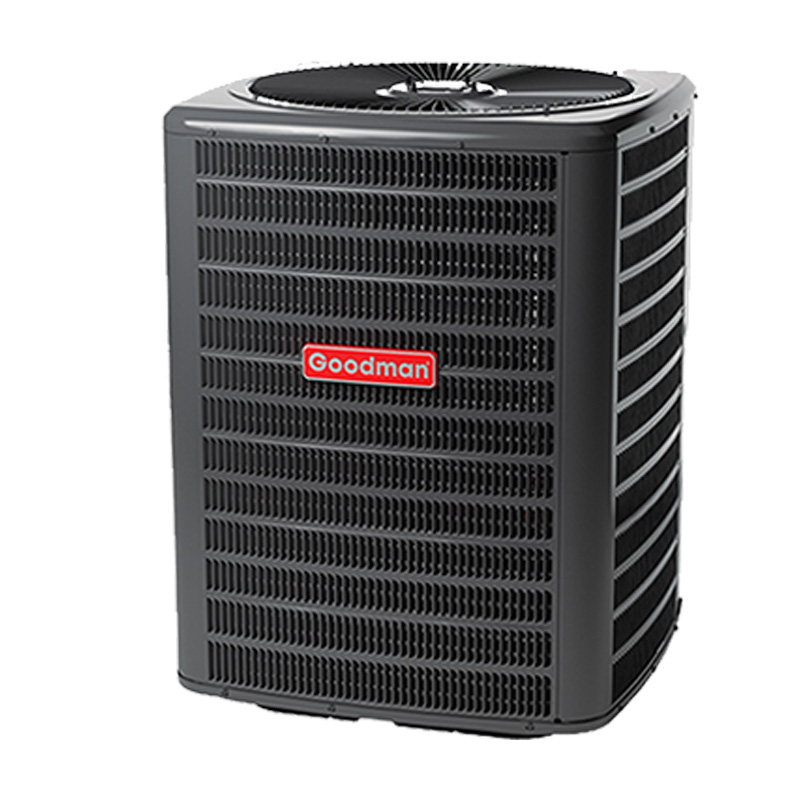
- R-32 refrigerant with lower global warming potential than R-410A
- Two-stage compressor reduces short cycling and improves humidity control
- Upflow furnace configuration for basement or ground-level installs
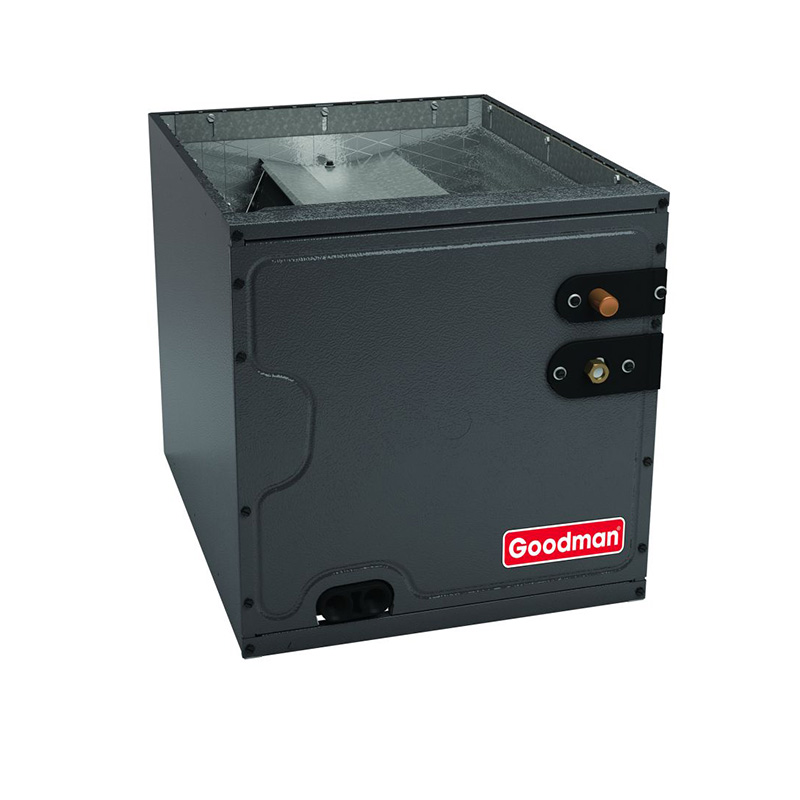
- Matched coil and condenser sold as a factory-approved system bundle
About this system
This Goodman bundle pairs a 5-ton R-32 condenser with a matched evaporator coil and an 80,000 BTU 80% AFUE two-stage gas furnace in an upflow configuration. The package is sized for larger homes, typically in the 2,200 to 3,000 square foot range depending on climate and insulation, where a single-stage system would cycle on and off too aggressively and a variable-speed setup would push the budget further than many buyers want to go. Two-stage cooling and heating means the system runs on a lower capacity most of the time, cycling to full output only on the hottest or coldest days, which generally produces more even temperatures and lower humidity than single-stage equipment.
At 13.8 SEER2 this system clears the federal minimum for most U.S. regions but lands at the lower end of the efficiency spectrum. Expect modest but real energy savings compared to older R-22 or early R-410A equipment, though homeowners chasing the lowest utility bills will find higher-SEER2 options worth the price premium. The switch to R-32 refrigerant is a genuine improvement: R-32 has a global warming potential roughly 70 percent lower than R-410A and is easier to recover and recharge in the field. The upflow furnace configuration suits homes where the air handler sits in a basement or ground-level utility closet with supply ducts running up through the living space.
This Goodman bundle offers an accessible price of entry for a two-stage, larger-capacity split system and suits budget-conscious buyers who want better comfort than single-stage equipment provides without paying for premium brands. The trade-off is a compressor lifespan that historically runs shorter than Carrier, Trane, or Lennox, and a brand track record that leans heavily on installation quality to reach its potential. Buyers who invest in a skilled installer and plan for occasional component maintenance can get solid years of service; those looking for the longest possible run with minimal intervention should compare costs against mid-tier alternatives.
Overall score is the average of the five ratings above.
What we like
- Lower upfront cost than comparable Carrier, Trane, or Lennox two-stage systems
- Two-stage operation improves comfort and humidity control versus single-stage
- R-32 refrigerant is more environmentally responsible and serviceable than R-410A
- Factory-matched system bundle simplifies equipment selection and preserves warranty coverage
- Widely available parts and service network across most U.S. markets
Trade-offs
- 80% AFUE furnace wastes 20 cents of every fuel dollar, notably less efficient than 90%+ alternatives
- 13.8 SEER2 is near the federal minimum; higher-efficiency options can meaningfully cut cooling costs over time
- Compressor lifespan averages 10 to 14 years versus 15 to 20 years for premium brands
- Documented owner reports of evaporator coil leaks and dual-run capacitor failures increase maintenance costs after year 7
What homeowners and pros say about Goodman
Homeowners who browse Goodman reviews encounter a split picture. On ConsumerAffairs, the brand scores around 2.5 out of 5, a channel that draws disproportionately from frustrated owners, and the recurring theme in those complaints is repair costs that begin accumulating after roughly year 7. Google dealer reviews tell a somewhat different story, averaging around 3.8 out of 5 across hundreds of location reviews, where affordability is cited most often as a reason for satisfaction. The gap between those two scores reflects both the audience and a real truth: Goodman equipment tends to perform acceptably when it is installed well and maintained, and less well when either of those conditions is not met.
HVAC technicians are generally candid about this system’s specific weak points. Dual-run capacitor failures are the most frequently mentioned service call, and most pros consider it a routine, low-cost fix in the $300 to $600 range. More consequential are evaporator coil leaks, which show up in owner reports with enough frequency to be worth noting, and a compressor lifespan that industry experience places at 10 to 14 years for Goodman versus 15 to 20 years for Carrier, Trane, or Lennox. A small minority of owners also report refrigerant issues in the first year, which technicians typically attribute to improper charging at installation rather than a product defect. The consistent professional advice is that Goodman’s ceiling is set largely by who installs it.
Sources: ConsumerAffairs Goodman owner reviews, AHRI Directory of Certified Product Performance, U.S. DOE appliance and equipment efficiency standards, Goodman product specification sheets.
What it costs to run
At 13.8 SEER2, cooling this 5-ton system for a typical 1200-hour cooling season at the U.S. average electricity rate of $0.17/kWh works out to roughly $887 per year in cooling, about $26 less per year than a minimum-efficiency 13.4 SEER2 unit of the same size. Your real cost depends on your climate and local rate.
Method: (60,000 BTU/hr ÷ 13.8 SEER2) × 1200 hours ÷ 1000 × $0.17/kWh. Rate source: U.S. EIA average; cooling hours: moderate-climate estimate.
How it compares
| Brand | Comparable model | SEER2 | Stage | Price position |
|---|---|---|---|---|
| Goodman | 5 Ton 13.8 SEER2 / 80K BTU 80% Two-Stage Bundle (this system) | 13.8 | Two-stage | Value pick |
| Carrier | Comfort 24ACC636 Condenser with 58TP Two-Stage Furnace | ~15 | Two-stage | 15 to 25 percent above this Goodman bundle |
| Trane | XR15 Condenser with S9X2 Two-Stage Furnace | ~15.1 | Two-stage | 15 to 25 percent above this Goodman bundle |
| Lennox | Merit ML15XC1 Condenser with ML195 Two-Stage Furnace | ~15 | Two-stage | 20 to 30 percent above this Goodman bundle |
Competitor rows are comparable single-stage units at similar efficiency; price is relative position, not a quote.
Questions about this system
Is 13.8 SEER2 going to cost me more on my electric bill than a higher-rated system?
Yes, compared to a 16 or 18 SEER2 system, you will pay more in cooling costs each season, and the gap grows in hotter climates with longer cooling seasons. For a 5-ton system running significant hours each summer, the annual difference can be meaningful enough to factor into your total cost of ownership calculation before buying.
Why does this furnace only have 80% AFUE instead of 90% or higher?
An 80% AFUE furnace vents combustion gases through a standard flue pipe, making it simpler to install in homes that already have a conventional chimney or B-vent setup. High-efficiency 90%+ furnaces require a secondary heat exchanger and PVC condensate venting, which adds installation complexity and cost. If your home lacks existing high-efficiency venting, 80% AFUE can be the more practical fit, though your heating bills will reflect the lower efficiency.
What does R-32 refrigerant mean for me as a homeowner?
R-32 has a global warming potential about 70% lower than the R-410A refrigerant used in most older systems, and it tends to be easier and less expensive for technicians to work with. As a homeowner, the practical difference is modest, but if you ever need a recharge or coil repair, R-32 service should remain widely available and reasonably priced for the foreseeable future.
What are the most likely repairs I should budget for on a Goodman system like this?
The most commonly reported failure on Goodman equipment is the dual-run capacitor, which typically costs between $300 and $600 to replace and is a straightforward fix for any HVAC technician. Evaporator coil leaks are also reported by a notable share of owners, particularly after several years of use, and compressor replacement becomes a real possibility in the 10 to 14 year window. Setting aside an HVAC repair fund after year 5 is a reasonable precaution.
Will this upflow furnace work if my air handler is in the attic instead of the basement?
No, upflow means the furnace draws return air from the bottom and pushes conditioned air upward, which is designed for installations where the unit sits below the duct system, typically in a basement or first-floor closet. Attic installations generally require a downflow or horizontal configuration. Installing an upflow unit in a position it was not designed for will cause airflow and efficiency problems and will void the equipment warranty.
Specifications
| Cooling capacity | 5 Ton |
| Efficiency | 13.8 SEER2 |
| Furnace output | 80000 BTU |
| Configuration | Upflow |
| Refrigerant | R-32 |