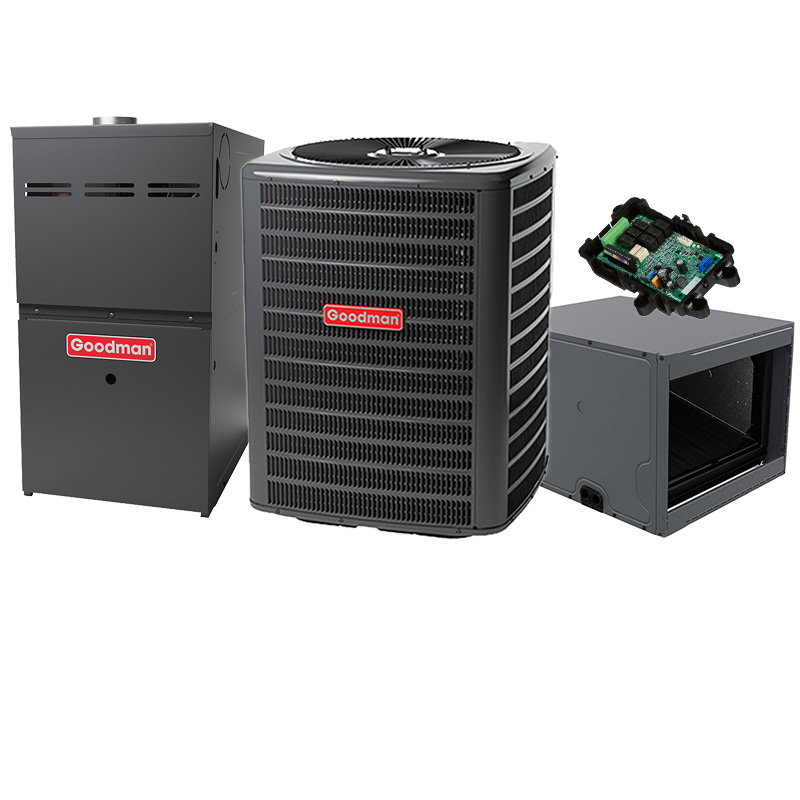
Goodman 5 Ton 13.4 SEER2 120000 BTU 80% Two-Stage Gas Furnace With R32 Air Conditioner Condenser And Coil System – Horizontal
View on AC Direct see your lowest price →Check current price on AC Direct →
Key features
- 5-ton cooling capacity for larger homes, typically 2,400 to 3,200 sq ft depending on climate and insulation
- 13.4 SEER2 efficiency rating meets current federal minimums for most U.S. regions
- Two-stage 120,000 BTU furnace at 80% AFUE for reduced temperature swings versus single-stage
- Horizontal configuration designed for attic, crawlspace, or side-discharge installations
- R-32 refrigerant with lower global warming potential than R-410A
- Matched coil and condenser sold as a system for verified ARI performance ratings
About this system
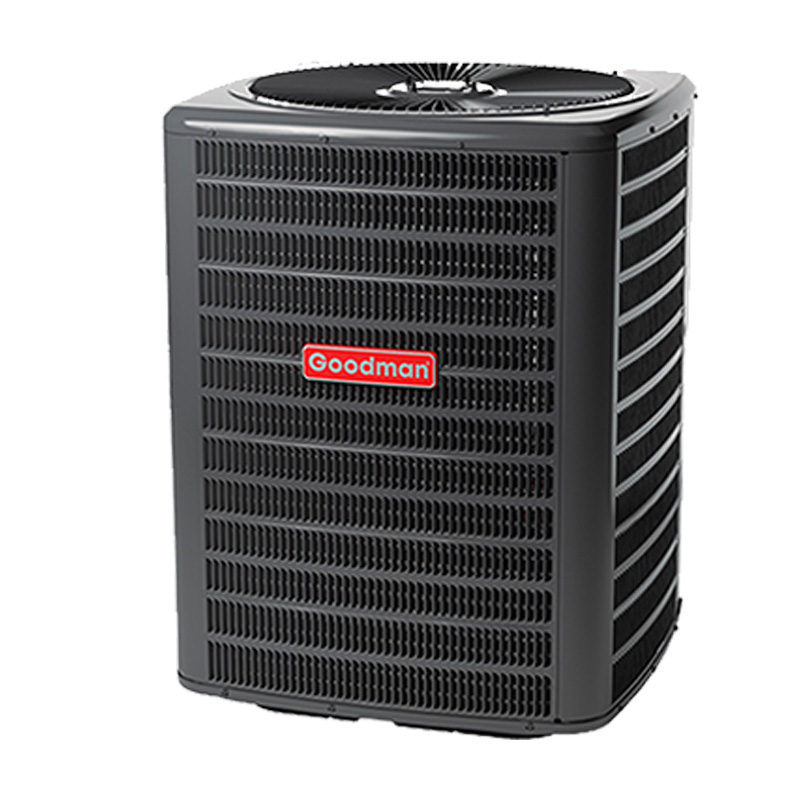
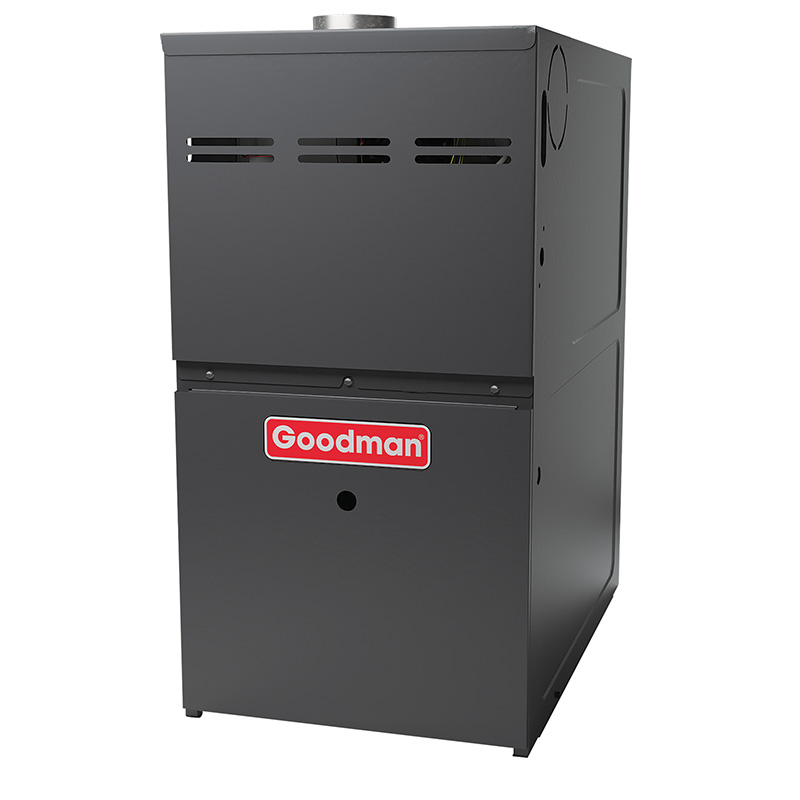
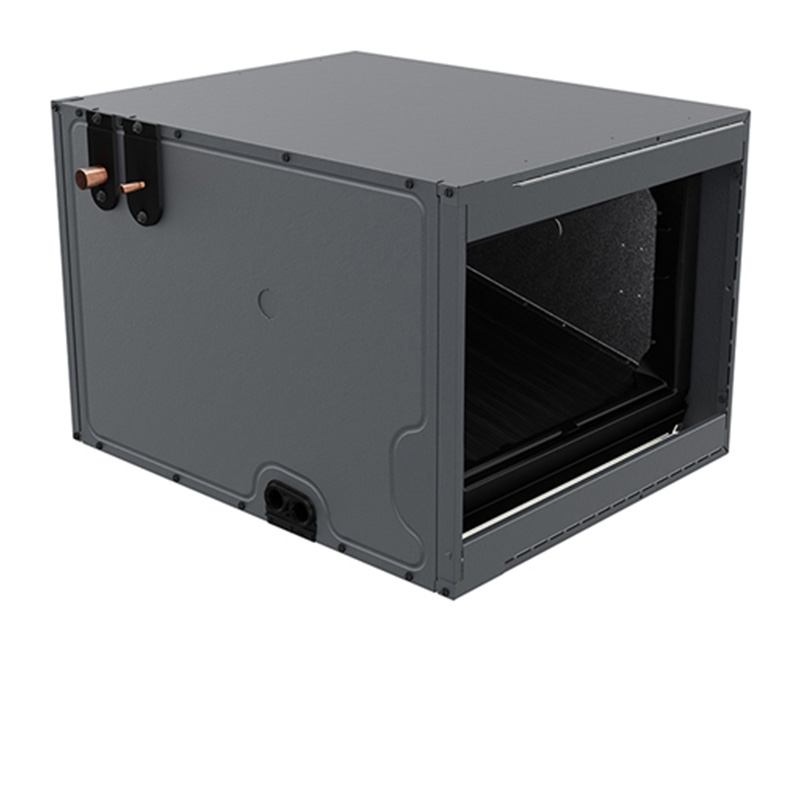
This Goodman system pairs a 5-ton, 13.4 SEER2 R-32 air conditioner condenser and matched evaporator coil with a 120,000 BTU 80% AFUE two-stage gas furnace in a horizontal configuration. The horizontal orientation is designed for installations where vertical space is limited, such as attic platforms, crawlspaces, or side-discharge closet applications. At 5 tons, this is a serious whole-home system suited to larger homes in the 2,400 to 3,200 square foot range, though actual sizing depends on your local climate, insulation, window area, and a proper Manual J load calculation.
The two-stage furnace runs at a lower firing rate most of the time, which reduces temperature swings, lowers noise, and improves humidity control compared to a single-stage unit. The 13.4 SEER2 rating clears the federal minimum thresholds for most U.S. regions, though it sits at the entry-level efficiency tier rather than the mid or high tiers. R-32 refrigerant carries a lower global warming potential than the older R-410A it replaces and is becoming the industry standard for new residential equipment. Together, this is a competent baseline system for budget-conscious buyers replacing aging equipment in larger homes, provided it is sized and commissioned correctly.
This Goodman system delivers a functional, code-compliant whole-home solution at a price point well below comparable equipment from Trane, Lennox, or Carrier. The two-stage furnace is a genuine comfort upgrade over single-stage units, but the 13.4 SEER2 rating and 80% AFUE place this firmly in entry-level efficiency territory, and long-term ownership costs depend heavily on the quality of the original installation.
Overall score is the average of the five ratings above.
What we like
- Price typically runs 15 to 25 percent below comparable Carrier, Trane, or Lennox systems
- Two-stage furnace operation improves comfort and humidity control compared to single-stage
- R-32 refrigerant is forward-looking and widely supported by HVAC technicians
- Horizontal configuration addresses installations where vertical equipment cannot fit
- Matched coil and condenser combination supports verified ARI efficiency ratings
Trade-offs
- 13.4 SEER2 is the lowest efficiency tier; operating costs will be higher than 16+ SEER2 alternatives over a long ownership period
- 80% AFUE furnace leaves 20% of fuel as exhaust heat, a real efficiency gap versus 90%+ condensing furnaces
- Goodman's documented failure modes include dual-run capacitor failures, evaporator coil leaks, and compressor lifespans averaging 10 to 14 years versus 15 to 20 for premium brands
- Horizontal installations add complexity and cost; improper leveling or drain slope is a recurring cause of early coil and drain pan issues
What homeowners and pros say about Goodman
Homeowners who post about Goodman systems tend to land in one of two camps. Those who had a skilled installer handle the job often report years of uneventful service and point to the upfront cost savings as a clear win. Those who ran into problems frequently trace the root cause either to installation shortcuts or to the equipment’s known weak points. Dual-run capacitor failures are the most frequently cited repair, typically a straightforward fix in the 300 to 600 dollar range, but enough owners report evaporator coil leaks and refrigerant loss in the first few years to make those genuine concerns rather than statistical noise. On ConsumerAffairs, Goodman sits at roughly 2.5 out of 5, a score that reflects a complaint-heavy audience but also a real pattern of repair costs climbing after year seven. Google dealer reviews average closer to 3.8 out of 5, where the most repeated praise is the price point.
HVAC technicians tend to view Goodman with measured respect rather than enthusiasm. The consensus in the trades is that the equipment performs acceptably when it is installed correctly, but that it leaves less margin for error than a Carrier or Trane unit would. Compressor lifespan is a recurring topic: Goodman compressors tend to average 10 to 14 years in real-world reports, compared to 15 to 20 years for premium brands, which matters a great deal on a 5-ton unit where compressor replacement is an expensive job. For a horizontal installation specifically, techs stress that proper commissioning, leveling, and refrigerant charge verification are not optional extras but the difference between a system that runs well and one that generates callbacks. The brand’s value proposition is real, but it is most reliable when a skilled installer treats the job as carefully as they would a premium unit.
Sources: ConsumerAffairs Goodman owner reviews, AHRI Directory of Certified Product Performance, U.S. DOE appliance and equipment efficiency standards, Goodman product specification sheets.
What it costs to run
At 13.4 SEER2, cooling this 5-ton system for a typical 1200-hour cooling season at the U.S. average electricity rate of $0.17/kWh works out to roughly $913 per year in cooling, about $0 less per year than a minimum-efficiency 13.4 SEER2 unit of the same size. Your real cost depends on your climate and local rate.
Method: (60,000 BTU/hr ÷ 13.4 SEER2) × 1200 hours ÷ 1000 × $0.17/kWh. Rate source: U.S. EIA average; cooling hours: moderate-climate estimate.
How it compares
| Brand | Comparable model | SEER2 | Stage | Price position |
|---|---|---|---|---|
| Goodman | 5 Ton 13.4 SEER2 Two-Stage Gas Furnace System Horizontal | 13.4 | Two-stage | Value pick |
| Carrier | Performance 15 (24ACC636 / 58STA series) | 15+ | Single-stage | Moderately higher than Goodman, mid-tier pricing |
| Trane | XR15 / S9X1 series | 15+ | Single-stage | Moderately higher than Goodman, mid-tier pricing |
| Lennox | Merit 14ACX / ML195 series | 13.4 to 14 | Single-stage | Comparable to slightly above Goodman at the entry efficiency tier |
Competitor rows are comparable single-stage units at similar efficiency; price is relative position, not a quote.
Questions about this system
Is 13.4 SEER2 going to cost me more to run than a higher-efficiency system?
Yes, meaningfully so in hot climates or homes that run the AC heavily from May through September. A system at 16 or 18 SEER2 will use noticeably less electricity per hour of runtime. For a 5-ton unit running several hundred hours per season, the difference in annual energy costs can offset part of the price gap between tiers within a few years.
Why is horizontal configuration more difficult to install than a standard upflow or downflow setup?
Horizontal installations require careful attention to leveling, condensate drain slope, and structural support of the air handler in tight spaces like attics or crawlspaces. Poor drain slope leads to standing water and eventual coil or drain pan corrosion. These issues are manageable with an experienced installer but are a more common source of early problems in horizontal setups than in vertical installations.
What is the warranty on this Goodman system and are there conditions I need to know about?
Goodman typically offers a 10-year parts limited warranty when the system is registered within a set window after installation, and a lifetime heat exchanger warranty on the furnace. However, the warranty generally requires installation by a licensed contractor and timely registration; skipping registration usually drops coverage to five years. Always confirm current warranty terms at the time of purchase, as they can change.
Should I be worried about the evaporator coil leak issue mentioned in owner reviews?
Coil leaks are a documented weakness in Goodman's owner feedback and represent a real ownership risk, not just an isolated complaint. A refrigerant leak typically means a service call, refrigerant recharge, and potentially a coil replacement depending on severity. The 10-year parts warranty covers the coil itself if the leak is traced to a manufacturing defect and the system is registered, but labor costs are not covered, so budget accordingly.
Does switching to R-32 refrigerant affect what a technician needs to service this system?
R-32 requires technicians to use equipment rated for mildly flammable refrigerants and to follow updated safety procedures, but most current HVAC technicians are trained and equipped for it. It should not be a barrier to getting the system serviced, though in some rural areas you may want to confirm a local tech has R-32 experience before buying.
Specifications
| Cooling capacity | 5 Ton |
| Efficiency | 13.4 SEER2 |
| Furnace output | 120000 BTU |
| Configuration | Horizontal |
| Refrigerant | R-32 |