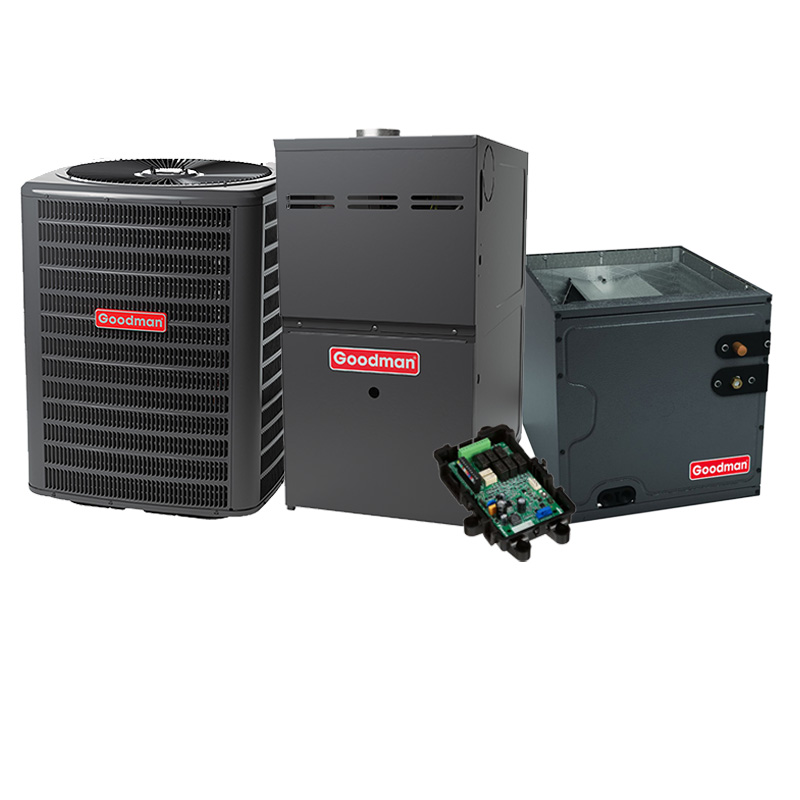
Goodman 3.5 Ton 13.8 SEER2 100000 BTU 80% Two-Stage Variable Speed Gas Furnace With R32 AC Condenser And Coil System – Upflow
View on AC Direct see your lowest price →Check current price on AC Direct →
Key features
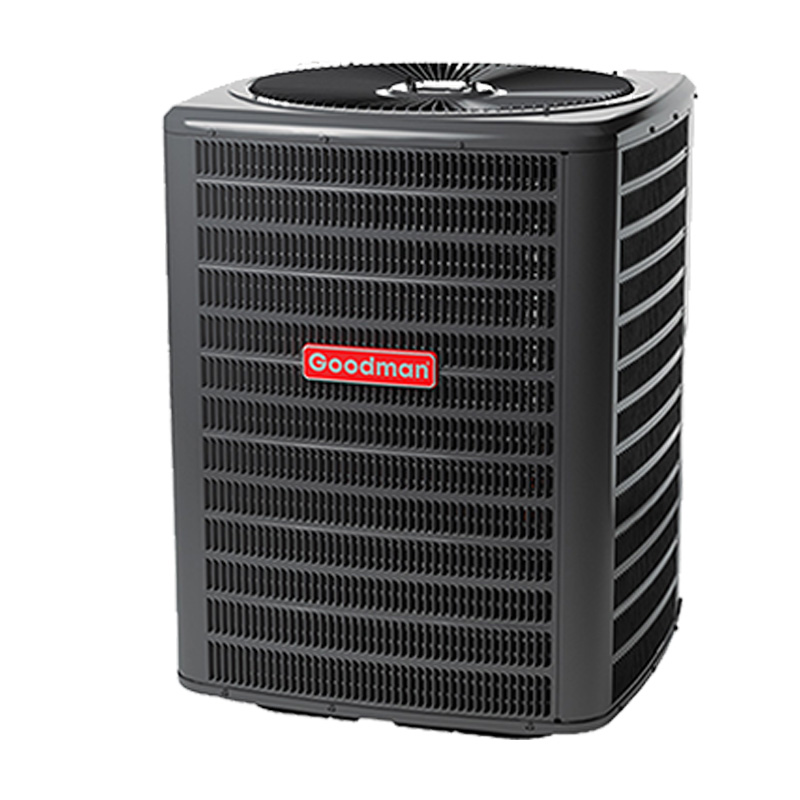
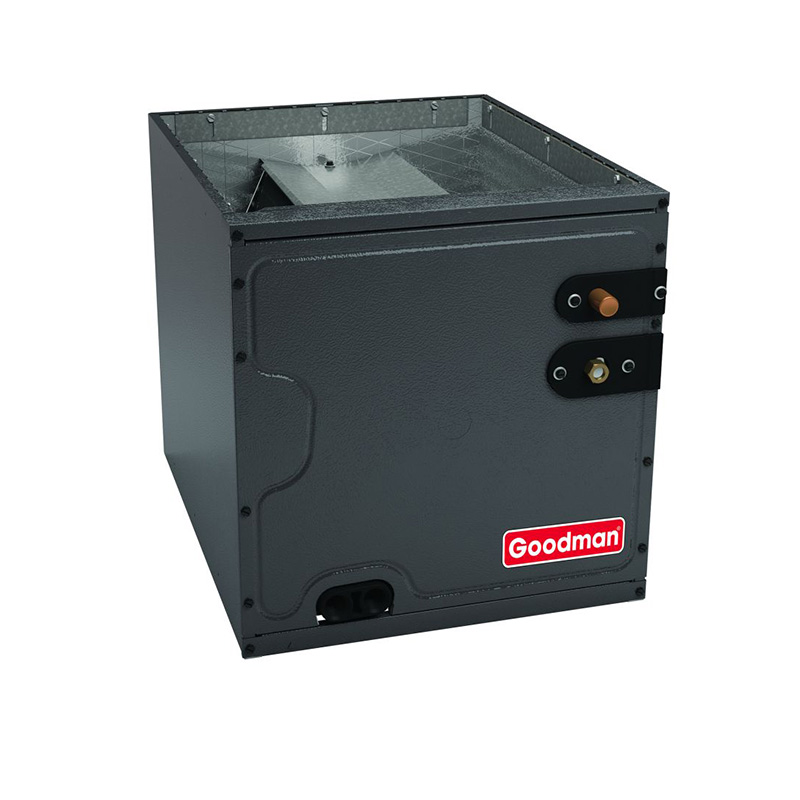
- 3.5-ton R-32 condenser matched with upflow evaporator coil and 100,000 BTU furnace
- 13.8 SEER2 cooling efficiency meets current federal minimums for most climate zones
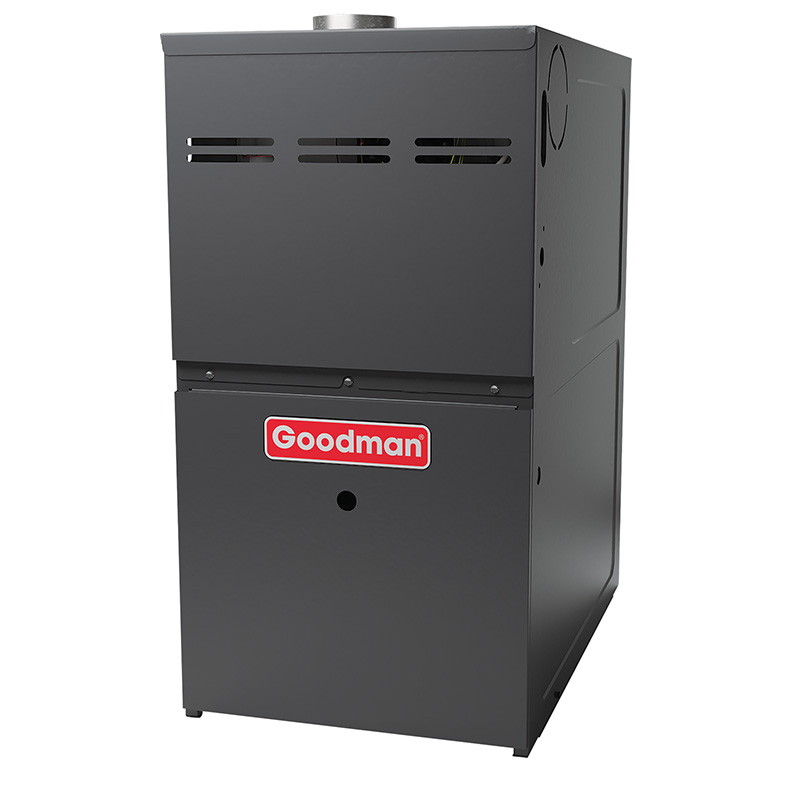
- Two-stage gas valve runs at reduced capacity most of the time for steadier temperatures
- Variable-speed blower motor improves humidity control and lowers blower electricity use
- R-32 refrigerant offers a significantly lower global warming potential than R-410A
- Upflow furnace cabinet designed for basement or ground-floor installations with overhead duct systems
About this system
This Goodman bundle pairs a 3.5-ton R-32 air conditioning condenser and matching evaporator coil with a 100,000 BTU, 80% AFUE two-stage variable-speed gas furnace in an upflow configuration. The combination is aimed at mid-size homes, typically in the 1,800 to 2,400 square foot range, that need serious heating capacity alongside adequate cooling. The 13.8 SEER2 rating clears the current federal minimum for most U.S. climate zones but sits at the lower end of the mid-efficiency tier, meaning operating costs will be higher than a 16 or 17 SEER2 system over a 10-to-15-year lifespan. The furnace’s two-stage gas valve and variable-speed blower do improve comfort and efficiency compared with single-stage equipment by running at lower capacity most of the time, which also reduces temperature swings and humidity during shoulder seasons.
The switch to R-32 refrigerant is a genuine forward-looking feature. R-32 has a global warming potential roughly 68 percent lower than the R-410A it replaces, and it is now the direction the industry is moving. The upflow configuration means the air handler draws return air from the bottom and discharges conditioned air upward, which suits a basement or ground-level mechanical room feeding overhead duct runs. Buyers should know that R-32 requires technicians who are certified to handle it, and not every local shop is equipped yet, which can complicate future service calls in some markets.
This system delivers solid entry-to-mid-level performance at a price point that is meaningfully lower than comparable Carrier, Trane, or Lennox bundles. The two-stage furnace and variable-speed blower are real comfort upgrades over basic single-stage equipment, but the 13.8 SEER2 rating means you are not buying long-term efficiency, and Goodman's track record shows repair costs can climb after year seven. It is a reasonable choice for budget-focused buyers who plan to invest in a quality installation and keep up with maintenance.
Overall score is the average of the five ratings above.
What we like
- Priced 15 to 25 percent below comparable Trane, Lennox, and Carrier bundles
- Two-stage furnace operation reduces hot-and-cold cycling and improves day-to-day comfort
- Variable-speed blower lowers blower motor electricity consumption versus PSC motors
- R-32 refrigerant is future-oriented and has a much lower environmental impact than R-410A
- Matched coil and condenser sold together reduces compatibility guesswork for installers
Trade-offs
- 13.8 SEER2 is near the federal minimum, so long-run energy savings lag behind 16-plus SEER2 systems
- Dual-run capacitors are the most commonly reported failure, though repairs typically run $300 to $600
- Evaporator coil leaks appear in a notable share of owner reviews, which can be a costly repair
- Compressor lifespan averages 10 to 14 years, shorter than the 15 to 20 years typical of premium brands
What homeowners and pros say about Goodman
Homeowners who review Goodman equipment on ConsumerAffairs give the brand roughly 2.5 out of 5 stars, a score that reflects a complaint-heavy audience where the recurring frustration is rising repair costs after about year seven. Google reviews aggregated across dealer locations land higher, around 3.8 out of 5, and the most consistent praise there is straightforward: the equipment cost less than competing bids and the installer made it work. For this specific bundle, the two-stage furnace and variable-speed blower earn positive mentions from owners who notice steadier temperatures and quieter operation compared with the older single-stage systems they replaced. The R-32 refrigerant draws little comment from typical homeowners, but installers note it requires proper certification and recovery equipment, which can narrow the field of who will service the system down the road.
On the reliability side, HVAC technicians and experienced owners are consistent about where Goodman systems tend to show stress. Dual-run capacitor failures are the most commonly reported issue across this product line, and while the repair is usually quick and runs $300 to $600, it signals that owners should budget for periodic maintenance costs rather than expecting trouble-free operation through the warranty period. Evaporator coil leaks appear in a meaningful share of owner feedback and represent a more serious expense when they occur. Compressor lifespan on Goodman equipment tends to average 10 to 14 years, which is shorter than the 15 to 20 years that premium brands more commonly achieve. A minority of owners also report refrigerant leaks within the first year, a pattern that technicians generally attribute to install or initial charge problems rather than manufacturing defects, which reinforces how heavily the long-term experience with this brand depends on who puts it in.
Sources: ConsumerAffairs Goodman owner reviews, AHRI Directory of Certified Product Performance, U.S. DOE appliance and equipment efficiency standards, Goodman product specification sheets.
What it costs to run
At 13.8 SEER2, cooling this 3.5-ton system for a typical 1200-hour cooling season at the U.S. average electricity rate of $0.17/kWh works out to roughly $621 per year in cooling, about $18 less per year than a minimum-efficiency 13.4 SEER2 unit of the same size. Your real cost depends on your climate and local rate.
Method: (42,000 BTU/hr ÷ 13.8 SEER2) × 1200 hours ÷ 1000 × $0.17/kWh. Rate source: U.S. EIA average; cooling hours: moderate-climate estimate.
How it compares
| Brand | Comparable model | SEER2 | Stage | Price position |
|---|---|---|---|---|
| Goodman | 3.5 Ton 13.8 SEER2 / 100K BTU 80% Two-Stage Variable-Speed Bundle | 13.8 | Two-stage | Value pick |
| Carrier | Performance 14 Series (24ACC636 with 80% two-stage furnace) | 14.0 | Two-stage | Roughly 20 to 25 percent more than this Goodman bundle |
| Trane | XR14 Condenser with S9V2 80% Variable-Speed Furnace | 14.0 | Two-stage | Roughly 20 to 30 percent more than this Goodman bundle |
| Lennox | Merit Series ML14XC1 with ML196V 80% Variable-Speed Furnace | 14.0 | Two-stage | Roughly 25 to 35 percent more than this Goodman bundle |
Competitor rows are comparable single-stage units at similar efficiency; price is relative position, not a quote.
Questions about this system
Is 13.8 SEER2 enough, or should I pay more for a higher-efficiency unit?
13.8 SEER2 meets federal minimums and will cool your home effectively, but the gap in monthly energy costs versus a 16 or 17 SEER2 system adds up over a decade. If you plan to stay in the home more than eight to ten years, a higher SEER2 unit often pays back the price difference in energy savings, especially in climates with long cooling seasons.
Can my current HVAC technician service an R-32 system?
Not all technicians are equipped for R-32 yet. It requires specific handling certification and compatible recovery equipment. Before buying, confirm that your installer and at least one backup service company in your area are already certified for R-32 work.
What are the most likely repairs I should budget for on a Goodman system?
Dual-run capacitor failures are the most common reported issue and are typically a straightforward repair in the $300 to $600 range. Evaporator coil leaks are a more significant concern, appearing in a notable share of owner reviews, and compressor replacement becomes a realistic possibility after the 10-to-14-year mark.
Does the upflow configuration work if my furnace is in a closet on the main floor?
Upflow furnaces are designed to pull return air from the bottom cabinet and push conditioned air upward through the plenum, which is well-suited to a basement mechanical room or a main-floor closet where ductwork runs through the ceiling. If your duct system runs beneath the floor or the unit must be installed horizontally, you would need a different configuration.
How much does install quality actually affect how long this system lasts?
HVAC technicians consistently identify install quality as the single biggest variable in Goodman system lifespan, more so than with premium brands that have tighter manufacturing tolerances. Proper refrigerant charge, correct airflow setup, and accurate gas pressure settings at startup are critical. A minority of owners who report refrigerant leaks in the first year trace the problem back to install or charge issues rather than equipment defects.
Specifications
| Cooling capacity | 3.5 Ton |
| Efficiency | 13.8 SEER2 |
| Furnace output | 100000 BTU |
| Configuration | Upflow |
| Refrigerant | R-32 |