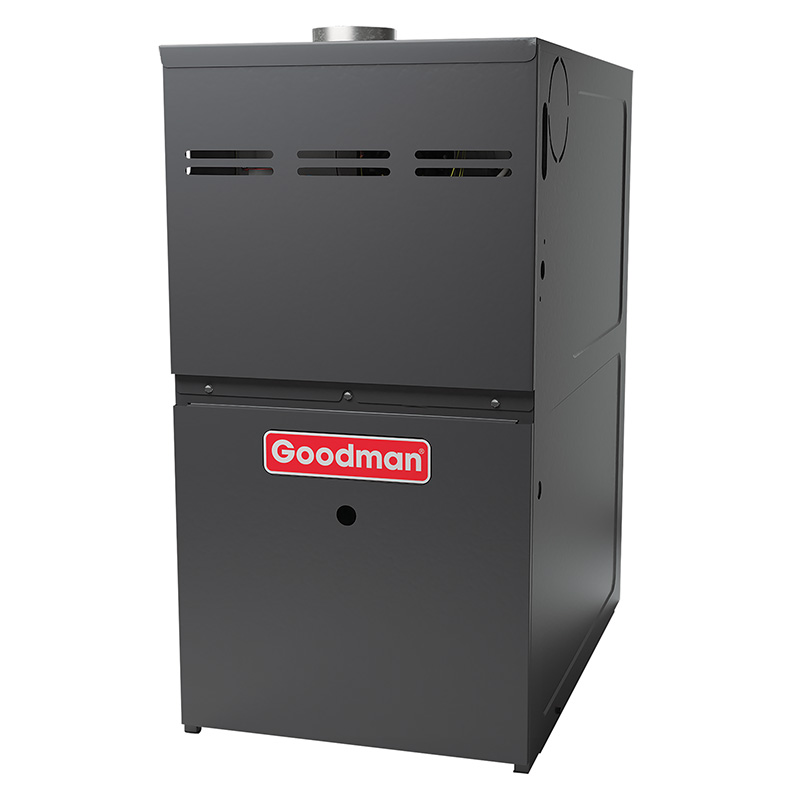
Goodman R32 120000 BTU 80% Multi-Speed ECM Gas Furnace Upflow / Horizontal (GR9S801205DN)
View on AC Direct see your lowest price →Check current price on AC Direct →
Key features
- 120,000 BTU output for larger homes in colder climates
- 80% AFUE standard-efficiency rating, no PVC venting required
- Multi-speed ECM blower motor reduces electricity use vs. PSC motors
- Upflow and horizontal configuration for attic, basement, or closet installs
- Compatible with communicating and standard thermostat controls
- Stainless steel secondary heat exchanger for corrosion resistance
About this system
The Goodman GR9S801205DN is a 120,000 BTU, 80% AFUE upflow and horizontal gas furnace designed for larger homes, typically in the 2,500 to 3,500 square foot range depending on climate and insulation. The 80% AFUE rating means that for every dollar spent on natural gas, 80 cents becomes usable heat, with the remaining 20 cents lost through the flue. That puts this unit in the standard-efficiency category, a practical choice for milder climates or situations where the payback period on a 90%-plus condensing furnace does not pencil out. The model designation does not indicate R-32 refrigerant involvement in a standalone furnace context, as gas furnaces do not use refrigerant, so the R-32 notation in the spec listing likely refers to a matched system designation rather than a furnace-specific attribute.
The multi-speed ECM (electronically commutated motor) blower is a meaningful upgrade over single-speed PSC motors. ECM technology uses significantly less electricity during the long blower run times that come with both heating and cooling cycles, and the variable airflow helps reduce hot and cold spots throughout the duct system. The DN cabinet size is built for high-capacity applications, and the upflow or horizontal configuration covers the most common installation scenarios, including attic installs, utility closets, and basement setups. This furnace suits budget-conscious buyers in larger homes who want reliable heating without the premium price of a Trane or Lennox, provided they invest in a quality installation and a maintenance plan.
The GR9S801205DN delivers solid heating capacity at a price point that is typically 15 to 25 percent below comparable Trane, Lennox, and Carrier units. The ECM motor is a genuine efficiency advantage, but the 80% AFUE is a trade-off in operating cost for buyers in cold climates. Long-term satisfaction hinges heavily on installation quality and a willingness to budget for maintenance after year seven.
Overall score is the average of the five ratings above.
What we like
- Priced 15 to 25 percent below comparable Carrier, Trane, and Lennox models
- Multi-speed ECM blower motor reduces blower electricity consumption noticeably
- 120,000 BTU capacity handles large homes and cold climates without undersizing
- No PVC condensate venting needed, simplifying installation vs. 90-plus AFUE units
- Widely stocked with broad technician familiarity across most service territories
Trade-offs
- 80% AFUE means higher annual gas bills compared to 95% to 97% AFUE alternatives
- Goodman's ConsumerAffairs score of about 2.5 out of 5 reflects a real pattern of repair costs rising after roughly year seven
- Compressor and component longevity tends to average shorter than premium brands, with compressors typically lasting 10 to 14 years vs. 15 to 20 for Trane or Lennox
- Performance and lifespan are heavily dependent on install quality, making contractor selection as important as brand selection
What homeowners and pros say about Goodman
Homeowners who choose Goodman most often point to affordability as the deciding factor, and that sentiment shows up clearly in Google dealer reviews where the brand averages around 3.8 out of 5 across hundreds of location-level reviews. The GR9S801205DN fits that pattern: buyers in larger homes who want a high-capacity furnace without the sticker shock of a premium brand tend to come away satisfied in the first several years. The ECM blower draws specific praise from owners who notice lower electricity bills and more even airflow compared to older single-speed units they replaced.
The harder feedback surfaces on longer-term ownership, and Goodman’s ConsumerAffairs score of about 2.5 out of 5 reflects a real pattern rather than isolated noise. The recurring theme in those reviews is that repair costs start climbing after roughly the seven-year mark. HVAC technicians who work on Goodman equipment frequently flag dual-run capacitor failures as the most common service call, a repair that usually lands in the 300 to 600 dollar range and is not unique to Goodman but does seem to appear earlier than on premium brands. Professionals also note that compressor lifespan on Goodman equipment tends to average 10 to 14 years versus 15 to 20 years for Trane or Lennox, and that installation quality matters more with this brand than most, since a rushed or improper install amplifies the reliability gap. For a 120,000 BTU furnace specifically, correct sizing, tight duct connections, and proper gas pressure setup at commissioning are not optional extras but baseline requirements for getting the value the price promises.
Sources: ConsumerAffairs Goodman owner reviews, AHRI Directory of Certified Product Performance, U.S. DOE appliance and equipment efficiency standards, Goodman product specification sheets.
How it compares
| Brand | Comparable model | SEER2 | Stage | Price position |
|---|---|---|---|---|
| Goodman | GR9S801205DN | N/A (furnace only) | Multi-speed | Value pick |
| Carrier | Performance 80 (58TP) | N/A (furnace only) | Multi-speed | Moderately higher than Goodman |
| Trane | S8X2 (XR80 series) | N/A (furnace only) | Single-stage | Moderately to significantly higher than Goodman |
| Lennox | Merit ML180 | N/A (furnace only) | Single-speed | Comparable to moderately higher than Goodman |
Competitor rows are comparable single-stage units at similar efficiency; price is relative position, not a quote.
Questions about this system
Will 120,000 BTU be too large for my home and cause short cycling?
Oversizing is a real risk with furnaces at this capacity. A proper Manual J load calculation is essential before purchase. Short cycling from an oversized furnace reduces comfort, efficiency, and equipment lifespan, so do not skip the sizing step.
Does this furnace require PVC venting like a high-efficiency unit?
No. At 80% AFUE, this is a standard-efficiency furnace that uses a conventional B-vent or metal flue pipe rather than PVC condensate venting. That makes it straightforward to drop into an existing venting setup when replacing an older 80% unit.
What is Goodman's warranty on this furnace and what does it actually cover?
Goodman typically offers a limited lifetime heat exchanger warranty and a 10-year parts warranty when the unit is registered within a set window after installation. Labor is not covered, which becomes relevant if repairs are needed after year seven when the ConsumerAffairs complaint pattern suggests repair frequency can increase.
How much does the ECM blower motor actually save compared to a standard PSC motor?
ECM motors typically consume 60 to 75 percent less electricity than single-speed PSC motors during blower operation. Given that the blower runs during both heating and any attached cooling cycles, the savings add up over a season, though the exact amount depends on local electricity rates and how many hours the system runs.
What are the most common repairs I should budget for over the life of this furnace?
Based on Goodman's documented failure patterns, dual-run capacitors are the most frequently reported service item and typically cost between 300 and 600 dollars including labor. Ignitor failures and inducer motor issues are also common service calls on gas furnaces in this class. Budgeting for annual tune-ups and setting aside a repair fund is a practical approach.
Specifications
| Furnace output | 120000 BTU |
| Configuration | Upflow |
| Refrigerant | R-32 |
| Model | GR9S801205DN |