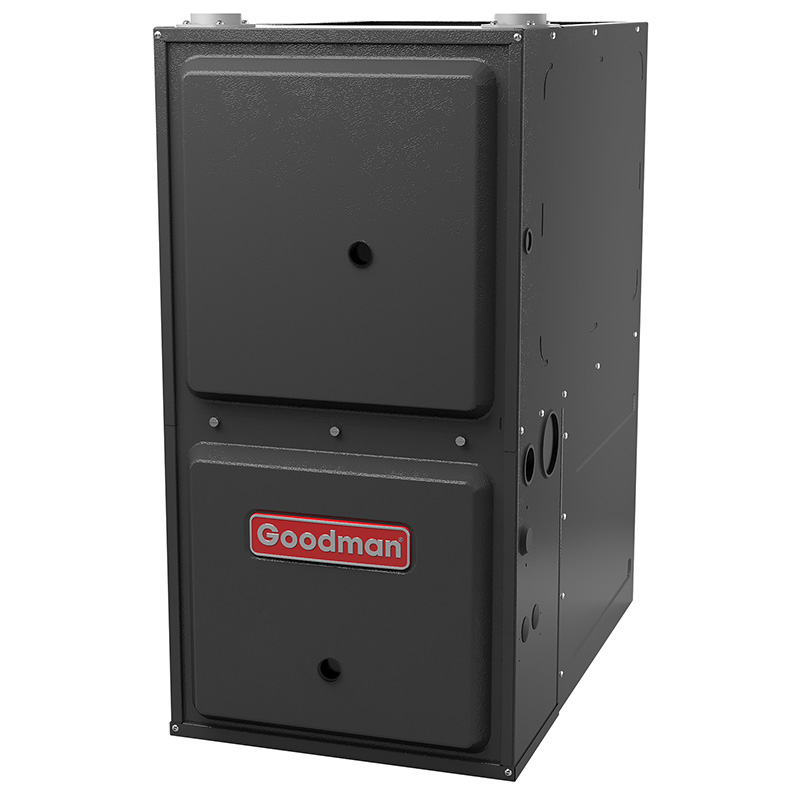
Goodman R32 80000 BTU 80% Multi-Speed ECM Gas Furnace Downflow (GD9S800804BN)
View on AC Direct see your lowest price →Check current price on AC Direct →
Key features
- 80,000 BTU downflow configuration for floor-level duct systems
- Multi-speed ECM blower motor reduces noise and fan electricity use
- 80% AFUE heating efficiency meets code minimum in most U.S. jurisdictions
- Single-stage gas valve delivers straightforward, proven heating operation
- Stainless-steel tubular heat exchanger for corrosion resistance
- Priced 15 to 25 percent below comparable Trane, Lennox, and Carrier models
About this system
The Goodman GD9S800804BN is an 80,000 BTU, 80% AFUE downflow gas furnace built around a multi-speed ECM blower motor and designed specifically for downflow installations, meaning the air discharges downward through a floor or crawlspace plenum rather than upward or horizontally. That configuration makes it the right call for homes where the duct system runs beneath the living space, which is common in slab-on-grade construction and certain manufactured-home setups. The R-32 designation in the product name refers to refrigerant compatibility labeling in Goodman’s line, but since this is a standalone furnace with no refrigerant circuit, it has no direct bearing on heating performance here.
The multi-speed ECM motor is the most meaningful spec for everyday comfort. Unlike single-speed PSC blowers that run at full blast or not at all, the ECM adjusts airflow to match heating demand, which reduces temperature swings, cuts electrical consumption during fan operation, and runs noticeably quieter at lower speeds. At 80% AFUE, this furnace converts 80 cents of every dollar of gas into usable heat, which meets code minimum in most U.S. climates but is not a high-efficiency unit. Homeowners in colder regions who run the furnace heavily from October through April will see a meaningful gap in annual fuel costs compared to a 96% AFUE condensing furnace. This model suits budget-conscious buyers in mild-to-moderate heating climates who need a downflow configuration and want to keep first costs low.
The GD9S800804BN is a workmanlike downflow furnace that delivers reliable heat at a lower upfront cost than most name-brand alternatives, but its 80% AFUE efficiency means higher annual fuel bills compared to condensing units, and Goodman's long-term track record shows repair costs tend to climb after year seven. It earns its place for budget-focused buyers in downflow applications where installation quality is high, but it is not the right fit for cold climates or owners who want to minimize lifetime operating costs.
Overall score is the average of the five ratings above.
What we like
- Lower purchase price than comparable Carrier, Trane, or Lennox downflow furnaces
- ECM multi-speed blower cuts fan electricity use and reduces hot-and-cold cycling
- Downflow design covers an underserved configuration that not all brands stock readily
- Single-stage operation keeps the control system simple and easy for technicians to service
- Widely available parts network due to Goodman's large installed base across the U.S.
Trade-offs
- 80% AFUE leaves real money on the table in cold climates versus 95-96% AFUE alternatives
- Goodman's ConsumerAffairs score of about 2.5 out of 5 reflects a pattern of rising repair costs after roughly year seven
- Single-stage heating is less comfortable and less efficient than two-stage or modulating furnaces in the same price tier from some competitors
- Performance and longevity depend heavily on installation quality, so a cut-rate install amplifies the brand's known reliability risks
What homeowners and pros say about Goodman
Homeowners who choose Goodman most often cite the lower sticker price as the deciding factor, and dealer Google reviews averaging around 3.8 out of 5 suggest that many buyers end up reasonably satisfied, particularly when the installing contractor does careful work. The consistent message from those positive reviews is straightforward: the equipment does what it is supposed to do for the first several years, and the savings at purchase feel worthwhile. The picture on ConsumerAffairs is rougher, with a score of about 2.5 out of 5, driven heavily by owners who ran into problems after the warranty honeymoon period ended. The recurring complaint there is that repair bills accumulate more quickly than expected after roughly year seven, which lines up with what independent service technicians observe in the field.
Among HVAC pros, Goodman occupies a well-understood niche. Technicians generally describe it as serviceable equipment that performs close to its rated specs when installed correctly, and the brand’s large installed base means replacement parts are easy to source. The failure modes they flag most often are dual-run capacitor failures, which are common and inexpensive to fix, and evaporator coil leaks that show up in a meaningful share of owner reports over time. Compressor lifespan on Goodman systems tends to land in the 10 to 14 year range rather than the 15 to 20 years seen with premium brands, which factors into the true lifetime cost comparison. For this specific furnace, the absence of a refrigerant circuit removes the coil and compressor concerns entirely, leaving installation quality and the heat exchanger as the main long-term variables to watch.
Sources: ConsumerAffairs Goodman owner reviews, AHRI Directory of Certified Product Performance, U.S. DOE appliance and equipment efficiency standards, Goodman product specification sheets.
How it compares
| Brand | Comparable model | SEER2 | Stage | Price position |
|---|---|---|---|---|
| Goodman | GD9S800804BN | N/A (furnace only) | Single-stage | Value pick |
| Carrier | Performance 80 / 59SP5 | N/A (furnace only) | Single-stage | Roughly 15 to 20 percent higher than Goodman |
| Trane | S8X1 80% AFUE | N/A (furnace only) | Single-stage | Roughly 20 to 25 percent higher than Goodman |
| Lennox | ML180 80% AFUE | N/A (furnace only) | Single-stage | Roughly 20 to 25 percent higher than Goodman |
Competitor rows are comparable single-stage units at similar efficiency; price is relative position, not a quote.
Questions about this system
Can this furnace be installed in a closet or alcove, or is it only for dedicated mechanical rooms?
Downflow furnaces like this one can be installed in closets and alcoves as long as clearances required by the manufacturer and local code are maintained and combustion air is properly supplied. The downflow configuration means the supply plenum connects at the bottom, so the unit typically sits on a raised platform or directly over a floor opening. Always confirm clearance specs in the installation manual before framing the space.
What does 80% AFUE actually cost me compared to a 96% AFUE furnace over time?
At 80% AFUE, 20 cents of every dollar of gas escapes as exhaust heat rather than warming your home. At 96% AFUE, that loss drops to 4 cents. The annual dollar difference depends entirely on your local gas rates and how many heating hours you accumulate, but in a cold northern climate that difference can reach several hundred dollars per year. In a mild southern climate the payback on the higher-efficiency unit stretches out significantly, which is part of why 80% units still sell in those regions.
What is the warranty on this Goodman furnace and are there any conditions I should know about?
Goodman typically offers a limited lifetime heat exchanger warranty and a 10-year parts warranty on registered units, but registration must be completed within a set window after installation or the warranty defaults to a shorter term. The warranty also generally requires installation by a licensed HVAC contractor, so DIY installs can void coverage. Read the warranty certificate that ships with the unit and register promptly.
What are the most common repairs I should budget for over the life of this furnace?
Across Goodman's broader product line, dual-run capacitors are the most frequently reported failure point, usually a straightforward repair in the 300 to 600 dollar range. Beyond that, owner reviews document a pattern of repair costs climbing after roughly year seven, so setting aside a maintenance budget makes sense from the start. Scheduling annual tune-ups with a qualified technician is the single most effective way to catch issues early.
Is this furnace compatible with a standard thermostat, or does the ECM motor require a special control?
The multi-speed ECM blower is controlled internally by the furnace's own control board, not by the thermostat directly, so most standard 24-volt thermostats are compatible for basic heating and cooling control. If you want features like variable-speed fan modes or communicating system integration, verify thermostat compatibility with your installing contractor before purchase, as not all smart thermostats expose those advanced ECM functions without a matched system.
Specifications
| Furnace output | 80000 BTU |
| Configuration | Downflow |
| Refrigerant | R-32 |
| Model | GD9S800804BN |