Goodman R32 100000 BTU 80% Two Stage 9-Speed ECM Gas Furnace Upflow / Horizontal (GR9T801005CN)
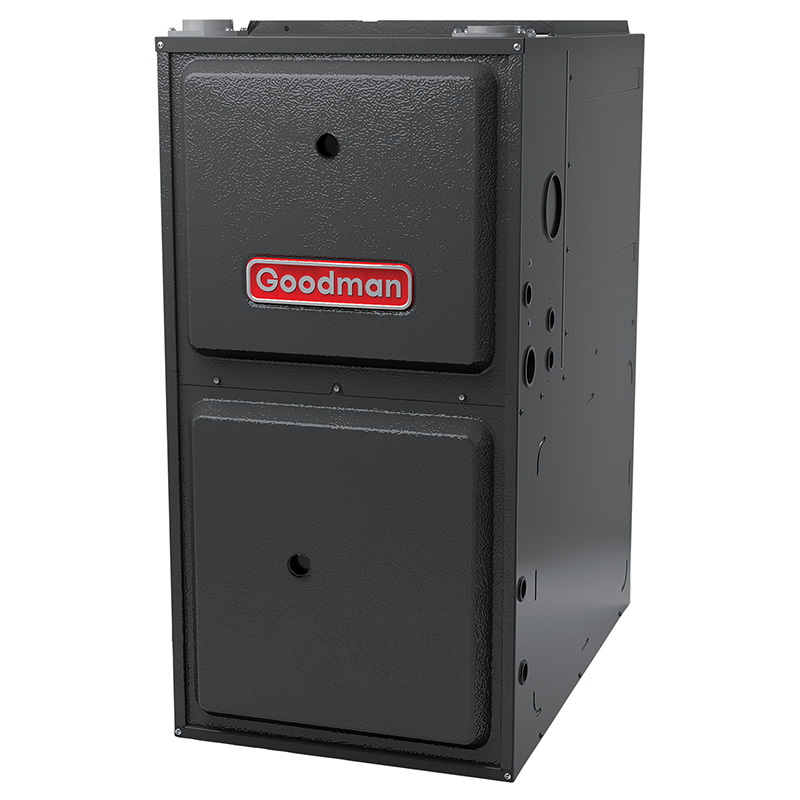
View on AC Direct see your lowest price →Check current price on AC Direct →
Key features
- 100,000 BTU two-stage gas burner reduces short-cycling and temperature swings
- 9-speed ECM blower motor lowers electricity use vs. standard PSC motors
- 80% AFUE efficiency rating, suitable for moderate climates with gas piped to the home
- Upflow or horizontal configuration for basement, closet, or attic installs
- Compatible with matched R-32 coil and outdoor equipment for full-system builds
- Stainless steel secondary heat exchanger on the primary stage for corrosion resistance
About this system
The Goodman GR9T801005CN is a 100,000 BTU, 80% AFUE two-stage gas furnace built for upflow or horizontal installations. The two-stage gas valve means the burner runs at a lower fire on mild days and steps up to full capacity only when outdoor temperatures demand it, which reduces temperature swings and cuts fuel consumption compared to a single-stage unit running flat-out all winter. The 9-speed ECM blower motor adds another layer of efficiency by drawing far less electricity than a standard PSC motor and ramping airflow to match the heating stage in use.
This furnace uses R-32 refrigerant labeling in the model number, which in Goodman’s current lineup often indicates compatibility with matched R-32 coil and outdoor equipment rather than a refrigerant contained inside the furnace itself. Verify with your installer that your full system components are matched correctly before ordering. At 100,000 BTU output, this unit is sized for larger homes, typically in the 2,500 to 3,500 square foot range depending on climate zone, insulation, and duct layout. An 80% AFUE rating means 20 cents of every dollar of gas goes up the flue, so homeowners in very cold climates may want to compare running costs against a 96% AFUE model before committing.
The GR9T801005CN fits homeowners who want meaningful comfort upgrades over basic single-stage furnaces without paying the premium commanded by Trane, Carrier, or Lennox two-stage equivalents. It rewards good installation. Pair it with a qualified local contractor and a properly designed duct system and it performs reliably for most households. Cut corners on installation and the savings from the lower purchase price tend to evaporate in service calls.
The GR9T801005CN delivers genuine two-stage comfort and a real ECM blower at a price point noticeably below comparable Carrier, Trane, and Lennox units. It is a reasonable choice for budget-conscious homeowners who can pair it with an experienced installer, but the brand's repair history after year 7 and shorter average compressor lifespan on paired outdoor units are trade-offs worth weighing against the upfront savings.
Overall score is the average of the five ratings above.
What we like
- Two-stage firing reduces temperature swings and improves comfort over single-stage furnaces
- 9-speed ECM motor cuts blower electricity costs meaningfully over a PSC motor
- Purchase price runs 15 to 25 percent below comparable Trane, Carrier, and Lennox models
- Upflow and horizontal flexibility suits a wide range of home configurations
- Widely available parts network makes capacitor and board replacements straightforward for most HVAC technicians
Trade-offs
- 80% AFUE leaves significant heat going up the flue; cold-climate homeowners may find operating costs higher than a condensing furnace
- Repair costs tend to climb after roughly year 7 based on owner feedback, more so than with premium brands
- Dual-run capacitors are a documented early failure point, and while the fix is low-cost, it adds service call expenses
- Performance is heavily dependent on install quality, meaning a poor contractor can undermine the value proposition quickly
What homeowners and pros say about Goodman
Homeowners who have installed Goodman furnaces frequently cite the purchase price as the standout reason they chose the brand, and that tracks with its real-world positioning: 15 to 25 percent below comparable Trane, Lennox, and Carrier equipment. Google dealer reviews aggregate around 3.8 out of 5 across locations, with affordability appearing repeatedly as the top praise. The picture shifts when you look at ConsumerAffairs, which sits closer to 2.5 out of 5, though that channel draws disproportionately from owners motivated by a frustrating experience. The recurring theme in those lower-score reviews is repair costs climbing after roughly year 7, a pattern worth taking seriously when projecting total ownership cost over 15 or more years.
HVAC technicians who service Goodman equipment point to dual-run capacitor failures as the most common call they get, a repair that typically runs 300 to 600 dollars and is generally straightforward. Evaporator coil leaks appear in a meaningful portion of owner accounts as well, and compressor longevity on paired outdoor units averages 10 to 14 years versus the 15 to 20 years more commonly associated with premium brands. A small minority of owners have reported refrigerant leaks in the first year, which technicians attribute more to installation or charge errors than to the equipment itself. The consistent advice from both camps is that this furnace performs at its best when installed by someone who takes setup seriously, and underperforms quickly when that step is rushed.
Sources: ConsumerAffairs Goodman owner reviews, AHRI Directory of Certified Product Performance, U.S. DOE appliance and equipment efficiency standards, Goodman product specification sheets.
How it compares
| Brand | Comparable model | SEER2 | Stage | Price position |
|---|---|---|---|---|
| Goodman | GR9T801005CN | N/A (furnace only) | Two-stage | Value pick |
| Carrier | Performance 80 (58TP) | N/A (furnace only) | Two-stage | Priced 15 to 20 percent above this Goodman |
| Trane | S8X2 80% AFUE Two-Stage | N/A (furnace only) | Two-stage | Priced 20 to 25 percent above this Goodman |
| Lennox | ML195 80% AFUE Two-Stage | N/A (furnace only) | Two-stage | Priced 20 to 30 percent above this Goodman |
Competitor rows are comparable single-stage units at similar efficiency; price is relative position, not a quote.
Questions about this system
Is this furnace actually 80% AFUE, and does that matter for my heating bill?
Yes, 80% AFUE means 80 cents of every dollar of gas burned becomes heat in your home. In moderate climates like the mid-Atlantic or Pacific Northwest, the difference in annual fuel cost versus a 96% AFUE unit may be modest enough that the lower purchase price pays back quickly. In Minnesota or Wisconsin, the gap widens and a condensing furnace may save more over the life of the unit.
What does the R-32 designation mean on a gas furnace, and does it affect what AC equipment I pair with it?
Gas furnaces do not contain refrigerant themselves, but the R-32 in this model number indicates it is engineered for system compatibility with Goodman's R-32 refrigerant coils and outdoor condensing units. You should confirm with your installer that your indoor coil and outdoor unit are all matched R-32 components, particularly as R-410A equipment is being phased out.
What is the most common repair issue I should budget for on a Goodman furnace?
Dual-run capacitors are the most frequently documented failure point across Goodman owner reports. Replacement typically runs between 300 and 600 dollars including the service call, and most technicians can complete it quickly. Setting aside a small service fund for year 7 and beyond is a reasonable precaution based on the brand's owner feedback patterns.
How important is installer quality with this furnace, and how do I find a good one?
Installer quality is the single biggest factor technicians cite in how long a Goodman unit lasts. Proper gas pressure setup, duct sizing, and airflow commissioning matter enormously. Ask prospective contractors for Goodman installation experience, request references on similar-sized jobs, and verify they will perform a Manual J load calculation rather than just swapping in a same-size furnace.
What warranty does Goodman offer on this furnace, and are there conditions I need to meet?
Goodman typically offers a 10-year parts limited warranty on registered units, with lifetime heat exchanger coverage on many current models. Registration must be completed within a set window after installation, usually 60 days, and coverage generally requires installation by a licensed HVAC contractor. Check the warranty certificate included with the unit for the exact terms, as coverage details can vary by model year.
Specifications
| Furnace output | 100000 BTU |
| Configuration | Upflow |
| Refrigerant | R-32 |
| Model | GR9T801005CN |