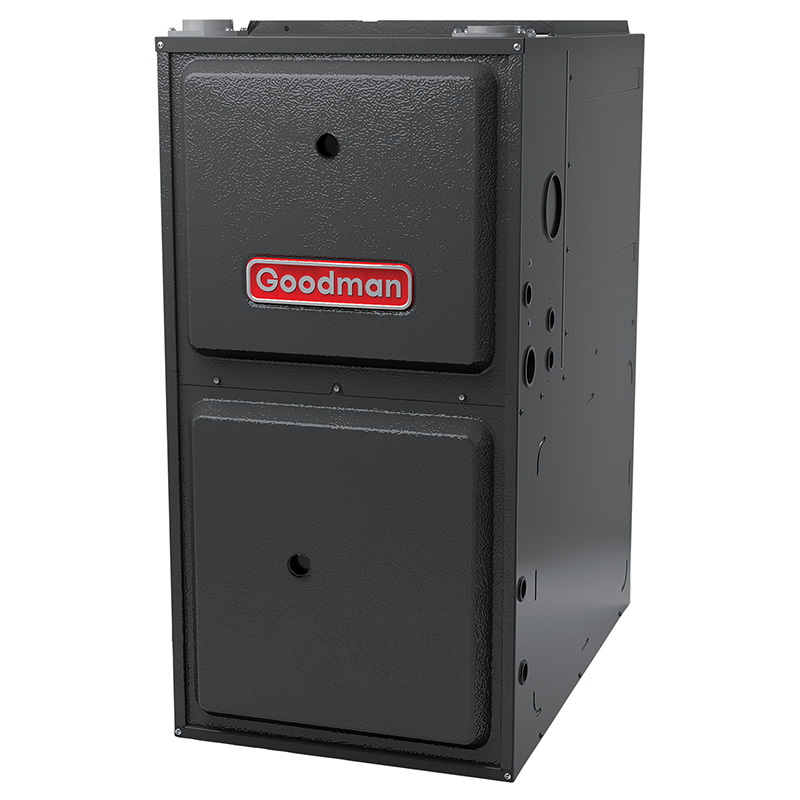
Goodman R32 100000 BTU 80% Two Stage 9-Speed ECM Gas Furnace Upflow / Horizontal (GR9T801004CN)
View on AC Direct see your lowest price →Check current price on AC Direct →
Key features
- 100,000 BTU output with two-stage gas valve for better capacity matching on mild days
- 80% AFUE mid-efficiency rating with conventional flue venting, no condensate drain required
- 9-speed ECM blower motor reduces electricity use and improves airflow consistency
- Upflow and horizontal configurations supported for flexible placement
- Two-stage operation reduces temperature cycling and extends system run times for more even heat distribution
- Factory-installed pressure switch and integrated control board with self-diagnostic fault codes
About this system
The Goodman GR9T801004CN is a 100,000 BTU, 80% AFUE two-stage gas furnace designed for upflow or horizontal installation. The two-stage gas valve fires at a lower capacity on mild days and ramps up to full output only when temperatures drop sharply, which reduces temperature swings and lowers fuel consumption compared to a single-stage unit running at full blast every cycle. The 9-speed ECM blower motor adjusts airflow in fine increments, improving comfort distribution and cutting electricity use relative to a standard PSC motor. R-32 refrigerant is noted in the model specs, though this is a gas furnace; if R-32 appears in the documentation it likely refers to coil compatibility with a matched split-system air handler rather than refrigerant contained in the furnace itself.
At 80% AFUE, this furnace falls in the mid-efficiency tier. Roughly 20 cents of every dollar spent on gas exits through the flue rather than heating your home, which is an honest trade-off: installation is simpler because you only need standard metal vent piping, not the PVC condensate system required by 95%+ condensing furnaces, and upfront cost is lower. For homeowners in mild-to-moderate climates, or those replacing an older 60-70% unit in a home that already has conventional venting, the 80% tier frequently makes more economic sense than paying the premium for a condensing model. Larger homes in cold climates where the furnace runs hard for five or six months a year will recover the cost of a 95%+ unit faster.
The upflow and horizontal configuration options make this furnace usable in a basement, utility closet, or crawlspace application where the air handler sits on its side. Proper sizing and a quality installation are not optional with Goodman equipment; contractor skill has a documented, outsized effect on long-term reliability with this brand. Budget for a licensed installer who will perform Manual J load calculations rather than swapping in a unit by rule of thumb.
The GR9T801004CN delivers a practical mid-efficiency heating solution at a price point that is noticeably below comparable Trane, Lennox, and Carrier two-stage furnaces. The two-stage valve and ECM motor are genuine comfort upgrades over entry-level equipment, and the 80% AFUE tier suits homes where condensing venting would be costly or impractical to retrofit. Long-term satisfaction hinges heavily on the quality of your installer, and owners should plan for potential capacitor and coil service costs in years seven and beyond.
Overall score is the average of the five ratings above.
What we like
- Two-stage gas valve reduces short cycling and fuel waste on mild winter days
- 9-speed ECM motor is measurably more efficient than single-speed PSC alternatives
- Priced 15 to 25 percent below comparable Trane, Lennox, and Carrier models
- Upflow and horizontal configurations cover a wide range of installation scenarios
- Conventional metal flue venting avoids the added cost and complexity of PVC condensate systems
Trade-offs
- 80% AFUE leaves 20% of fuel cost uncaptured; a 95%+ unit pays back the difference in colder climates over time
- Goodman's real-world reliability tracks below premium brands after year seven, with capacitor failures and evaporator coil leaks among the documented failure points
- Brand outcome is heavily dependent on installer quality; a poor setup is the most common root cause of early problems
- ConsumerAffairs scores average around 2.5 out of 5, driven largely by owners reporting rising repair costs after the initial warranty period
What homeowners and pros say about Goodman
Homeowners who have lived with Goodman furnaces for fewer than seven years tend to speak positively, particularly about the lower purchase price and the comfort improvement a two-stage unit delivers over the single-stage equipment it typically replaces. Google dealer reviews across Goodman installers average around 3.8 out of 5, and affordability is the most frequently mentioned reason buyers chose the brand. The ECM motor and two-stage valve on a unit like the GR9T801004CN receive specific praise from owners who notice quieter operation and more consistent temperatures compared to older equipment.
The picture changes in longer-term ownership. ConsumerAffairs scores for Goodman land around 2.5 out of 5, and that platform skews toward owners with problems, so the true average satisfaction is likely somewhere between the two figures. The recurring theme in negative reviews is repair costs escalating after roughly year seven. HVAC technicians consistently flag dual-run capacitor failures as the most common service call on Goodman equipment, a repair that runs 300 to 600 dollars but is generally straightforward. Evaporator coil leaks are a documented concern in a meaningful share of owner reports, and compressor longevity in paired Goodman systems typically averages 10 to 14 years rather than the 15 to 20 years more often seen with Trane, Carrier, or Lennox. Professionals who work on Goodman equipment frequently emphasize that installation quality has an outsized effect on how long the system holds up, more so than with premium brands that carry tighter factory tolerances.
Sources: ConsumerAffairs Goodman owner reviews, AHRI Directory of Certified Product Performance, U.S. DOE appliance and equipment efficiency standards, Goodman product specification sheets.
How it compares
| Brand | Comparable model | SEER2 | Stage | Price position |
|---|---|---|---|---|
| Goodman | GR9T801004CN | N/A (furnace only) | Two-stage | Value pick |
| Carrier | Performance 59TP6 (two-stage, 80% AFUE) | N/A (furnace only) | Two-stage | Typically 15 to 25 percent higher than Goodman |
| Trane | S8X2 (two-stage, 80% AFUE) | N/A (furnace only) | Two-stage | Typically 15 to 25 percent higher than Goodman |
| Lennox | ML196V (two-stage, 80% AFUE) | N/A (furnace only) | Two-stage | Typically 20 to 30 percent higher than Goodman |
Competitor rows are comparable single-stage units at similar efficiency; price is relative position, not a quote.
Questions about this system
Why does this furnace show R-32 in the model name if R-32 is a refrigerant and this is a gas furnace?
Goodman uses an internal nomenclature system where certain character sequences can indicate coil compatibility or product line designations rather than refrigerant contained in the furnace itself. A gas furnace does not contain refrigerant. If you are pairing this unit with a matched air conditioner or heat pump coil, confirm refrigerant compatibility with your installer before purchasing the full system.
Is 80% AFUE going to cost me significantly more in gas bills than a 96% model?
On a 100,000 BTU furnace, the difference between 80% and 96% AFUE means roughly 16,000 more BTUs of gas are wasted per hour of full-output operation with the 80% unit. In a mild climate where the furnace runs at partial capacity most of the season, the annual dollar gap narrows considerably. In a cold northern climate with a long heating season, the payback period on a higher-efficiency unit is typically five to ten years depending on local gas rates.
What does the two-stage gas valve actually do day to day?
On most winter days the furnace fires at the lower stage, which is quieter, runs longer cycles, and distributes heat more evenly through the home. It only escalates to full 100,000 BTU output when outdoor temperatures drop sharply and the low stage cannot keep up. The result is fewer dramatic on-off swings in room temperature compared to a single-stage furnace.
What are the most likely repair costs I should budget for over the life of this furnace?
Dual-run capacitors are the most commonly reported failure on Goodman equipment and typically cost 300 to 600 dollars to repair, including a service call. Evaporator coil leaks appear in a meaningful share of owner reports and can run higher depending on coil replacement cost in your market. Goodman compressors in paired systems tend to average 10 to 14 years of service, shorter than the 15 to 20 years more commonly seen with premium brands.
Does the upflow configuration mean I can only install this furnace standing upright in a basement or closet?
No. The GR9T801004CN supports both upflow and horizontal orientations, so it can be installed standing upright with supply air leaving through the top, or laid on its side in a crawlspace or attic application where horizontal airflow is needed. Your installer will need to adjust the flue and drain connections appropriately for horizontal use, so confirm the exact orientation with them before the equipment arrives.
Specifications
| Furnace output | 100000 BTU |
| Configuration | Upflow |
| Refrigerant | R-32 |
| Model | GR9T801004CN |