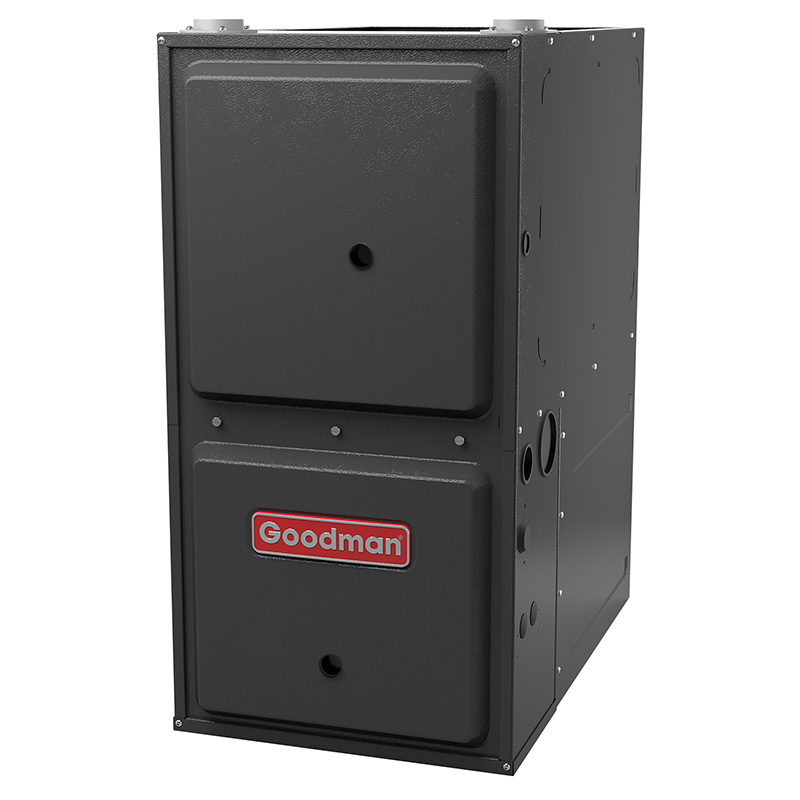
Goodman R32 60000 BTU 80% Two Stage 9-Speed ECM Gas Furnace Low Nox Downflow (GD9T800603AX)
View on AC Direct see your lowest price →Check current price on AC Direct →
Key features
- 60,000 BTU output in a downflow cabinet, suited for floor-discharge duct systems
- 80% AFUE two-stage burner for mid-efficiency heating with reduced cycling
- Nine-speed ECM blower motor reduces electricity use and smooths airflow
- Low NOx burner design meets stricter regional air quality requirements
- Factory-compatible with Goodman matched cooling coils and R-32 refrigerant systems
- Two-stage operation provides quieter, more even heat distribution on moderate-load days
About this system
The Goodman GD9T800603AX is a 60,000 BTU, 80% AFUE two-stage gas furnace built in a downflow configuration, meaning warm air is discharged downward through the floor rather than upward through the top. That orientation makes it the right choice for homes where the furnace sits in a closet or utility space above a crawlspace or basement, with ductwork running beneath the floor. The two-stage burner operates at a reduced first stage most of the time, cycling up to full capacity only when outdoor temperatures drop or the thermostat calls for a faster recovery, which smooths out temperature swings and reduces the abrupt on-off cycling of single-stage equipment.
The nine-speed ECM blower motor is a meaningful efficiency upgrade over standard PSC motors. ECM motors adjust airflow to match the load rather than running flat out every time, which cuts blower electricity consumption and improves comfort during long, low-demand heating cycles. At 80% AFUE, this furnace converts 80 cents of every dollar of gas into usable heat, a respectable mid-efficiency tier that avoids the extra cost and venting complexity of 90-plus condensing furnaces while still outperforming older 60 to 70 percent units. The Low NOx designation satisfies stricter air quality regulations in states like California, expanding where it can legally be installed. R-32 refrigerant is listed in the specs but applies to any matched cooling coil or system, not to the furnace itself, which operates on natural gas or propane.
The GD9T800603AX delivers solid mid-efficiency heating at a price well below Carrier, Trane, and Lennox equivalents, and the ECM blower and two-stage burner are genuinely useful features at this price point. Long-term ownership costs depend heavily on install quality and the luck of the draw on components, and owners should budget for likely capacitor and possibly coil service after year seven. It is a reasonable buy for budget-conscious homeowners who want two-stage comfort without premium-brand pricing, provided a qualified installer does the work.
Overall score is the average of the five ratings above.
What we like
- Priced roughly 15 to 25 percent below comparable Trane, Lennox, and Carrier two-stage furnaces
- Two-stage burner reduces temperature swings and improves comfort on mild days
- Nine-speed ECM motor cuts blower electricity consumption compared to standard PSC motors
- Low NOx certification allows installation in California and other restricted-emission markets
- Downflow configuration is the correct fit for closet or platform installations with underfloor ductwork
Trade-offs
- Dual-run capacitors are the most frequently reported failure point, typically surfacing after year seven
- ConsumerAffairs reviews average about 2.5 out of 5, with repair costs after year seven as the recurring complaint
- Compressor lifespan on matched cooling equipment averages 10 to 14 years versus 15 to 20 years for premium brands
- Downflow-only configuration limits installation flexibility compared to multi-position models
What homeowners and pros say about Goodman
Homeowners who follow Goodman on review platforms tend to split along a familiar line. On Google dealer reviews, where the brand averages around 3.8 out of 5 across hundreds of dealer-level reviews, the most consistent praise is straightforward: the price was lower than other quotes and the heat works. On ConsumerAffairs, where the brand scores closer to 2.5 out of 5, the story shifts after year seven or eight, when repair bills start appearing in the comments. The documented failure modes match what technicians describe in the field: dual-run capacitors are the most commonly reported breakdown, usually a 300 to 600 dollar fix that is more annoying than catastrophic. Evaporator coil leaks show up in a meaningful share of owner accounts, and compressors on matched cooling equipment tend to reach the end of their useful life at 10 to 14 years, a shorter window than the 15 to 20 years more commonly seen with Trane, Lennox, or Carrier equipment.
HVAC professionals tend to describe Goodman as workable equipment that rewards a careful installation and punishes a careless one. The two-stage burner and nine-speed ECM motor on this furnace are not corner-cut features; they are the same functional technology found on more expensive brands, just in a cabinet that will not carry the same resale cachet or command the same confidence in a long-term reliability conversation. For a downflow application in particular, where installation geometry adds complexity, the quality of the installing contractor matters at least as much as the brand name on the unit. Buyers who treat install quality as a non-negotiable and keep a modest service budget in mind tend to report reasonable satisfaction with Goodman equipment through its first decade.
Sources: ConsumerAffairs Goodman owner reviews, AHRI Directory of Certified Product Performance, U.S. DOE appliance and equipment efficiency standards, Goodman product specification sheets.
How it compares
| Brand | Comparable model | SEER2 | Stage | Price position |
|---|---|---|---|---|
| Goodman | GD9T800603AX | N/A (furnace only) | Two-stage | Value pick |
| Carrier | Performance 80 (58TP0) | N/A (furnace only) | Two-stage | Roughly 20 to 25 percent more than this Goodman |
| Trane | S8X2 (XR80 series) | N/A (furnace only) | Two-stage | Roughly 20 to 30 percent more than this Goodman |
| Lennox | Merit ML180 | N/A (furnace only) | Single-stage | Comparable to slightly above this Goodman depending on dealer |
Competitor rows are comparable single-stage units at similar efficiency; price is relative position, not a quote.
Questions about this system
Can this furnace be converted from natural gas to propane?
Most Goodman furnaces including this series can be converted to propane using an approved LP conversion kit, but the kit must be installed by a licensed technician and the conversion must be documented. Running natural gas equipment on propane without the correct orifice and pressure settings is a safety and warranty issue, so confirm the kit is available for this specific model before purchasing.
Why does the spec sheet mention R-32 refrigerant on a gas furnace?
The R-32 notation refers to the matched cooling coil or air conditioning system that would be installed alongside this furnace in a split system, not to the furnace itself. The furnace operates on natural gas or propane and has no refrigerant circuit of its own.
What does downflow mean and how do I know if my home needs it?
Downflow means the furnace draws return air in through the top and discharges heated air downward through the bottom, feeding ductwork that runs under the floor. If your existing furnace sits in a closet or on a raised platform with supply ducts beneath it, downflow is likely the correct orientation. Installing a downflow unit in an upflow application is not possible without significant ductwork modification.
What should I expect from Goodman warranty coverage on this model?
Goodman typically offers a 10-year parts limited warranty when the unit is registered within a specified window after installation, dropping to a shorter coverage period if registration is missed. Labor is not covered under the manufacturer warranty, so service calls after the first year come out of pocket unless a separate labor warranty is purchased from the installer.
How important is the installer, and what should I ask before hiring someone?
Technicians consistently identify install quality as the single largest factor in how long a Goodman unit lasts and how reliably it runs. Ask the installer to verify proper gas pressure, static pressure testing on the duct system, and correct thermostat wiring for two-stage operation. Skipping any of those steps is a common root cause of early service calls on otherwise adequate equipment.
Specifications
| Furnace output | 60000 BTU |
| Configuration | Downflow |
| Refrigerant | R-32 |
| Model | GD9T800603AX |