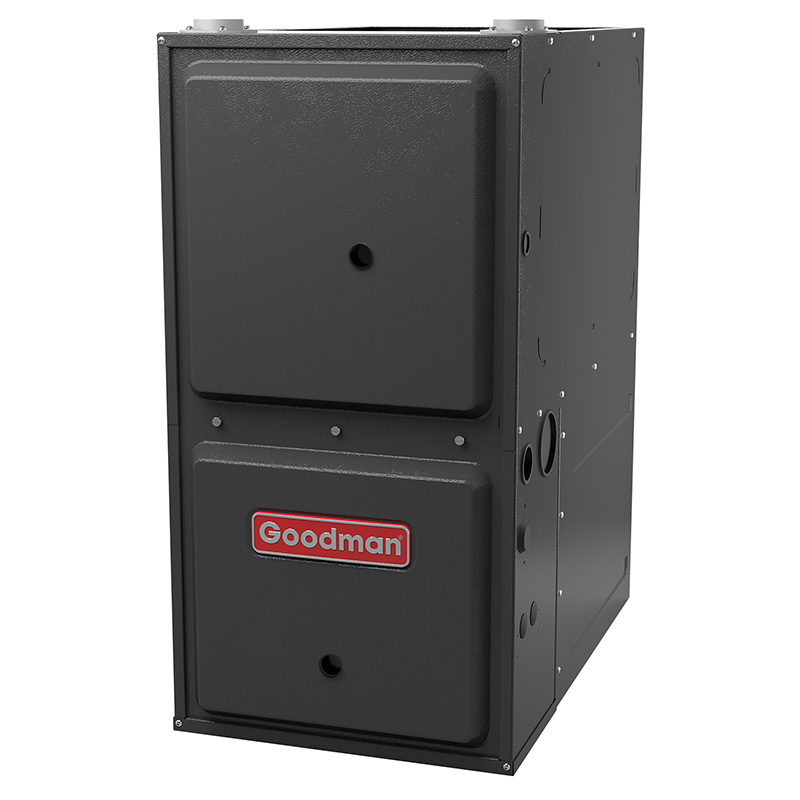
Goodman R32 60000 BTU 80% Two Stage 9-Speed ECM Gas Furnace Low Nox Downflow (GD9T800603BX)
View on AC Direct see your lowest price →Check current price on AC Direct →
Key features
- 60,000 BTU two-stage burner reduces short-cycling and evening temperature swings
- 80% AFUE rating meets federal minimums for non-condensing furnaces in most U.S. regions
- Nine-speed ECM blower motor cuts electrical draw versus standard PSC motors
- Downflow-only cabinet design for systems where supply air exits through the bottom
- Low NOx combustion meets stricter air-quality regulations in California and similar jurisdictions
- R-32 compatible refrigerant circuit; verify coil and outdoor unit compatibility before pairing
About this system
The Goodman GD9T800603BX is a 60,000 BTU, 80% AFUE two-stage gas furnace built in a downflow configuration, meaning the air discharge exits from the bottom of the cabinet rather than the top. That orientation is essential for homes with basement-to-first-floor ductwork or crawlspace-fed systems, and it is not interchangeable with upflow or horizontal units without major ductwork modification. The two-stage burner operates at a lower fire rate for most heating hours and ramps to full capacity only on the coldest days, which smooths temperature swings and reduces the short-cycling that wears components faster in single-stage furnaces.
The nine-speed ECM blower motor is the standout efficiency feature here. ECM (electronically commutated motor) technology consumes significantly less electricity than a standard PSC motor across its operating range, which matters on a furnace that runs its blower for both heating and air conditioning circulation. The R-32 refrigerant designation on this furnace is an unusual spec note for a gas heating unit; R-32 is typically associated with refrigerant circuits in heat pumps or air handlers, so buyers pairing this furnace with a cooling coil or heat pump should verify refrigerant compatibility with their chosen outdoor unit before purchasing. The Low NOx rating satisfies tighter California and regional air-quality requirements, making it eligible for installation in districts that restrict higher-emission furnaces.
At 60,000 BTU this unit is sized for smaller to mid-size homes, roughly 1,200 to 2,000 square feet depending on climate zone and insulation levels, though a proper Manual J load calculation by an installer should always drive sizing decisions. It sits in Goodman’s value tier, carrying a lower sticker price than comparable Trane, Lennox, or Carrier two-stage ECM furnaces while delivering the same fundamental feature set.
The GD9T800603BX delivers a legitimate two-stage, ECM-equipped furnace at a price point 15 to 25 percent below comparable premium-brand units, which is a real advantage for budget-conscious buyers. The 80% AFUE rating is functional but not high-efficiency, so annual fuel costs will run higher than a 96% condensing alternative. Long-term ownership experience with Goodman tracks closely with install quality, and buyers should weight contractor selection heavily.
Overall score is the average of the five ratings above.
What we like
- Two-stage operation improves comfort and reduces wear compared to single-stage furnaces at the same price tier
- Nine-speed ECM blower cuts ongoing electricity costs during both heating and cooling seasons
- Priced 15 to 25 percent below Trane, Lennox, and Carrier equivalents for the same feature set
- Low NOx rating opens installation options in strict air-quality jurisdictions including California
- Downflow configuration directly addresses homes where upflow units simply will not fit
Trade-offs
- 80% AFUE means roughly 20 cents of every fuel dollar exits as exhaust, a real cost gap versus 95-96% condensing models over a furnace's lifespan
- Goodman's documented weak points include dual-run capacitor failures and evaporator coil leaks, which can surface after year 7 according to ConsumerAffairs complaint patterns
- Compressor longevity on Goodman systems averages 10 to 14 years versus 15 to 20 years for premium brands, relevant if this furnace is paired with a Goodman cooling system
- Downflow-only installation limits flexibility; any future layout change requires ductwork re-routing
What homeowners and pros say about Goodman
Homeowners who have purchased Goodman equipment tend to split along a predictable line. Those who had it installed by experienced contractors and kept up with filter changes and annual tune-ups report solid, unremarkable service, which is exactly what a furnace should deliver. That satisfaction shows up in Google dealer review scores that average around 3.8 out of 5 across hundreds of reviews per dealership location, where the word that appears most often is affordable. The buyers who run into trouble more often point to issues that emerge after the warranty period closes, a pattern reflected in ConsumerAffairs scores that sit around 2.5 out of 5 on a channel where people mostly show up to complain. The recurring theme there is repair bills climbing after roughly the seventh year of ownership.
HVAC technicians who work on Goodman equipment frequently echo both sides of that picture. On the positive side, they note that parts are widely available and that common failures like dual-run capacitor replacements are relatively inexpensive, typically in the 300 to 600 dollar range for parts and labor. On the cautionary side, they point to evaporator coil leaks as a repair that shows up more often in long-term Goodman ownership than in premium-brand equipment, and they note that compressor lifespan on Goodman systems tends to average 10 to 14 years rather than the 15 to 20 years more typical of Trane, Lennox, or Carrier units. For a furnace specifically, those compressor numbers apply to any paired cooling equipment rather than the gas heat components, but they inform the overall picture of what ownership with this brand looks like over a full system lifespan.
Sources: ConsumerAffairs Goodman owner reviews, AHRI Directory of Certified Product Performance, U.S. DOE appliance and equipment efficiency standards, Goodman product specification sheets.
How it compares
| Brand | Comparable model | SEER2 | Stage | Price position |
|---|---|---|---|---|
| Goodman | GD9T800603BX | N/A (furnace only) | Two-stage | Value pick |
| Carrier | Performance 80 (58TP0) | N/A (furnace only) | Two-stage | 15 to 25 percent higher than Goodman |
| Trane | S8X2 (80% Two-Stage) | N/A (furnace only) | Two-stage | 15 to 25 percent higher than Goodman |
| Lennox | Merit ML180 (80% Two-Stage) | N/A (furnace only) | Two-stage | 15 to 20 percent higher than Goodman |
Competitor rows are comparable single-stage units at similar efficiency; price is relative position, not a quote.
Questions about this system
Why does a gas furnace list R-32 as a refrigerant spec, and does it affect what cooling coil I can pair with it?
R-32 appears on this model's spec sheet in relation to its refrigerant-circuit compatibility, which matters when you select a matching evaporator coil and outdoor cooling unit. Before purchasing a coil or air conditioner to pair with this furnace, confirm with your contractor that all components in the system are rated for R-32 to avoid compatibility or warranty issues.
Is 80% AFUE still worth buying, or should I step up to a 96% condensing furnace?
An 80% furnace costs less upfront and does not require a condensate drain or PVC flue, which simplifies installation in some homes. However, the 16-percentage-point efficiency gap translates to a measurable fuel cost difference over years of operation, and in colder climates a condensing furnace typically pays back the price premium within several heating seasons.
How reliable is this furnace, and what parts are most likely to need repair over time?
Goodman earns roughly 3.8 out of 5 stars across Google dealer reviews, with affordability as the most common praise. ConsumerAffairs scores sit around 2.5 out of 5, a complaint-heavy channel where repair costs rising after approximately year 7 are a recurring theme. Dual-run capacitor failures are the most documented issue and are a relatively low-cost fix, while evaporator coil leaks represent a more expensive repair that shows up in a meaningful share of long-term owner accounts.
Can I install this furnace myself to save money?
Gas furnace installation requires licensed HVAC and gas work in virtually every jurisdiction, and Goodman's warranty typically requires professional installation to remain valid. Beyond legality, Goodman's own performance data and technician feedback consistently show that install quality is the single largest factor in how long the equipment lasts, making a qualified contractor essential rather than optional.
What size home is a 60,000 BTU furnace right for?
As a rough guide, 60,000 BTU is commonly appropriate for homes in the 1,200 to 2,000 square foot range in moderate to cold climates, but actual sizing depends on insulation levels, window area, ceiling height, infiltration rate, and local design temperatures. A Manual J heat load calculation performed by your installer is the only reliable way to confirm this unit is correctly sized for your specific home.
Specifications
| Furnace output | 60000 BTU |
| Configuration | Downflow |
| Refrigerant | R-32 |
| Model | GD9T800603BX |