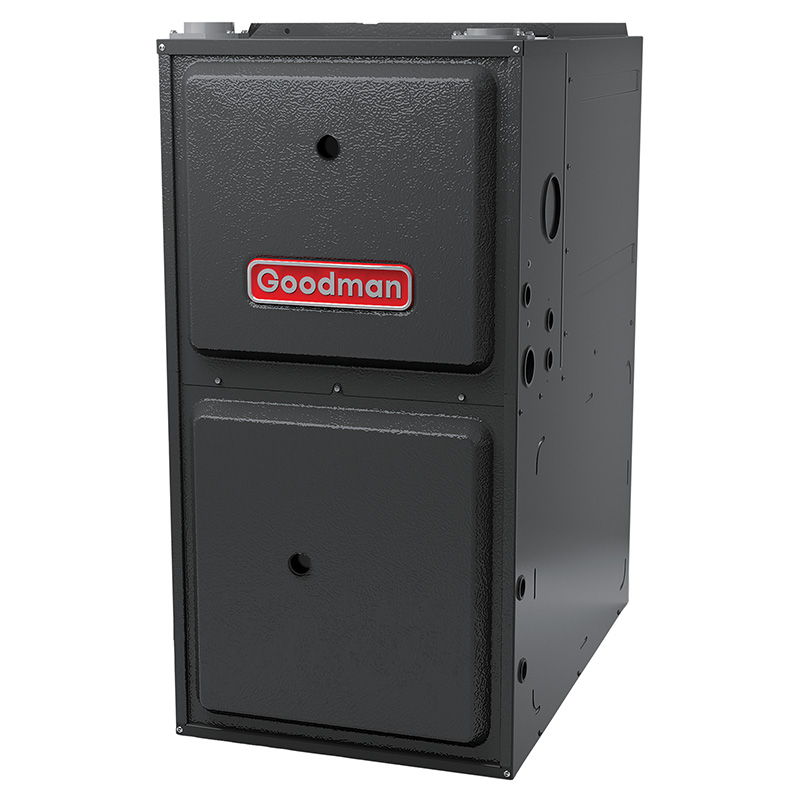
Goodman R32 100000 BTU 96% Multi-Speed ECM Gas Furnace Upflow / Horizontal (GR9S961005CN)
View on AC Direct see your lowest price →Check current price on AC Direct →
Key features
- 96% AFUE high-efficiency rating reduces fuel waste and supports utility rebate eligibility
- 100,000 BTU output suited for larger homes in cold-to-moderate climates
- Multi-speed ECM blower motor improves comfort and lowers blower electricity costs vs. PSC motors
- Upflow/horizontal configuration for flexible basement, closet, or attic placement
- Two-stage gas valve moderates heat output between low and high fire for steadier temperatures
- Stainless steel secondary heat exchanger designed for condensing operation at high efficiency
About this system
The Goodman GR9S961005CN is a 100,000 BTU, 96% AFUE upflow/horizontal gas furnace designed for larger homes, typically those in the 2,500 to 3,500 square foot range depending on climate zone and insulation. The 96% AFUE rating means 96 cents of every dollar spent on natural gas is converted to usable heat, placing this unit firmly in the high-efficiency tier and making it eligible for many utility rebates. The multi-speed ECM (electronically commutated motor) blower adjusts airflow in increments, which improves comfort distribution, reduces temperature swings, and cuts electricity consumption compared to a single-speed PSC motor.
The upflow/horizontal configuration makes this furnace well suited for installation in a basement, utility closet, or attic space where the air handler sits upright or on its side feeding a horizontal duct run. The R-32 designation in the model name is a Goodman internal classification and does not indicate this furnace uses refrigerant; gas furnaces do not use refrigerant. The GR9S961005CN is a straightforward forced-air heating solution for homeowners who want above-average efficiency at a price point well below premium brands, and who are working with an experienced installer capable of proper sizing, venting, and commissioning.
The GR9S961005CN delivers genuine high-efficiency performance at a price 15 to 25 percent below comparable Trane, Lennox, and Carrier units, making it a credible choice for budget-conscious buyers who secure a skilled installer. Its long-term reliability is serviceable rather than exceptional, with repair costs that tend to climb after year seven and component failure rates that trail premium competitors. Buyers who prioritize upfront savings over lowest lifetime cost will find the most value here.
Overall score is the average of the five ratings above.
What we like
- 96% AFUE puts it in the top efficiency tier, reducing monthly gas bills in cold climates
- Multi-speed ECM blower cuts fan electricity use and improves room-to-room comfort consistency
- Priced noticeably below Trane, Lennox, and Carrier units at similar efficiency, freeing budget for quality installation
- Upflow/horizontal flexibility suits a wide range of home configurations and duct layouts
- Two-stage heating reduces short-cycling and maintains steadier indoor temperatures on mild days
Trade-offs
- Reliability trails premium brands, with repair costs commonly rising after roughly year seven per owner reports
- Dual-run capacitors are the most frequently reported failure point, typically adding a repair call in the 300 to 600 dollar range
- Compressor and heat exchanger longevity averages shorter than Trane or Lennox equivalents over a 15-plus year horizon
- Overall performance depends heavily on installer quality, and a poor setup can negate the efficiency gains on paper
What homeowners and pros say about Goodman
Homeowners who choose Goodman equipment most often cite the lower purchase price as the deciding factor, and that pattern holds for units like the GR9S961005CN. On Google dealer reviews, Goodman-installed systems average around 3.8 out of 5, where satisfied owners typically note that the system heats reliably and that the savings at purchase gave them room to invest in a thorough installation. On ConsumerAffairs, the score drops to roughly 2.5 out of 5, a platform that skews toward people reporting problems, and the recurring story there is repair bills that begin compounding around year seven or eight after installation.
HVAC technicians who service Goodman equipment regularly point to two recurring issues: the dual-run capacitor, which is the most commonly replaced component and usually a straightforward 300 to 600 dollar fix, and evaporator coil leaks, which show up in a meaningful share of owner accounts and are a more involved repair. Technicians also note that Goodman compressors and heat exchangers tend to average 10 to 14 years of service life, compared to the 15 to 20 years more commonly seen on premium-brand equipment. The consistent message from the field is that installation quality matters enormously with Goodman units: a properly sized, correctly commissioned GR9S961005CN with annual maintenance performs acceptably for its price point, while a rushed or undersized install tends to produce the complaints that show up in review channels.
Sources: ConsumerAffairs Goodman owner reviews, AHRI Directory of Certified Product Performance, U.S. DOE appliance and equipment efficiency standards, Goodman product specification sheets.
How it compares
| Brand | Comparable model | SEER2 | Stage | Price position |
|---|---|---|---|---|
| Goodman | GR9S961005CN | N/A (gas furnace) | Two-stage | Value pick |
| Carrier | Performance 96 (58TP6) | N/A (gas furnace) | Two-stage | Moderately higher than Goodman |
| Trane | S9X2 (XR95 series) | N/A (gas furnace) | Two-stage | Moderately to substantially higher than Goodman |
| Lennox | EL296V | N/A (gas furnace) | Two-stage | Substantially higher than Goodman |
Competitor rows are comparable single-stage units at similar efficiency; price is relative position, not a quote.
Questions about this system
What does the R-32 in the model name mean for a gas furnace?
In this context, R-32 is a Goodman internal product-line identifier and does not mean the furnace uses refrigerant. Gas furnaces heat air through combustion and a heat exchanger, not refrigerant cycles, so no refrigerant is present in this unit.
Is 100,000 BTU the right size for my home?
Sizing depends on your home's square footage, insulation, window area, and local climate, not a simple rule of thumb. A qualified installer should perform a Manual J load calculation before purchasing; an oversized furnace will short-cycle, waste fuel, and wear components faster.
How does the multi-speed ECM blower affect my electricity bill compared to a standard motor?
ECM motors use significantly less electricity than single-speed PSC motors, particularly during the long, lower-demand heating cycles when the motor runs at reduced speed. In regions with high electricity rates or long heating seasons, this difference can add up meaningfully over a year.
What is Goodman's warranty on this furnace, and what does it actually cover?
Goodman typically offers a limited lifetime heat exchanger warranty and a 10-year parts warranty when the unit is registered within a set window after installation. Labor is not covered, so out-of-pocket repair costs after the first year fall on the homeowner unless a service contract is in place.
What are the most common repairs I should budget for over the life of this furnace?
Based on documented owner experience with Goodman equipment, the dual-run capacitor is the most frequently replaced component, usually costing 300 to 600 dollars including labor. Igniter and pressure switch failures are also common service calls. Repair frequency tends to increase noticeably after year seven, so setting aside an annual maintenance budget is advisable.
Specifications
| Furnace output | 100000 BTU |
| Configuration | Upflow |
| Refrigerant | R-32 |
| Model | GR9S961005CN |