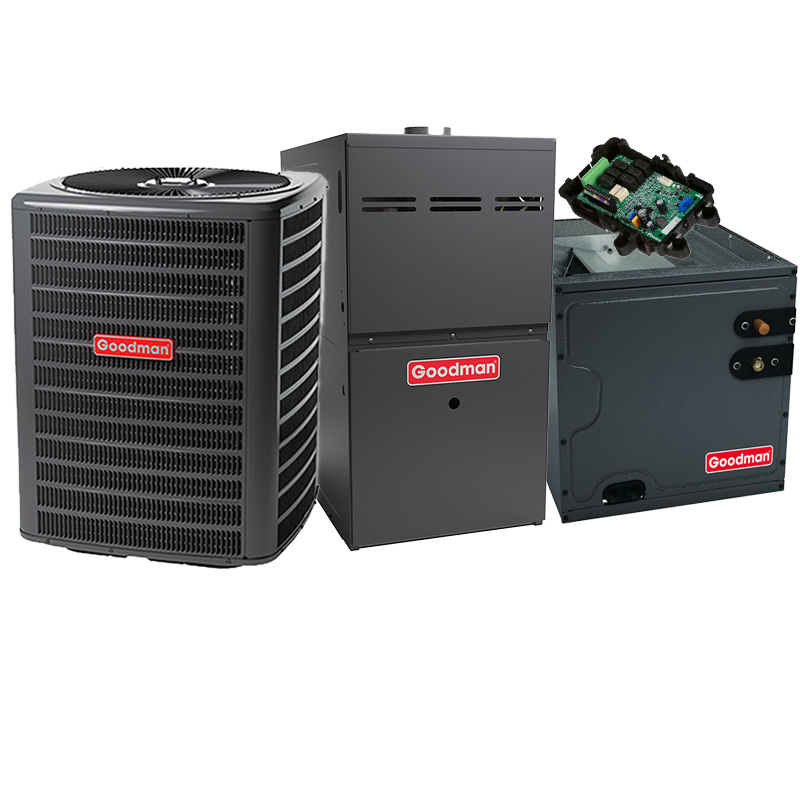
Goodman 2.5 Ton 13.4 SEER2 60000 BTU 96% AFUE Two-Stage Gas Furnace With R32 Air Condenser and Coil System – Upflow
View on AC Direct see your lowest price →Check current price on AC Direct →
Key features
- 96% AFUE two-stage gas furnace reduces fuel waste and temperature swings
- 13.4 SEER2 cooling efficiency meets current federal minimum standards
- R-32 refrigerant with lower global warming potential than R-410A
- 2.5-ton capacity suited to approximately 1,200 to 1,600 sq ft (load calc required)
- Upflow configuration for basement or closet installations with overhead duct runs
- Two-stage cooling operation improves humidity control and comfort on part-load days
About this system
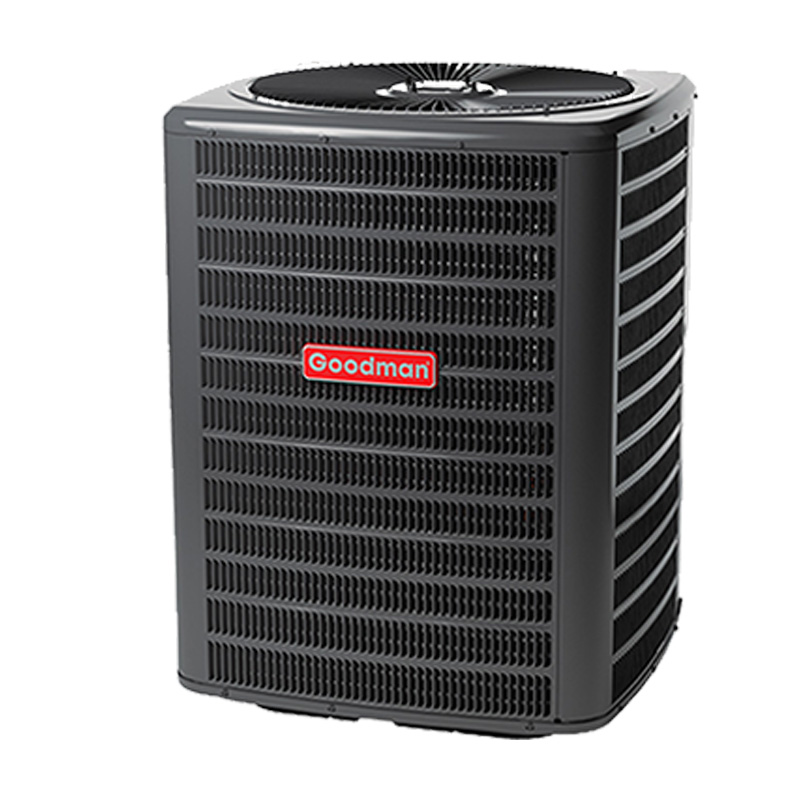
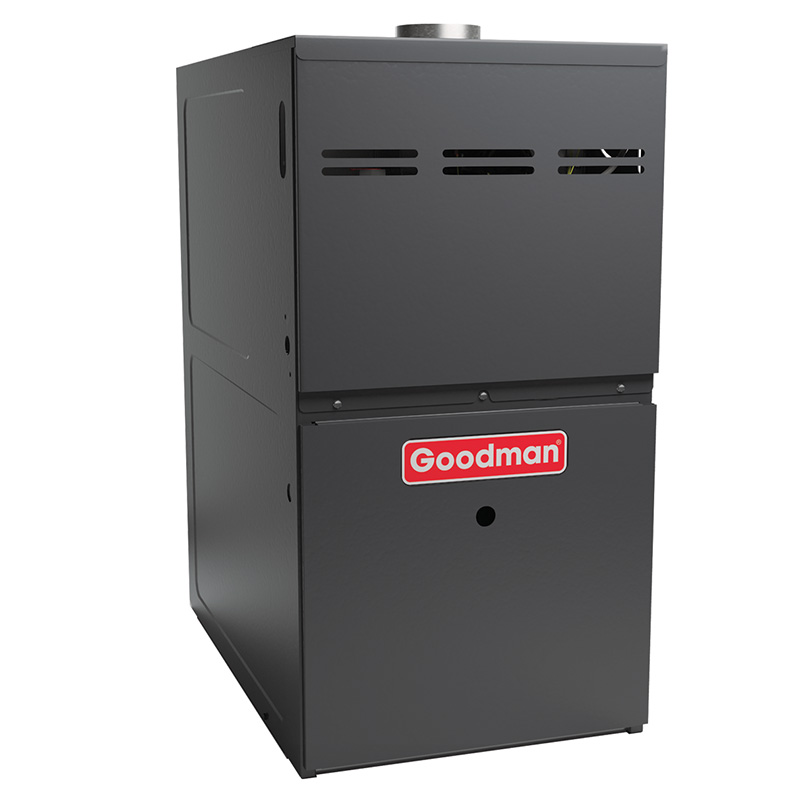
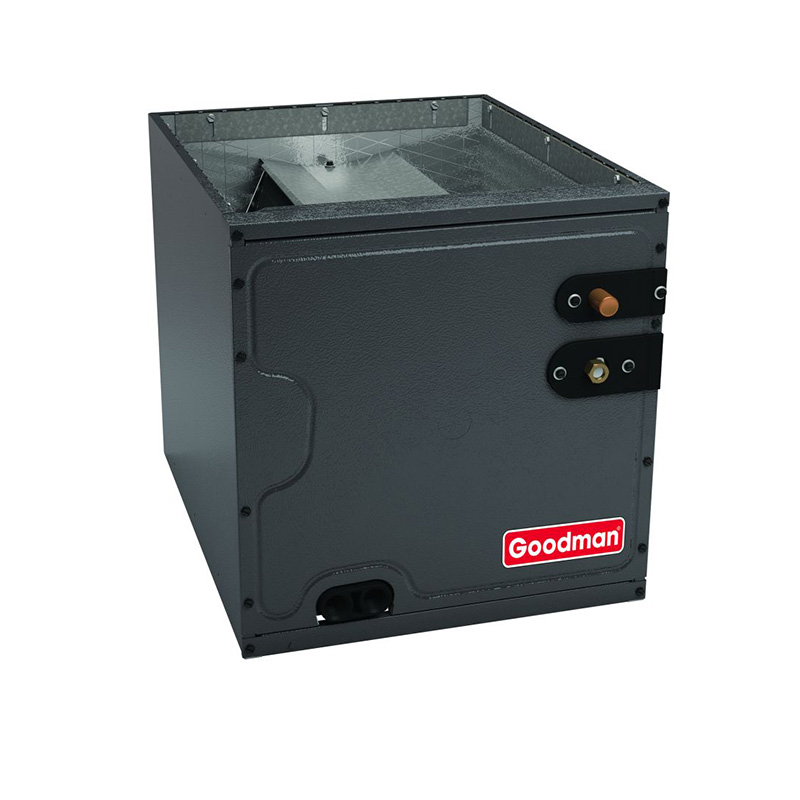
The Goodman 2.5-ton upflow system pairs a 13.4 SEER2 R-32 air condenser and coil with a 60,000 BTU, 96% AFUE two-stage gas furnace. That furnace efficiency rating sits near the top of the condensing-furnace category, meaning roughly 96 cents of every dollar spent on natural gas becomes usable heat. The two-stage operation lets the furnace run at a lower firing rate on mild days, which smooths out temperature swings and reduces short-cycling noise compared with a single-stage unit. The 2.5-ton cooling side is sized for homes in roughly the 1,200-to-1,600 square-foot range, though a proper Manual J load calculation should always confirm sizing before purchase.
R-32 refrigerant is a meaningful step forward from older R-410A systems. It has a lower global warming potential, requires a smaller refrigerant charge by weight, and is the direction the HVAC industry is actively moving. The upflow configuration means the air handler discharges from the top, which suits basements, utility closets, and mechanical rooms where supply ducts run overhead. If your ductwork exits from the side or bottom, a different orientation would be required. Taken together, this is a capable mid-efficiency cooling and high-efficiency heating package aimed squarely at homeowners who want real energy savings without paying a premium-brand price.
This Goodman system delivers genuinely high furnace efficiency and a solid feature set at a price point 15 to 25 percent below comparable Trane, Lennox, and Carrier equipment. The trade-off is a brand track record that shows real weak points around year 7 and beyond, and long-term performance that depends heavily on who installs it. For budget-conscious buyers who vet their installer carefully, it represents a reasonable value; for buyers prioritizing long-term peace of mind, the premium brands close that gap more than the sticker price suggests.
Overall score is the average of the five ratings above.
What we like
- 96% AFUE furnace is among the most efficient available and meaningfully cuts heating bills
- Two-stage furnace and condenser operation improves comfort and humidity control
- R-32 refrigerant is future-oriented with a lower environmental footprint
- Price is typically 15 to 25 percent below equivalent Carrier, Trane, and Lennox systems
- Parts are widely stocked nationally, so repair turnaround is generally fast
Trade-offs
- ConsumerAffairs reviews average around 2.5 out of 5, with recurring complaints about repair costs rising after year 7
- Compressor lifespan averages 10 to 14 years versus 15 to 20 years for premium-brand compressors
- Evaporator coil leaks appear in a meaningful share of owner reviews and can be costly to address
- A minority of owners report refrigerant leaks within the first year, typically tied to install quality or improper charge
What homeowners and pros say about Goodman
Homeowner feedback on Goodman equipment splits fairly predictably by where people are in the ownership timeline. On Google dealer reviews, which aggregate to roughly 3.8 out of 5 across locations, the most consistent praise is straightforward: the system cost less than competing quotes and it has done its job without drama through the early years. Installers and contractors who work with the brand regularly tend to echo that sentiment, noting that Goodman ships reliable enough hardware at a price that makes it accessible to a broader range of buyers. The most commonly documented repair, a failed dual-run capacitor, is acknowledged even by Goodman-friendly technicians as a known weak point but also characterized as a quick, relatively low-cost fix in the 300-to-600-dollar range when it does occur.
The picture shifts on ConsumerAffairs, which aggregates to roughly 2.5 out of 5 and skews toward people motivated to leave a complaint. The recurring pattern there is not catastrophic early failure but rather accelerating repair costs beginning around year 7, which aligns with the documented compressor lifespan of 10 to 14 years compared to 15 to 20 years reported for premium-brand compressors. Evaporator coil leaks also surface consistently in that channel, and a smaller but notable share of owners have reported refrigerant loss within the first year. Pros who specialize in service rather than installation are generally candid that Goodman systems hold up reasonably well when installed correctly and maintained on schedule, but that the margin for error on both fronts is thinner than with Carrier, Trane, or Lennox equipment at a similar efficiency tier.
Sources: ConsumerAffairs Goodman owner reviews, AHRI Directory of Certified Product Performance, U.S. DOE appliance and equipment efficiency standards, Goodman product specification sheets.
What it costs to run
At 13.4 SEER2, cooling this 2.5-ton system for a typical 1200-hour cooling season at the U.S. average electricity rate of $0.17/kWh works out to roughly $457 per year in cooling, about $0 less per year than a minimum-efficiency 13.4 SEER2 unit of the same size. Your real cost depends on your climate and local rate.
Method: (30,000 BTU/hr ÷ 13.4 SEER2) × 1200 hours ÷ 1000 × $0.17/kWh. Rate source: U.S. EIA average; cooling hours: moderate-climate estimate.
How it compares
| Brand | Comparable model | SEER2 | Stage | Price position |
|---|---|---|---|---|
| Goodman | 2.5T 13.4 SEER2 / 96% AFUE Two-Stage Upflow System (this unit) | 13.4 | Two-stage | Value pick |
| Carrier | Comfort 96 / 24ACC636 Series (2.5T, 96% AFUE, 14 SEER2) | 14 | Two-stage | Approximately 15 to 20 percent more than this Goodman system |
| Trane | S9X2 Furnace / 4TTR3 Condenser (2.5T, 96% AFUE, 14.3 SEER2) | 14.3 | Two-stage | Approximately 20 to 25 percent more than this Goodman system |
| Lennox | ML96 Furnace / 14ACX Condenser (2.5T, 96% AFUE, 14 SEER2) | 14 | Two-stage | Approximately 15 to 25 percent more than this Goodman system |
Competitor rows are comparable single-stage units at similar efficiency; price is relative position, not a quote.
Questions about this system
Is 2.5 tons the right size for my home?
Tonnage should always be confirmed with a Manual J load calculation that accounts for your home's square footage, insulation, window area, local climate, and ceiling height. A rough rule of thumb puts 2.5 tons in the 1,200-to-1,600 square-foot range, but that figure can shift significantly based on your specific conditions. An oversized or undersized system will underperform regardless of brand.
What does two-stage mean for the furnace, and does it actually matter?
Two-stage means the furnace has a high-fire and a low-fire setting. On mild days it runs at the lower stage, which keeps the system running longer at reduced output rather than blasting on and off repeatedly. This reduces temperature swings, cuts noise, and can modestly improve efficiency. For most climates, two-stage is a worthwhile upgrade over single-stage.
Why does this system use R-32 refrigerant, and does that affect service costs?
R-32 has a lower global warming potential than R-410A and requires a smaller refrigerant charge, which is why manufacturers are transitioning to it ahead of upcoming regulatory requirements. It does require technicians to use specific recovery equipment and follow updated safety protocols, so you will want to confirm your service contractor is already set up for R-32 work before purchasing.
What are the most common repair issues owners of this system should plan for?
The most frequently reported failure on Goodman equipment is the dual-run capacitor, which typically costs between 300 and 600 dollars to diagnose and replace and is considered a minor repair. Evaporator coil leaks are a more serious issue reported by a meaningful share of owners and can be considerably more expensive. A minority of owners have also reported refrigerant leaks within the first year, which usually points to an install or initial charge problem rather than a defective component.
How important is the installer, and what should I look for when choosing one?
Technicians consistently cite install quality as the single biggest factor in how long a Goodman system lasts, which matters more with this brand than with premium competitors that tolerate less-than-perfect installs more gracefully. Look for a contractor who will perform a Manual J sizing calculation, pressure-test the refrigerant lines before charging, and provide documentation of the startup checklist. Checking Google dealer reviews and verifying NATE certification are reasonable starting points.
Specifications
| Cooling capacity | 2.5 Ton |
| Efficiency | 13.4 SEER2 |
| Furnace output | 60000 BTU |
| Furnace efficiency | 96% AFUE |
| Configuration | Upflow |
| Refrigerant | R-32 |