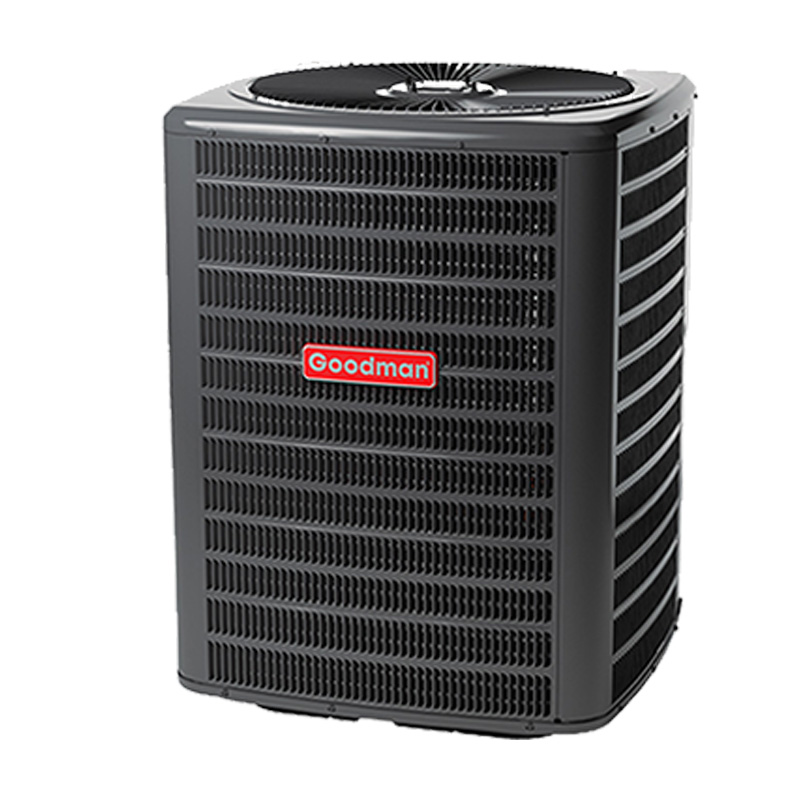
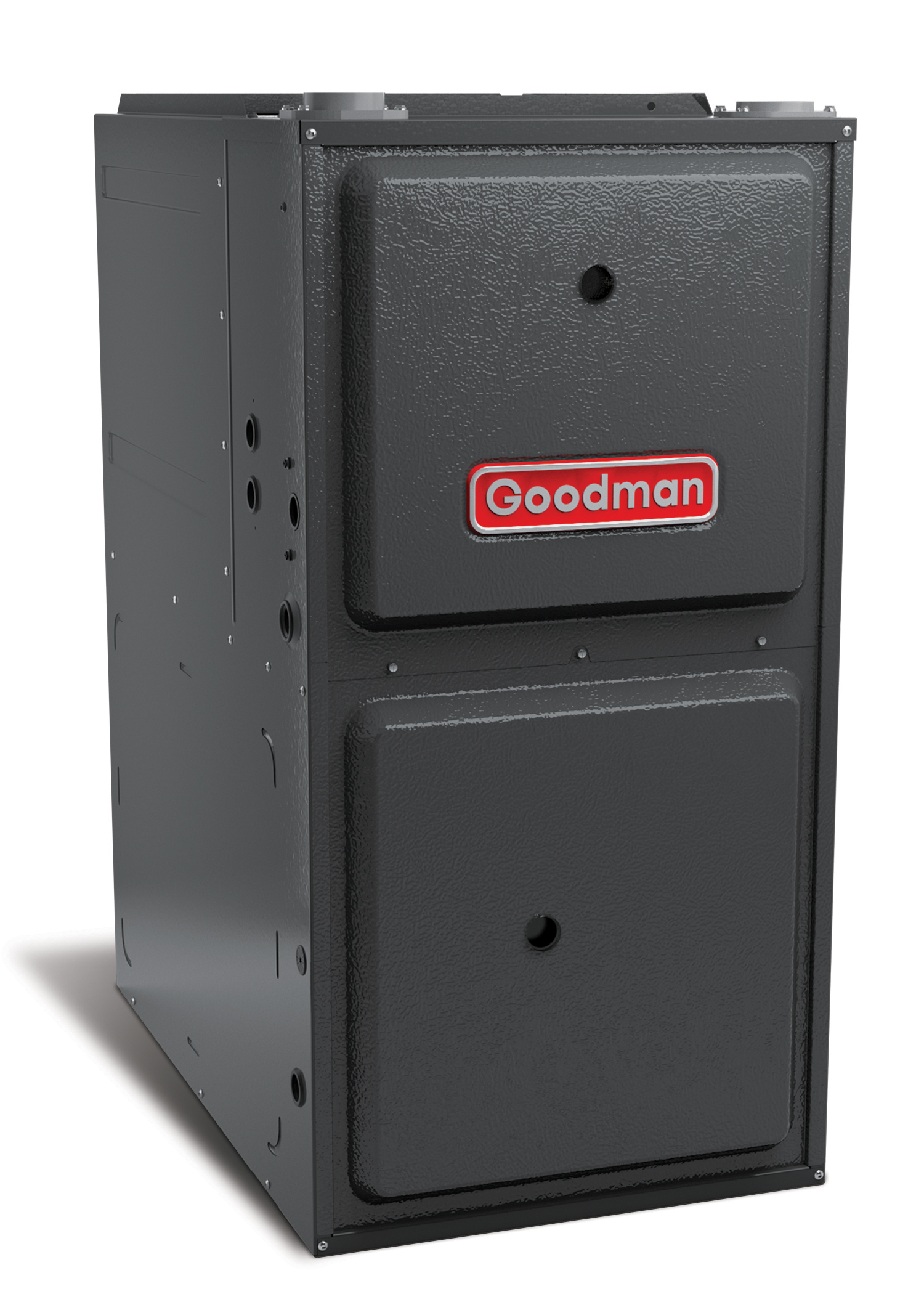
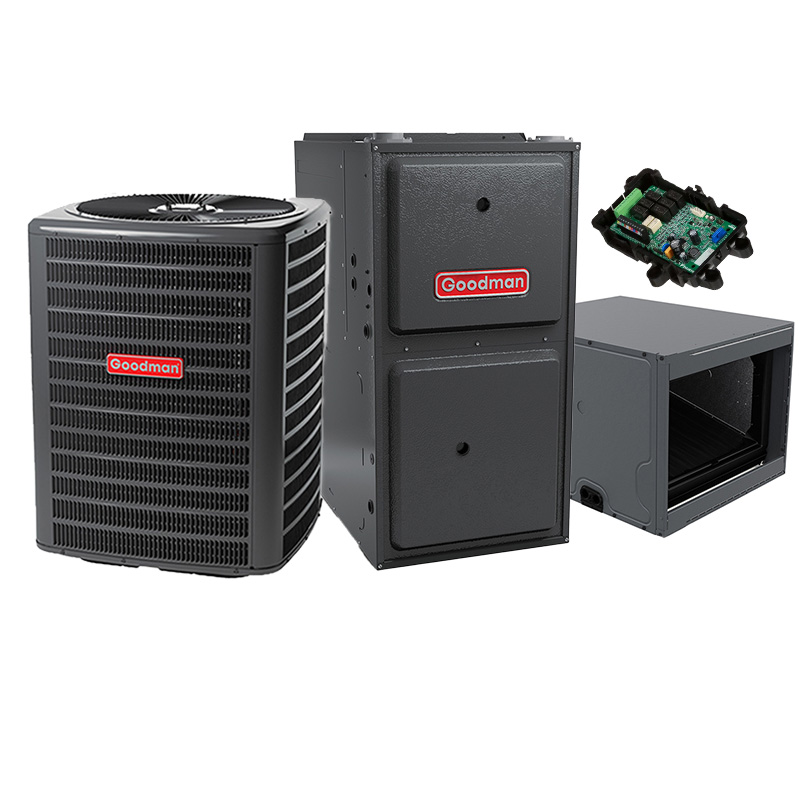
Goodman 2.5 Ton 13.8 SEER2 80000 BTU 96% AFUE Two-Stage Gas Furnace With R32 Air Condenser and Coil System – Horizontal
View on AC Direct see your lowest price →Check current price on AC Direct →
Key features
- 13.8 SEER2 rated cooling efficiency, meeting current federal minimums with modest headroom
- 96% AFUE two-stage gas furnace reduces low-fire cycling noise and wear
- R-32 refrigerant with lower global warming potential than R-410A
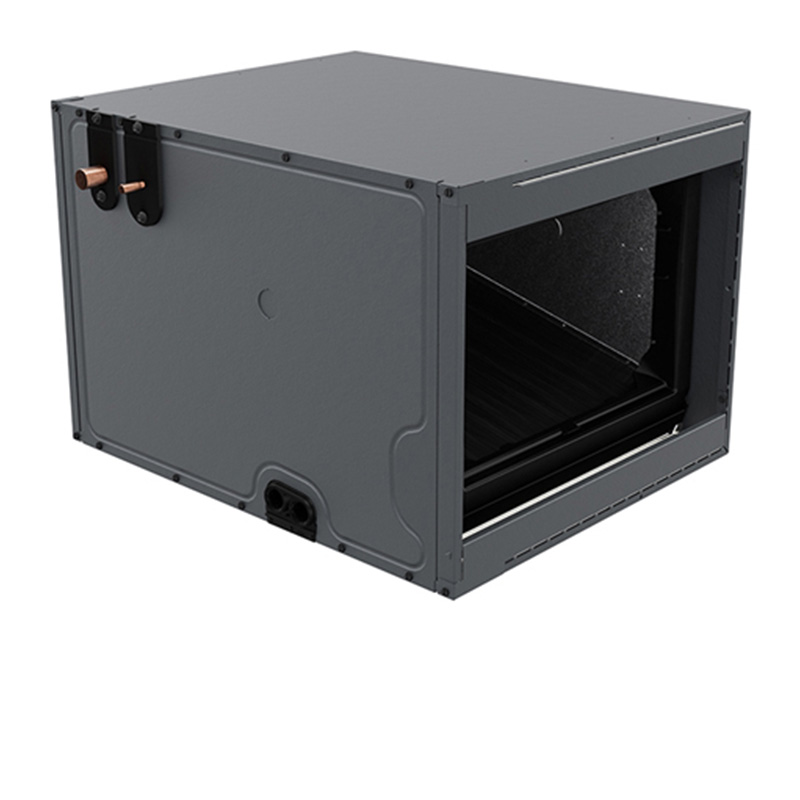
- Horizontal coil configuration for crawl space, attic, or side-discharge closet installs
- 80,000 BTU heating capacity suited to mid-size homes in moderate to cold climates
- Condensing furnace design requires PVC flue venting and a condensate drain line
About this system
This Goodman bundle pairs a 2.5-ton R-32 air condenser and matching coil with an 80,000 BTU, 96% AFUE two-stage gas furnace in a horizontal configuration, making it a practical fit for homes where the air handler lives in a crawl space, attic, or closet that requires side-discharge airflow. At 13.8 SEER2, the cooling side sits just above the current federal minimum for most U.S. climate zones, so it won’t set efficiency records, but it will keep cooling bills reasonable for a mid-size home in the 1,200 to 1,800 square foot range. The 96% AFUE furnace is a genuine highlight: two out of every hundred BTUs of gas are lost to exhaust, which is solidly in the high-efficiency category and qualifies as a condensing furnace requiring a PVC flue and condensate drain.
The two-stage furnace operation is worth noting. Running on low fire the majority of the time means quieter cycles, more even temperatures from room to room, and less on-off wear on the heat exchanger compared to a single-stage unit. R-32 refrigerant, which replaces the older R-410A in newer Goodman equipment, has a lower global warming potential and slightly better thermodynamic properties, though it does require technicians who are familiar with its mildly flammable classification. The horizontal-only coil restricts installation flexibility, so confirm your air handler position before ordering.
This system delivers a legitimate high-efficiency furnace and code-compliant cooling in one bundle at a price point that undercuts Carrier, Trane, and Lennox by a meaningful margin. The trade-off is a brand track record that shows more repair activity after year seven and a compressor lifespan that typically falls short of premium competitors. For budget-conscious buyers willing to budget for routine maintenance, it represents solid value; for buyers expecting set-and-forget longevity, the calculus gets tighter.
Overall score is the average of the five ratings above.
What we like
- 96% AFUE furnace is genuinely high-efficiency and reduces monthly gas costs compared to 80% units
- Two-stage heating improves comfort and extends equipment cycles compared to single-stage furnaces
- R-32 refrigerant is more environmentally favorable and increasingly standard across the industry
- Bundled coil and condenser reduce compatibility guesswork and simplify the ordering process
- Purchase price runs roughly 15 to 25 percent below comparable Trane, Lennox, and Carrier systems
Trade-offs
- Horizontal-only coil limits installation flexibility; vertical or multi-position setups require a different coil
- Compressor lifespan averages 10 to 14 years versus 15 to 20 years reported for premium-brand compressors
- Evaporator coil leaks appear in a notable share of long-term owner reports, a known Goodman pattern
- 13.8 SEER2 is only modestly above minimum code; buyers in hot climates will see limited savings versus a 16+ SEER2 system
What homeowners and pros say about Goodman
Owners and installers tend to land in two camps when talking about Goodman equipment. On Google dealer review pages, where the brand averages around 3.8 out of 5 across hundreds of location-level reviews, affordability is the word that shows up most consistently. Buyers who got a professional install and kept up with annual maintenance report years of uneventful operation. On ConsumerAffairs, where Goodman sits at roughly 2.5 out of 5, the tone shifts. That channel skews toward frustrated owners, and the recurring pattern there is repair costs accumulating after the seven-year mark, which lines up with the documented failure modes: dual-run capacitor failures are the most commonly cited repair, typically running 300 to 600 dollars and generally a straightforward fix. More serious are the evaporator coil leaks that appear in a notable share of longer-term ownership reports, and the compressor lifespan that technicians peg at roughly 10 to 14 years, shorter than the 15 to 20 years more commonly cited for Trane, Carrier, and Lennox compressors.
HVAC professionals who work on Goodman equipment regularly point out that the brand’s performance is unusually sensitive to installation quality. A proper refrigerant charge, correctly sized line set, and clean condensate drainage matter for any system, but technicians note that Goodman units seem to show the effects of a rushed or shortcuts-heavy install more visibly and more quickly than premium brands. For this specific horizontal configuration, that observation is worth taking seriously: horizontal coil installs have fewer experienced hands working on them than standard vertical setups, so interviewing your installer about their familiarity with horizontal configurations is a reasonable step before signing a contract. First-year refrigerant leaks, another documented Goodman pattern in owner reports, are typically traced back to charge or connection issues at install rather than factory defects, which reinforces the point that the installer you choose matters at least as much as the brand name on the cabinet.
Sources: ConsumerAffairs Goodman owner reviews, AHRI Directory of Certified Product Performance, U.S. DOE appliance and equipment efficiency standards, Goodman product specification sheets.
What it costs to run
At 13.8 SEER2, cooling this 2.5-ton system for a typical 1200-hour cooling season at the U.S. average electricity rate of $0.17/kWh works out to roughly $443 per year in cooling, about $14 less per year than a minimum-efficiency 13.4 SEER2 unit of the same size. Your real cost depends on your climate and local rate.
Method: (30,000 BTU/hr ÷ 13.8 SEER2) × 1200 hours ÷ 1000 × $0.17/kWh. Rate source: U.S. EIA average; cooling hours: moderate-climate estimate.
How it compares
| Brand | Comparable model | SEER2 | Stage | Price position |
|---|---|---|---|---|
| Goodman | 2.5 Ton 13.8 SEER2 96% AFUE Two-Stage Horizontal Bundle (this system) | 13.8 | Two-stage | Value pick |
| Carrier | Performance 24ACC636A003 Condenser with 96% Gas Furnace (comparable bundle) | 14.0 | Two-stage | Priced approximately 20 percent higher than this Goodman bundle |
| Trane | XR14c Condenser with S9X2 96% AFUE Furnace (comparable bundle) | 14.0 | Two-stage | Priced approximately 20 to 25 percent higher than this Goodman bundle |
| Lennox | Merit ML14XC1 Condenser with SLP98V Furnace (comparable efficiency tier bundle) | 14.0 | Two-stage | Priced approximately 25 percent higher than this Goodman bundle |
Competitor rows are comparable single-stage units at similar efficiency; price is relative position, not a quote.
Questions about this system
Can this coil be used in a vertical upflow or downflow orientation, or is it strictly horizontal?
This particular coil is rated and listed for horizontal installation only. If your air handler sits in an upflow or downflow position, you will need to select a different Goodman coil that supports those orientations. Confirm the cabinet orientation before purchasing.
Does the 96% AFUE furnace require a special venting setup compared to a standard 80% furnace?
Yes. A condensing furnace like this one cannot share a masonry chimney or metal B-vent with an 80% unit. It requires two-pipe PVC venting for combustion air intake and exhaust, plus a condensate drain line to carry away the water produced during combustion. Factor those added materials and labor into your installation estimate.
My technician mentioned R-32 has a flammability classification. Is that a concern for a home installation?
R-32 is classified as mildly flammable (A2L), which is a lower risk category than propane or natural gas but is different from R-410A. Most updated building codes permit R-32 in residential split systems, and equipment is designed with this in mind. The main practical impact is that your servicing technician should be familiar with A2L refrigerant handling practices.
What are the most common repairs I should budget for over the life of this system?
Based on documented Goodman ownership patterns, dual-run capacitor failures are the most frequently reported issue and typically cost between 300 and 600 dollars to diagnose and fix. Evaporator coil leaks show up in a meaningful share of reviews at older ages, and compressor replacement becomes a realistic consideration somewhere in the 10 to 14 year window. Setting aside a small annual maintenance fund and scheduling yearly tune-ups helps catch capacitor and refrigerant charge issues early.
What size home is 2.5 tons and 80,000 BTU actually appropriate for?
A rough rule of thumb places 2.5 tons in the range of 1,200 to 1,800 square feet for cooling in a moderately well-insulated home, though climate zone, ceiling height, window area, and insulation quality all shift that range significantly. The 80,000 BTU furnace is typically well matched to the same size home in a cold-weather region. A licensed HVAC contractor performing a Manual J load calculation is the only reliable way to confirm the right size for your specific house.
Specifications
| Cooling capacity | 2.5 Ton |
| Efficiency | 13.8 SEER2 |
| Furnace output | 80000 BTU |
| Furnace efficiency | 96% AFUE |
| Configuration | Horizontal |
| Refrigerant | R-32 |