Goodman 5 Ton Up To 16 SEER2 R32 High-Efficiency Heat Pump Condenser (GLZS5BA6010)
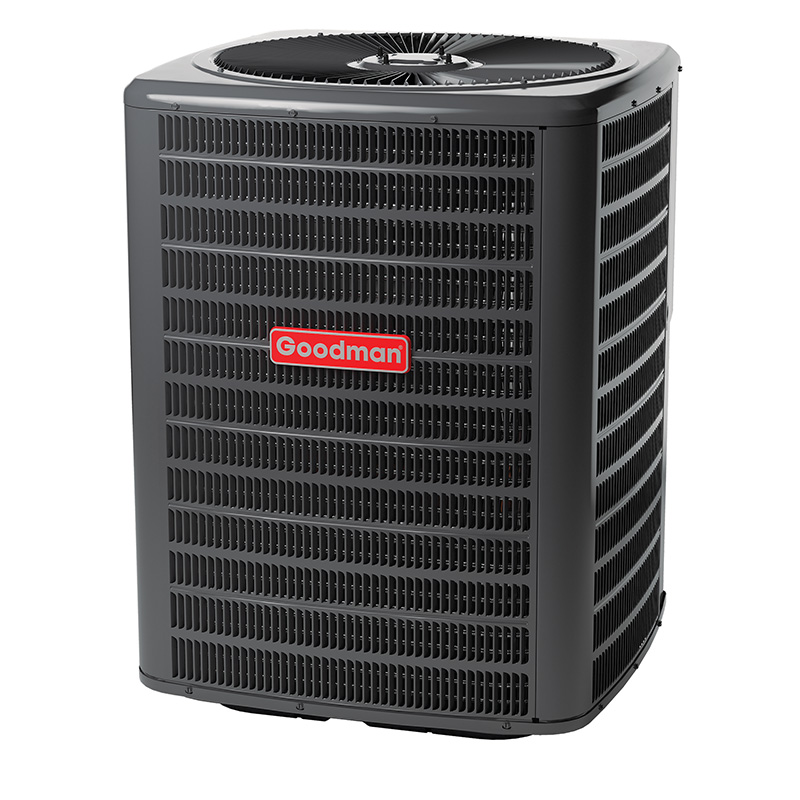
View on AC Direct see your lowest price →Check current price on AC Direct →
Key features
- 5-ton capacity for larger residential applications up to roughly 3,500 sq ft depending on load
- Up to 16 SEER2 efficiency rating, meeting and exceeding current federal minimum standards
- R-32 refrigerant with lower global warming potential than R-410A
- Single-stage compressor operation with straightforward controls
- Powder-coat cabinet finish designed for corrosion resistance in outdoor installations
- Compatible with Goodman matched air handlers and select third-party coil systems when properly matched
About this system
The Goodman GLZS5BA6010 is a 5-ton heat pump condenser rated up to 16 SEER2, sized for larger homes typically in the 2,500 to 3,500 square foot range depending on climate, insulation, and local design temperatures. It runs on R-32 refrigerant, a lower global-warming-potential option that is increasingly common as the industry moves away from R-410A. At 16 SEER2, this unit sits at the entry point of what regulators and the industry consider high efficiency, clearing the new federal minimums with some headroom but stopping well short of the 18 to 22 SEER2 range you find on variable-speed premium systems.
This condenser is a single-component purchase, meaning you will need a matched air handler or furnace, a metering device, and correct lineset sizing to complete a working system. Goodman positions this model for homeowners who want a reliable replacement or new-construction solution without the price premium of Trane, Lennox, or Carrier. The R-32 refrigerant charge is modestly lower in volume than R-410A systems, which can reduce leak impact and improve heat transfer efficiency slightly. Commissioning and charge verification matter more than usual with R-32 because a small percentage of early-life refrigerant issues traced in owner feedback point back to install and initial charge quality rather than factory defects.
The GLZS5BA6010 delivers solid entry-level high efficiency at a price point that is genuinely 15 to 25 percent below comparable Trane, Carrier, and Lennox hardware. It is a workable long-term solution when installed by an experienced technician who verifies refrigerant charge and electrical components at startup, but owners should budget for capacitor replacements and be aware that compressor longevity tends to trail premium-brand equipment. For buyers who prioritize upfront cost and can accept slightly shorter expected service life, it competes well.
Overall score is the average of the five ratings above.
What we like
- Price is typically 15 to 25 percent below Trane, Lennox, and Carrier at similar efficiency
- 16 SEER2 rating provides meaningful seasonal energy savings over minimum-efficiency equipment
- R-32 refrigerant is increasingly supported by HVAC technicians and has lower environmental impact than R-410A
- Dual-run capacitor failures, the most common documented issue, are a relatively low-cost repair in the $300 to $600 range
- Wide dealer and parts availability makes service calls straightforward in most metro areas
Trade-offs
- Compressor lifespan averages 10 to 14 years versus 15 to 20 years for premium-brand compressors
- Evaporator coil leaks appear in a meaningful share of owner reviews and can be a costly mid-life repair
- A minority of owners report refrigerant leaks within the first year, highlighting sensitivity to install quality
- Single-stage operation means less precise humidity and temperature control compared to two-stage or variable-speed alternatives
What homeowners and pros say about Goodman
Homeowners who choose Goodman equipment consistently land on the same point: the price is the draw. On Google dealer reviews, Goodman installations average around 3.8 out of 5 across hundreds of reviews per location, and affordability is the praise that comes up most often. That positive sentiment tends to hold through the first several years of ownership, when the equipment generally performs without major incident. The picture shifts on ConsumerAffairs, where the brand sits at about 2.5 out of 5, a score shaped partly by the platform’s complaint-heavy nature but also by a real pattern of repair costs climbing after roughly year seven. Dual-run capacitor failures are the most commonly reported problem and are widely discussed in owner forums, though the repair is typically modest at $300 to $600. More costly are evaporator coil leaks, which appear in a meaningful share of reviews, and compressor longevity that tends to average 10 to 14 years rather than the 15 to 20 years owners of Trane or Carrier equipment often report.
HVAC technicians have a nuanced view of Goodman. Many will install it without hesitation for budget-conscious customers, noting that the hardware is straightforward to work on and parts are easy to source. The consistent caveat is that install quality drives outcomes more with Goodman than with premium brands, and a small but documented share of first-year refrigerant issues point directly to charge and setup errors rather than factory problems. For the GLZS5BA6010 specifically, the R-32 refrigerant adds a layer of install accountability, since proper handling requires technician certification and the correct tools. Pros who are fully equipped for R-32 work report no unusual concerns; those who are not should not be touching this system. The bottom line from the field is that a Goodman installed well, in a home where the owner commits to annual maintenance, can deliver solid service life at a price that leaves real money on the table for future repairs.
Sources: ConsumerAffairs Goodman owner reviews, AHRI Directory of Certified Product Performance, U.S. DOE appliance and equipment efficiency standards, Goodman product specification sheets.
What it costs to run
At 16 SEER2, cooling this 5-ton system for a typical 1200-hour cooling season at the U.S. average electricity rate of $0.17/kWh works out to roughly $765 per year in cooling, about $148 less per year than a minimum-efficiency 13.4 SEER2 unit of the same size. Your real cost depends on your climate and local rate.
Method: (60,000 BTU/hr ÷ 16 SEER2) × 1200 hours ÷ 1000 × $0.17/kWh. Rate source: U.S. EIA average; cooling hours: moderate-climate estimate.
How it compares
| Brand | Comparable model | SEER2 | Stage | Price position |
|---|---|---|---|---|
| Goodman | GLZS5BA6010 | 16 | Single-stage | Value pick |
| Carrier | Performance 16 (25HPB660) | 16 | Single-stage | Typically 15 to 20 percent higher than Goodman |
| Trane | XR16 (4TWR6060) | 16 | Single-stage | Typically 20 to 25 percent higher than Goodman |
| Lennox | Merit 16 (14HPX-060) | 16 | Single-stage | Typically 15 to 25 percent higher than Goodman |
Competitor rows are comparable single-stage units at similar efficiency; price is relative position, not a quote.
Questions about this system
Does this unit work with my existing air handler or furnace, or do I need to replace that too?
You will need to verify that your existing indoor unit is rated for R-32 refrigerant and is matched to a 5-ton, 16 SEER2 system. Most older R-410A air handlers are not rated for R-32, so a full system replacement is often the right call. Your installer should run a load calculation and confirm compatibility before any equipment is ordered.
How does R-32 refrigerant affect service and safety compared to R-410A?
R-32 is mildly flammable, which means technicians need specific training and tools to handle it safely, and not every local HVAC company has made that investment yet. Confirm your installer is R-32 certified before scheduling work. On the environmental side, R-32 has a significantly lower global warming potential than R-410A, which is one reason manufacturers are moving toward it.
What does the Goodman warranty actually cover on this model, and are there conditions I need to meet?
Goodman's standard residential warranty on this line is typically 10 years on the compressor and covered components, but only if you register the product within a set window after installation. Failure to register usually drops coverage to a shorter base period. Read the registration terms carefully and confirm your installer uses a matched Goodman coil, as mismatched systems can affect warranty eligibility.
The capacitor failure issue keeps coming up in reviews. How worried should I be, and what does it cost to fix?
Dual-run capacitor failure is the most commonly reported Goodman repair and is well-documented across owner feedback. The good news is that it is one of the simpler HVAC repairs, with typical costs falling in the $300 to $600 range including labor. Having your technician inspect and optionally replace the capacitor at each annual tune-up is a reasonable preventive step, especially after year five.
Is 16 SEER2 actually efficient enough to see real savings on my electric bill at 5-ton capacity?
At 5 tons, even modest efficiency gains matter because the system is moving a large volume of air and refrigerant. Compared to a 14 SEER2 minimum system, a 16 SEER2 unit can reduce cooling season energy use by roughly 12 percent under similar conditions. That said, single-stage operation means the system runs at full capacity whenever it runs, so it will cycle more frequently than a variable-speed unit and may not wring out every available efficiency point in mild weather.
Specifications
| Cooling capacity | 5 Ton |
| Efficiency | 16 SEER2 |
| Refrigerant | R-32 |
| Model | GLZS5BA6010 |