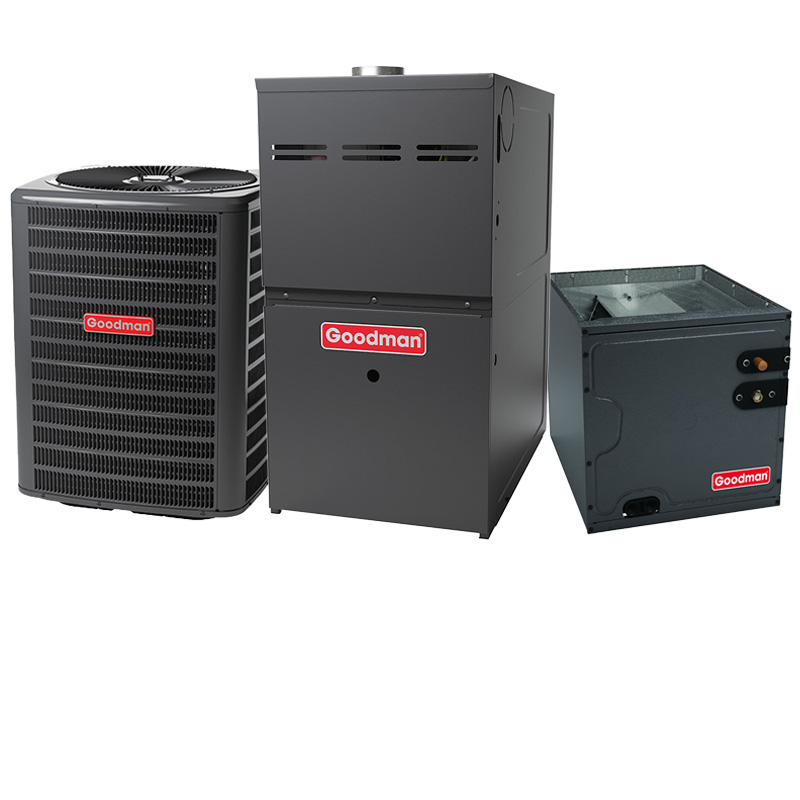
Goodman R32 3.5 Ton 13.8 SEER2 100000 BTU 80% Multi-Speed ECM Gas Furnace and Air Conditioner System – Upflow
View on AC Direct see your lowest price →Check current price on AC Direct →
Key features
- 3.5-ton cooling capacity paired with 100,000 BTU 80% AFUE multi-speed gas furnace
- 13.8 SEER2 efficiency rating, meeting 2023 federal minimums for most U.S. regions
- R-32 refrigerant with lower global warming potential than R-410A
- Multi-speed ECM blower motor for improved humidity control and reduced fan energy use
- Upflow configuration for basement or ground-floor mechanical room installations
- Goodman factory warranty (parts coverage on registered systems; compressor and heat exchanger terms vary by model)
About this system
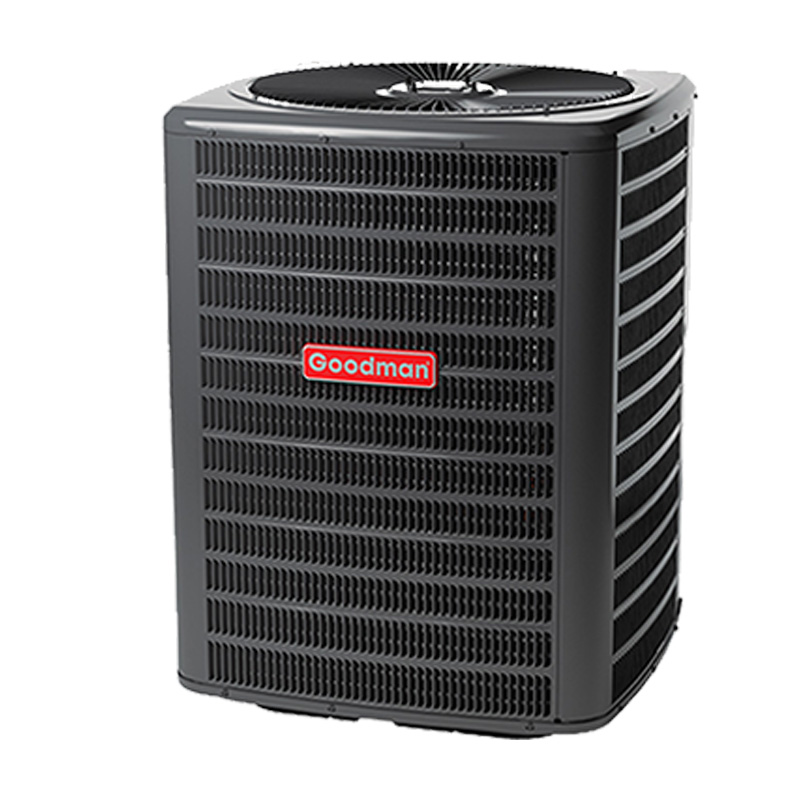
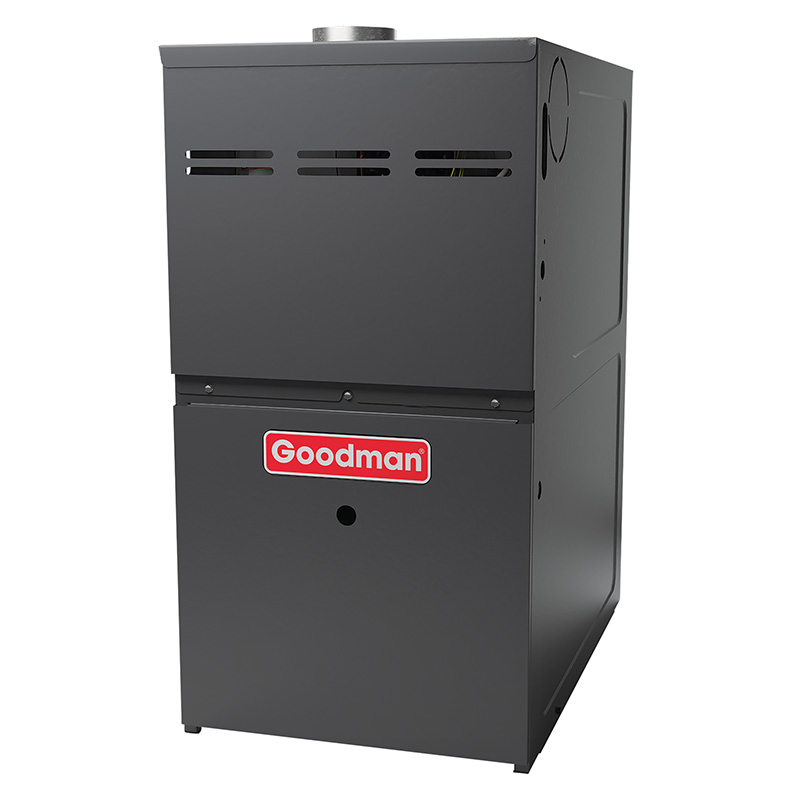
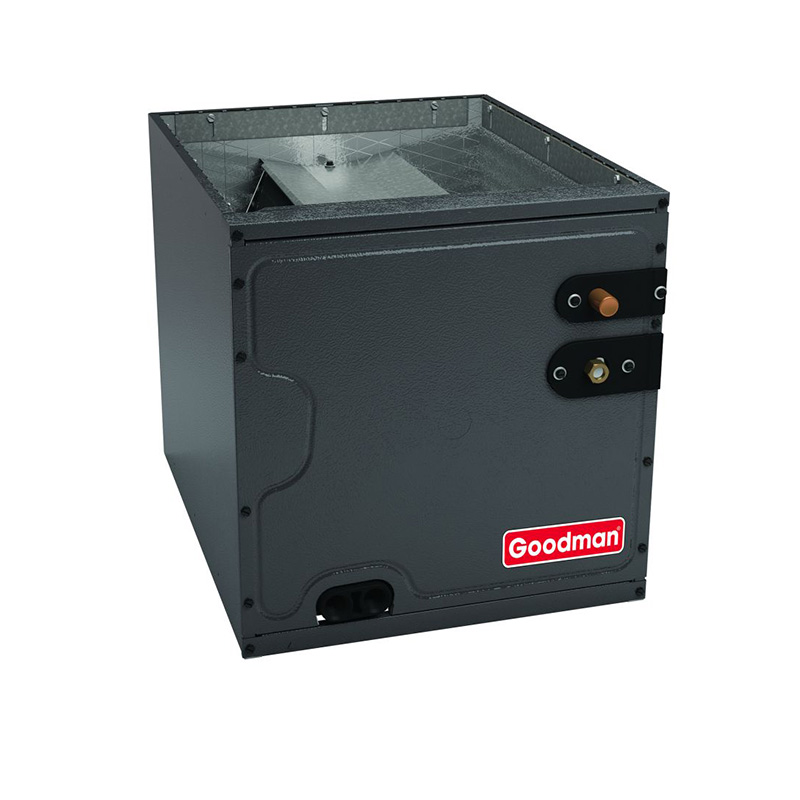
The Goodman R-32 3.5-ton upflow system pairs a 13.8 SEER2 air conditioner with a 100,000 BTU 80% AFUE multi-speed ECM gas furnace, making it a full split-system bundle aimed at mid-size to larger homes in climates where both serious cooling and meaningful heating loads are the norm. The 3.5-ton capacity sits in a practical middle ground, suitable for roughly 1,600 to 2,200 square feet depending on insulation, ceiling height, and local design temperatures. The upflow configuration means the furnace discharges conditioned air upward into the duct system, the standard orientation for installations where the air handler lives in a basement, utility closet, or ground-floor mechanical room with ducts running overhead.
On the efficiency side, 13.8 SEER2 clears the federal minimums that took effect in 2023 but sits at the entry tier rather than the mid-efficiency or premium tier. Homeowners who run their systems heavily through long summers will notice that gap versus 16 or 17 SEER2 equipment on their utility bills over time. The R-32 refrigerant is a meaningful upgrade over older R-410A systems: it carries a lower global warming potential and requires a smaller charge by weight, which can simplify future service. The multi-speed ECM blower motor improves humidity control and airflow consistency compared with a single-speed PSC motor, and it draws less electricity during the longer, slower fan runs that multi-speed operation produces.
This Goodman bundle delivers a functional, code-compliant ducted system at a price point that undercuts Carrier, Trane, and Lennox by a meaningful margin, but the 13.8 SEER2 rating and Goodman's documented reliability pattern mean buyers are trading long-term operating costs and durability expectations for lower upfront spend. It is a reasonable choice when installation quality is prioritized and the budget does not stretch to mid-efficiency equipment from premium brands.
Overall score is the average of the five ratings above.
What we like
- Priced roughly 15 to 25 percent below comparable Carrier, Trane, and Lennox systems
- R-32 refrigerant is more environmentally favorable and easier to service than R-410A
- Multi-speed ECM motor improves comfort and dehumidification over single-speed alternatives
- 100,000 BTU furnace output suits larger or poorly insulated homes in cold climates
- Widely stocked, with most HVAC distributors carrying Goodman parts for capacitor and other common repairs
Trade-offs
- 13.8 SEER2 is entry-level efficiency; utility savings versus mid-efficiency alternatives are limited over the system's life
- Dual-run capacitor failures and evaporator coil leaks are documented recurring issues across the Goodman lineup
- Compressor lifespan averages 10 to 14 years, shorter than the 15 to 20 years typical of premium-brand compressors
- Performance is heavily dependent on installer quality; a poor charge or improper airflow setup amplifies reliability risks
What homeowners and pros say about Goodman
Goodman sits at around 2.5 out of 5 on ConsumerAffairs, a complaint-skewed platform where the most common thread is repair costs that climb noticeably after roughly the seventh year of ownership. On Google dealer reviews the picture is more balanced, with scores around 3.8 out of 5 across several hundred reviews per location, and affordability consistently showing up as the reason buyers chose Goodman in the first place. For this particular bundle, those sentiments apply cleanly: buyers who got competitive installer quotes, went with Goodman, and had the system commissioned carefully tend to report solid early-year performance. Those who ran into trouble more often point to install-related issues like refrigerant charge problems or airflow mismatches rather than the equipment itself as the root cause.
Among the documented failure patterns the trade talks about, dual-run capacitor failure is the most routine: it is a low-cost, quick fix in the 300 to 600 dollar range, and most HVAC technicians keep the part on their truck. Evaporator coil leaks are a more serious concern and appear in a meaningful number of Goodman owner reports over the life of a system. Compressor longevity is the other honest limitation, averaging 10 to 14 years in real-world data versus the 15 to 20 years that Carrier, Trane, and Lennox compressors tend to achieve. For a homeowner who understands those trade-offs and wants to put the savings from the lower purchase price toward a service contract or reserve fund, this system can represent a reasonable decision. For someone expecting set-it-and-forget-it reliability over 18 or 20 years, the premium brands have a clearer track record at this capacity range.
Sources: ConsumerAffairs Goodman owner reviews, AHRI Directory of Certified Product Performance, U.S. DOE appliance and equipment efficiency standards, Goodman product specification sheets.
What it costs to run
At 13.8 SEER2, cooling this 3.5-ton system for a typical 1200-hour cooling season at the U.S. average electricity rate of $0.17/kWh works out to roughly $621 per year in cooling, about $18 less per year than a minimum-efficiency 13.4 SEER2 unit of the same size. Your real cost depends on your climate and local rate.
Method: (42,000 BTU/hr ÷ 13.8 SEER2) × 1200 hours ÷ 1000 × $0.17/kWh. Rate source: U.S. EIA average; cooling hours: moderate-climate estimate.
How it compares
| Brand | Comparable model | SEER2 | Stage | Price position |
|---|---|---|---|---|
| Goodman | R-32 3.5-Ton 13.8 SEER2 / 100,000 BTU 80% ECM Bundle (this system) | 13.8 | Multi-speed | Value pick |
| Carrier | Comfort 24ACC6 / 58TP 80% series bundle | 14.0 | Single-stage | Moderately higher than this Goodman bundle |
| Trane | XR14C / S8X1 80% series bundle | 14.0 | Single-stage | Moderately higher than this Goodman bundle |
| Lennox | Merit ML14XC1 / ML180 80% series bundle | 14.0 | Single-stage | Moderately to substantially higher than this Goodman bundle |
Competitor rows are comparable single-stage units at similar efficiency; price is relative position, not a quote.
Questions about this system
Will 3.5 tons be enough for my 2,000 square foot house?
For many homes in that range it can work, but correct sizing depends on your climate zone, insulation levels, window area, and ceiling height, not square footage alone. A Manual J load calculation by your installer is the only reliable way to confirm 3.5 tons is the right fit before purchase.
Is R-32 refrigerant going to be hard or expensive to service in a few years?
R-32 is increasingly common in new residential equipment and is widely available through HVAC distributors. Technicians certified to handle mildly flammable refrigerants (A2L class) are required to work with it, but that certification is becoming standard in the trade as R-32 and similar refrigerants expand across the market.
What does multi-speed ECM actually mean for day-to-day comfort?
The ECM blower can run at lower speeds for longer periods rather than cycling on and off at full blast. This tends to improve humidity removal, reduce temperature swings between cycles, and cut blower electricity use compared with a single-speed PSC motor.
How worried should I be about the capacitor and coil leak issues mentioned in reviews?
Dual-run capacitor failure is the most commonly reported Goodman repair and typically costs 300 to 600 dollars including labor, making it a manageable nuisance rather than a catastrophe. Evaporator coil leaks are more expensive and do show up in a meaningful share of owner accounts, so it is worth confirming what coil warranty coverage applies to your registered unit before buying.
The furnace is listed at 80% AFUE. Should I be looking at a 96% model instead?
An 80% AFUE furnace is a reasonable fit for mild-to-moderate heating climates or for replacing an existing 80% system where high-efficiency venting is not already in place. In cold climates where the furnace runs for many months, a 96% or higher AFUE unit will typically recover the price difference in fuel savings within a few years, so the math is worth running with your installer.
Specifications
| Cooling capacity | 3.5 Ton |
| Efficiency | 13.8 SEER2 |
| Furnace output | 100000 BTU |
| Configuration | Upflow |
| Refrigerant | R-32 |