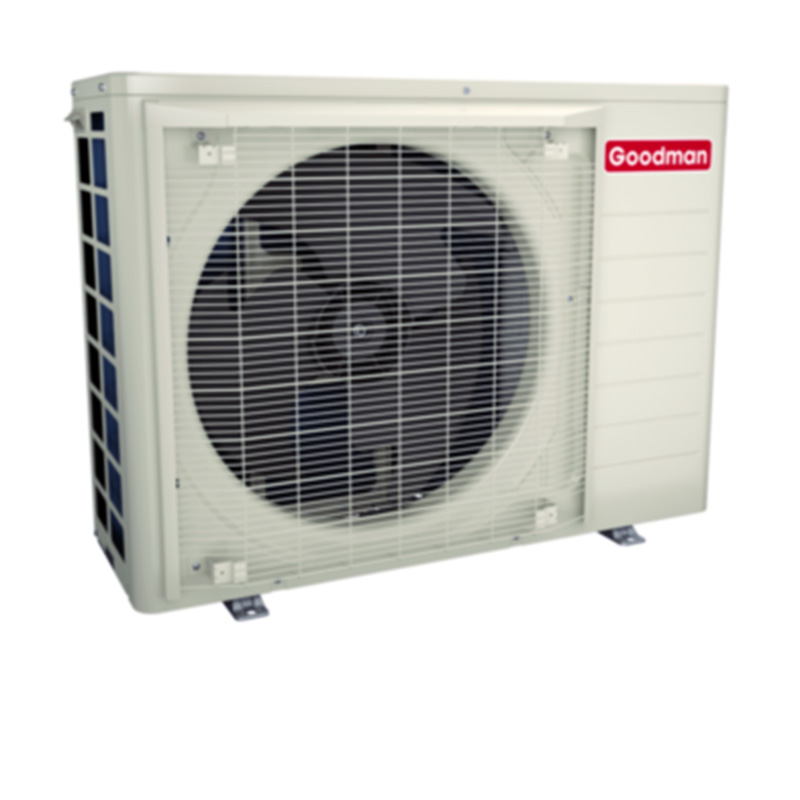
Goodman 2 Ton Up to 17.2 SEER2 Variable-Speed Inverter AC Side Discharge Condenser, R32 (GXV6SS2410)
View on AC Direct see your lowest price →Check current price on AC Direct →
Key features
- Variable-speed inverter compressor for continuous capacity modulation and quieter operation
- Up to 17.2 SEER2 efficiency rating, exceeding federal minimum standards by a significant margin
- R-32 refrigerant with lower global warming potential than R-410A
- Side-discharge airflow configuration for flexible placement in tight or restricted spaces
- 2-ton capacity suited to approximately 900 to 1,200 square feet depending on load conditions
- Compatible with Goodman communicating and non-communicating air handlers and coil systems
About this system
The Goodman GXV6SS2410 is a 2-ton, R-32 refrigerant condenser rated up to 17.2 SEER2, placing it firmly in the upper tier of mid-efficiency variable-speed equipment. The inverter-driven compressor modulates output continuously rather than cycling on and off at full blast, which means quieter operation, more consistent indoor temperatures, and meaningfully lower electric bills compared to single-stage units of the same tonnage. The side-discharge cabinet design suits installations where overhead clearance is limited or where local code or landscaping pushes airflow away from walls and fences.
R-32 refrigerant is worth noting here. It carries a lower global warming potential than the R-410A it replaces, and its higher energy density allows for slightly smaller refrigerant charges. For the homeowner, that mainly means a future-proof system that certified technicians are already equipped to handle. For the installer, R-32 requires specific gauges and recovery equipment, so confirming your contractor is rated for it before scheduling is not a minor detail. This unit pairs with a compatible air handler or coil and, at 2 tons, is best matched to conditioned spaces in the 900 to 1,200 square foot range depending on local climate, insulation quality, and window load.
The GXV6SS2410 occupies an interesting position: variable-speed performance at a price that typically undercuts comparable Carrier, Trane, and Lennox hardware by 15 to 25 percent. That gap is real and attractive, but it comes with the understanding that Goodman’s long-term track record sits below the premium tier, and that the system’s longevity will depend heavily on who installs it and how well it is maintained over time.
The GXV6SS2410 delivers genuine variable-speed efficiency at a price well below premium-brand alternatives, making it a reasonable choice for cost-conscious buyers willing to accept a shorter average compressor lifespan and a support experience that is more contractor-dependent than brand-dependent. The R-32 refrigerant and 17.2 SEER2 rating are legitimate highlights, not marketing padding. The trade-off is a documented reliability record that trails Trane and Carrier, particularly after year seven, and a system whose performance ceiling is set almost entirely by the quality of the installation.
Overall score is the average of the five ratings above.
What we like
- 17.2 SEER2 variable-speed efficiency produces real monthly energy savings over single-stage equipment
- Priced 15 to 25 percent below comparable Trane, Lennox, and Carrier variable-speed units
- R-32 refrigerant is lower-GWP and future-oriented compared to R-410A systems still on the market
- Side-discharge design offers genuine placement flexibility for constrained installations
- Inverter compressor reduces temperature swings and cycling noise compared to single-stage units
Trade-offs
- Compressor lifespan averages 10 to 14 years versus 15 to 20 years for premium-brand equivalents
- Evaporator coil leaks appear in a meaningful share of owner reviews, often surfacing mid-life
- R-32 requires a contractor specifically equipped and certified for that refrigerant, narrowing your service pool
- Performance and longevity are heavily dependent on install quality, giving the brand less of a buffer when workmanship varies
What homeowners and pros say about Goodman
Among homeowners, Goodman’s reputation is genuinely split along a timeline. Early-year owners who had a skilled installer tend to report satisfaction and point to the lower upfront cost as a clear win. The friction surfaces later, and it maps closely to what Goodman’s ConsumerAffairs score of about 2.5 out of 5 reflects: repair costs climbing after roughly year seven, with dual-run capacitor failures being the most commonly reported issue and typically the least expensive to fix at 300 to 600 dollars. Evaporator coil leaks and refrigerant loss also appear in a meaningful share of owner accounts, and those repairs cost considerably more. Google dealer reviews tell a somewhat warmer story, averaging around 3.8 out of 5, where the praise almost always circles back to price and the criticism circles back to the brand’s dependence on whoever did the installation.
HVAC technicians tend to be pragmatic about Goodman. Most will say it installs and services without major drama in the early years, and that the variable-speed compressor on a unit like the GXV6SS2410 is a step up from the basic Goodman lineup. The consistent professional caution is around compressor lifespan: Goodman compressors average 10 to 14 years in documented patterns, compared to 15 to 20 years for Trane, Carrier, and Lennox at the top end. For this specific R-32 unit, contractors also flag the importance of being properly equipped for that refrigerant, since a shop still running R-410A tools cannot safely service it. The summary from the field is that this system can deliver on its efficiency numbers when installed correctly, but it offers less margin for error and a shorter reliability runway than what a premium brand typically provides at a higher price.
Sources: ConsumerAffairs Goodman owner reviews, AHRI Directory of Certified Product Performance, U.S. DOE appliance and equipment efficiency standards, Goodman product specification sheets.
What it costs to run
At 17.2 SEER2, cooling this 2-ton system for a typical 1200-hour cooling season at the U.S. average electricity rate of $0.17/kWh works out to roughly $285 per year in cooling, about $80 less per year than a minimum-efficiency 13.4 SEER2 unit of the same size. Your real cost depends on your climate and local rate.
Method: (24,000 BTU/hr ÷ 17.2 SEER2) × 1200 hours ÷ 1000 × $0.17/kWh. Rate source: U.S. EIA average; cooling hours: moderate-climate estimate.
How it compares
| Brand | Comparable model | SEER2 | Stage | Price position |
|---|---|---|---|---|
| Goodman | GXV6SS2410 | 17.2 | Variable-speed inverter | Value pick |
| Carrier | Infinity 24 (24VNA0) | Up to 17.3 SEER2 | Variable-speed inverter | Approximately 20 to 25 percent more than this Goodman |
| Trane | XV18i | Up to 18.0 SEER2 | Variable-speed inverter | Approximately 20 to 30 percent more than this Goodman |
| Lennox | XC21 | Up to 17.9 SEER2 | Variable-speed | Approximately 20 to 25 percent more than this Goodman |
Competitor rows are comparable single-stage units at similar efficiency; price is relative position, not a quote.
Questions about this system
Does my installer need special certification to work with R-32 refrigerant on this unit?
Yes. R-32 requires EPA 608 certification like any refrigerant, but technicians also need R-32-compatible gauges, recovery equipment, and leak detection tools. Before booking installation or service, confirm explicitly that your contractor has the right equipment, because not every shop has transitioned away from R-410A tooling yet.
What air handler or coil does the GXV6SS2410 need to reach the rated 17.2 SEER2?
To achieve the published SEER2 rating, the condenser must be matched with a compatible, properly sized Goodman or Amana coil or air handler that is listed in the AHRI-certified combination for this model. Mismatched or oversized indoor equipment can push the actual efficiency below the nameplate rating and may void the warranty, so verify the AHRI certificate number with your installer before purchase.
What is the warranty on this unit and what does it actually cover?
Goodman typically offers a 10-year parts limited warranty on registered systems, which covers the compressor and functional parts but not labor or refrigerant. Registration must be completed within a set window after installation, and coverage for the compressor can drop to a shorter term on unregistered units. Read the registration terms carefully and confirm your contractor completes that step.
Goodman's reviews online look pretty mixed. Should I be concerned?
Context matters here. Goodman's ConsumerAffairs score sits around 2.5 out of 5, which is a complaint-heavy channel where repair costs after roughly year seven are the recurring theme. Google dealer reviews average closer to 3.8 out of 5, with affordability cited most often as the reason for positive feedback. The picture that emerges is a brand that performs reasonably well in the first several years, with reliability declining faster than premium alternatives in the back half of a typical system's life.
Is a 2-ton unit the right size for my home?
Two tons is generally appropriate for conditioned spaces in the 900 to 1,200 square foot range, but climate zone, ceiling height, insulation level, window area, and duct condition all affect the real answer. An oversized unit on a variable-speed system is less damaging than on a single-stage unit, but correct sizing still matters for dehumidification and efficiency. Ask your installer to provide a Manual J load calculation rather than relying on square footage rules of thumb alone.
Specifications
| Cooling capacity | 2 Ton |
| Efficiency | 17.2 SEER2 |
| Refrigerant | R-32 |
| Model | GXV6SS2410 |