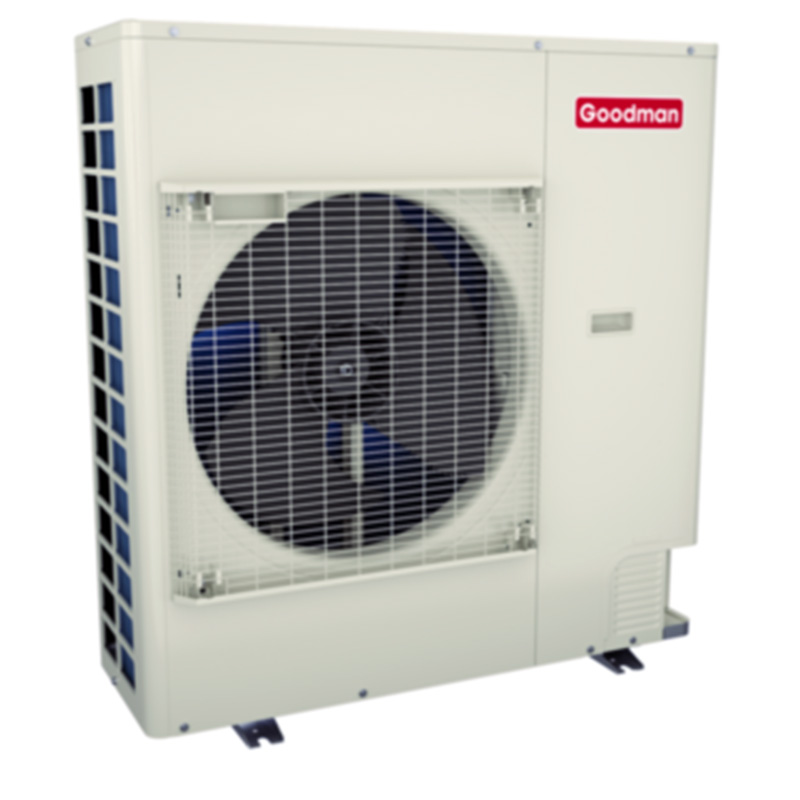
Goodman 3.5 Ton Up to 17.2 SEER2 Variable-Speed Inverter AC Side Discharge Condenser, R32 (GXV6SS4210)
View on AC Direct see your lowest price →Check current price on AC Direct →
Key features
- Up to 17.2 SEER2 variable-speed inverter compressor for continuous capacity modulation
- 3.5-ton cooling capacity suited to mid-size residential applications
- R-32 refrigerant with lower global warming potential than R-410A
- Side-discharge airflow design for installations with overhead clearance constraints
- Enhanced dehumidification and temperature consistency versus single-stage units
- Compatible with Goodman and Amana communicating air handlers for full inverter performance
About this system
The Goodman GXV6SS4210 is a 3.5-ton, up to 17.2 SEER2 variable-speed inverter condenser designed for side-discharge installations and charged with R-32 refrigerant. That SEER2 rating lands it solidly in the high-efficiency tier, meaning real-world energy bills should be noticeably lower than the 14–15 SEER2 entry-level equipment it typically replaces. The variable-speed inverter compressor continuously modulates output rather than cycling on and off, which translates to steadier temperatures, better humidity control, and quieter operation compared to single- or two-stage units. R-32 has a lower global warming potential than R-410A and is increasingly common in new equipment as the industry moves away from older refrigerants.
This condenser is a good fit for homes in the 1,800 to 2,400 square-foot range, though proper load calculation (Manual J) matters more than any rule of thumb. It suits homeowners who want genuine high-efficiency performance without paying the premium commanded by Carrier, Trane, or Lennox variable-speed systems. The side-discharge configuration works well on constrained lots or in installations where overhead airflow would conflict with fencing, overhangs, or utility lines. Paired with a compatible Goodman or Amana air handler and a communicating thermostat, the inverter drive can operate at its full potential. Skipping the matched system or running it with a mismatched coil is one of the most common ways performance and longevity fall short of expectations with this brand.
The GXV6SS4210 delivers genuine high-efficiency, variable-speed performance at a price point 15 to 25 percent below comparable Carrier, Trane, and Lennox systems, making the efficiency math work faster. The trade-off is a brand track record that shows more reliability concerns after year 7 and a compressor lifespan that tends to run shorter than premium competitors, so long-term ownership costs deserve honest consideration before buying.
Overall score is the average of the five ratings above.
What we like
- 17.2 SEER2 rating puts it in the high-efficiency tier with real monthly energy savings over standard equipment
- Variable-speed inverter compressor improves comfort and humidity control versus single- or two-stage units
- R-32 refrigerant is more environmentally responsible and increasingly supported by service technicians
- Side-discharge design adds installation flexibility for tight or restricted outdoor spaces
- Significantly lower upfront cost than variable-speed offerings from Carrier, Trane, or Lennox at similar efficiency ratings
Trade-offs
- Dual-run capacitors are the most frequently reported failure point, typically requiring a 300 to 600 dollar repair, often within the first 7 to 10 years
- Evaporator coil leaks appear in a notable share of owner reviews and can be costly if outside the parts warranty window
- Compressor lifespan averages 10 to 14 years versus 15 to 20 years for premium brand compressors
- A minority of owners report refrigerant leaks in the first year, usually tied to installation quality rather than the unit itself, making contractor selection critical
What homeowners and pros say about Goodman
Homeowners who have shopped aggressively tend to land on Goodman because the price gap versus Carrier, Trane, and Lennox is hard to ignore, and many report years of trouble-free cooling after a clean professional install. On Google dealer reviews, Goodman locations average around 3.8 out of 5, with affordability cited repeatedly as the reason buyers chose the brand. The variable-speed GXV6SS4210 specifically appeals to buyers who want inverter-level comfort without the premium brand markup. That said, the ConsumerAffairs score sits around 2.5 out of 5, and while that channel skews toward frustrated owners, the complaints carry a consistent pattern: repair costs that feel disproportionate once the system passes the seven-year mark.
HVAC technicians are generally pragmatic about Goodman. They point to install quality as the single biggest predictor of how long any unit lasts, and Goodman especially rewards a careful setup. The failure modes they mention most often are dual-run capacitor failures, typically a 300 to 600 dollar fix but one that recurs on some units, evaporator coil leaks that can become expensive outside the parts warranty window, and a compressor lifespan that tends to land in the 10 to 14 year range rather than the 15 to 20 years technicians associate with Trane or Carrier compressors. First-year refrigerant leaks also appear in a smaller share of reviews, and pros consistently trace those back to installation or initial charge quality rather than a factory defect. The bottom line from the field: Goodman is a reasonable bet if the install is done right and you carry a good extended warranty.
Sources: ConsumerAffairs Goodman owner reviews, AHRI Directory of Certified Product Performance, U.S. DOE appliance and equipment efficiency standards, Goodman product specification sheets.
What it costs to run
At 17.2 SEER2, cooling this 3.5-ton system for a typical 1200-hour cooling season at the U.S. average electricity rate of $0.17/kWh works out to roughly $498 per year in cooling, about $141 less per year than a minimum-efficiency 13.4 SEER2 unit of the same size. Your real cost depends on your climate and local rate.
Method: (42,000 BTU/hr ÷ 17.2 SEER2) × 1200 hours ÷ 1000 × $0.17/kWh. Rate source: U.S. EIA average; cooling hours: moderate-climate estimate.
How it compares
| Brand | Comparable model | SEER2 | Stage | Price position |
|---|---|---|---|---|
| Goodman | GXV6SS4210 | 17.2 | Variable-speed inverter | Value pick |
| Carrier | Infinity 26 (24VNA6) | Up to 20+ SEER2 | Variable-speed inverter | Significantly higher than Goodman |
| Trane | XV18i | Up to 18+ SEER2 | Variable-speed inverter | Meaningfully higher than Goodman |
| Lennox | XC21 | Up to 17.5 SEER2 | Variable-speed | Moderately to significantly higher than Goodman |
Competitor rows are comparable single-stage units at similar efficiency; price is relative position, not a quote.
Questions about this system
Does this unit work with my existing air handler, or do I need to replace the whole system?
For the variable-speed inverter to operate correctly and reach the rated 17.2 SEER2 efficiency, you need a compatible matched air handler with the right coil and ideally a communicating control board. Running it with a mismatched or older air handler can prevent the inverter from modulating properly and will void the matched-system efficiency rating. Ask your installer to confirm compatibility before purchase.
Is R-32 refrigerant harder to find or more expensive to service than R-410A?
R-32 is becoming more common as R-410A is phased down, and most certified HVAC technicians in urban and suburban markets can already handle it. Availability is growing, not shrinking. The main thing to confirm is that your service tech is certified and equipped for R-32 before you call for a repair, since it does require specific handling procedures.
What is the actual warranty on this Goodman unit, and should I buy an extended warranty?
Goodman typically offers a 10-year parts warranty when the unit is registered within a set window after installation, which covers the compressor and major components. Labor is not covered, and a compressor replacement outside of warranty can run into the thousands. Given the documented reliability timeline on Goodman equipment, an extended labor warranty through a reputable dealer is worth pricing out before installation day.
Why does Goodman have low ratings on some review sites if it sells so many units?
Goodman scores around 2.5 out of 5 on ConsumerAffairs, which is a complaint-skewed channel where satisfied owners rarely post. The recurring theme in those reviews is repair costs climbing after roughly year 7, often related to capacitors, coil leaks, or refrigerant issues. Google dealer reviews average closer to 3.8 out of 5, where affordability is the most common praise. The honest picture is a brand that works well when properly installed but carries more risk of mid-lifecycle repair costs than premium competitors.
What does side discharge actually mean, and does it limit where this unit can be installed?
Side discharge means the condenser exhausts hot air out the sides of the cabinet rather than straight up through the top. This is useful when you have a low overhang, pergola, or fence directly above the unit. The trade-off is that side-discharge units need adequate clearance on the sides so hot air does not recirculate back into the intake, so tight alley or wall installations require careful measurement before placement.
Specifications
| Cooling capacity | 3.5 Ton |
| Efficiency | 17.2 SEER2 |
| Refrigerant | R-32 |
| Model | GXV6SS4210 |