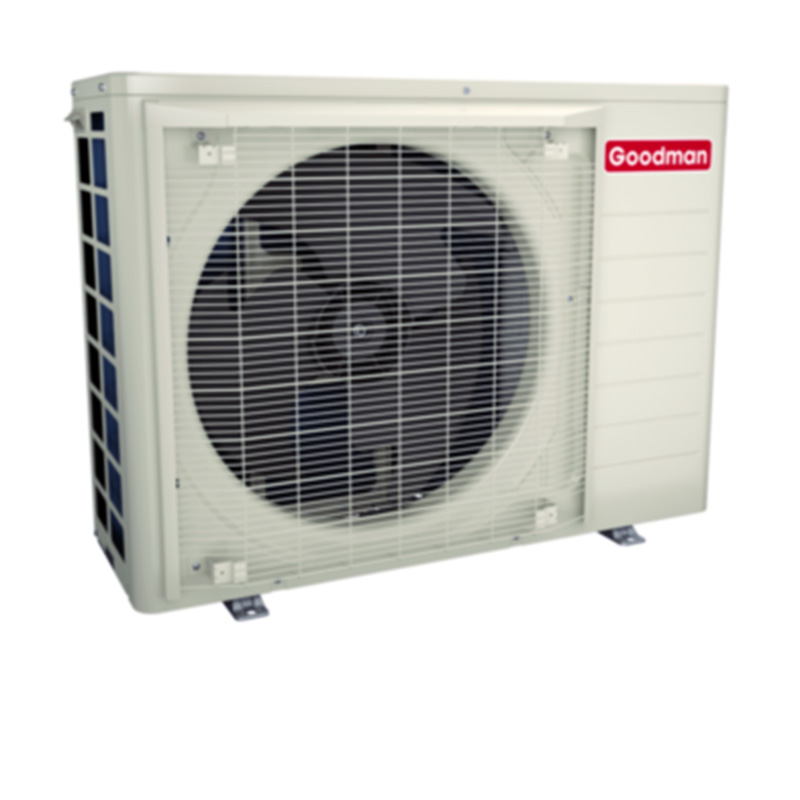
Goodman 2 Ton Up to 17.2 SEER2 Variable-Speed Inverter AC Side Discharge Condenser, R32 (GXV6SA2410)
View on AC Direct see your lowest price →Check current price on AC Direct →
Key features
- Variable-speed inverter compressor for continuous capacity modulation
- Up to 17.2 SEER2 efficiency rating
- R-32 refrigerant with lower global-warming potential than R-410A
- 2-ton (approximately 24,000 BTU/h) cooling capacity
- Side-discharge airflow configuration
- Requires compatible variable-speed air handler or communicating furnace to reach rated efficiency
About this system
The Goodman GXV6SA2410 is a 2-ton, side-discharge central air conditioner built around a variable-speed inverter compressor and charged with R-32 refrigerant, a lower-global-warming-potential refrigerant that is increasingly common as the industry moves away from R-410A. At up to 17.2 SEER2, it sits in the upper-mid efficiency tier, well above the federal minimums and meaningfully above entry-level single-stage units. The variable-speed inverter compressor modulates output continuously rather than cycling on and off, which reduces temperature swings, keeps humidity more stable, and lowers operating noise compared with single- or two-stage equipment.
This unit is sized for smaller homes, condos, or individual zones in the 700 to 1,000 square foot range, depending on local climate and insulation quality. It pairs with a compatible variable-speed air handler or furnace with communicating controls to realize its full efficiency potential. Buyers choosing this condenser are typically trying to maximize comfort and utility savings without stretching into Carrier, Trane, or Lennox territory on price. The R-32 charge also positions the system for easier future servicing as R-410A availability narrows over the next several years.
The GXV6SA2410 delivers genuine inverter-driven variable-speed comfort at a price point 15 to 25 percent below comparable Carrier, Trane, or Lennox hardware, making the efficiency tier accessible to cost-conscious buyers. The trade-off is a brand track record that shows more repair activity after year 7 and shorter average compressor life than premium alternatives. For budget-minded homeowners who prioritize upfront savings and plan to maintain the system proactively, it is a credible choice; for those who want to minimize lifetime ownership risk and can absorb higher upfront cost, a premium brand warrants serious consideration.
Overall score is the average of the five ratings above.
What we like
- Variable-speed inverter compressor improves comfort and humidity control over single-stage units
- 17.2 SEER2 qualifies for many utility rebates and reduces monthly operating costs noticeably versus minimum-efficiency equipment
- R-32 refrigerant is more environmentally friendly and is expected to remain available longer than R-410A
- Priced significantly below comparable variable-speed models from Carrier, Trane, and Lennox
- 10-year parts warranty (registration required) is competitive at this price tier
Trade-offs
- Brand reliability data (ConsumerAffairs: ~2.5/5) points to rising repair frequency after year 7, including documented evaporator coil leak issues
- Average compressor lifespan of 10 to 14 years trails the 15 to 20 years typical of premium brands
- A minority of owners report refrigerant leaks in the first year, usually tied to installation quality rather than the unit itself
- Full efficiency potential depends on pairing with a compatible communicating air handler, adding system cost and installation complexity
What homeowners and pros say about Goodman
Goodman sits at roughly 3.8 out of 5 across Google dealer reviews, where buyers most often cite affordability as the reason they chose the brand. That positive sentiment is real, but it reflects the purchase decision more than long-term ownership experience. ConsumerAffairs tells a different story, averaging around 2.5 out of 5, and that channel skews toward owners who felt motivated to write a review after something went wrong. The recurring complaint pattern there centers on repair costs climbing after roughly year 7, which aligns with what HVAC technicians note in the field: Goodman systems that are installed carefully and maintained regularly perform adequately, but those that receive a mediocre installation or skip annual tune-ups tend to show problems sooner than premium alternatives.
For this specific inverter model, the failure modes worth knowing about are the same ones documented across the Goodman line. Dual-run capacitors are the most commonly replaced part and are a relatively inexpensive fix at 300 to 600 dollars when caught early. Evaporator coil leaks show up in a meaningful share of mid-life reports. The compressor picture is the most significant long-term consideration: Goodman compressors average 10 to 14 years, compared with 15 to 20 years for premium brands, which means a 2-ton variable-speed system purchased today may require a compressor replacement or full system swap earlier than a buyer might expect. A small but documented minority of owners also experience refrigerant leaks within the first year, and technicians generally attribute those to installation issues rather than factory defects, which underscores how heavily this brand’s performance depends on who puts it in.
Sources: ConsumerAffairs Goodman owner reviews, AHRI Directory of Certified Product Performance, U.S. DOE appliance and equipment efficiency standards, Goodman product specification sheets.
What it costs to run
At 17.2 SEER2, cooling this 2-ton system for a typical 1200-hour cooling season at the U.S. average electricity rate of $0.17/kWh works out to roughly $285 per year in cooling, about $80 less per year than a minimum-efficiency 13.4 SEER2 unit of the same size. Your real cost depends on your climate and local rate.
Method: (24,000 BTU/hr ÷ 17.2 SEER2) × 1200 hours ÷ 1000 × $0.17/kWh. Rate source: U.S. EIA average; cooling hours: moderate-climate estimate.
How it compares
| Brand | Comparable model | SEER2 | Stage | Price position |
|---|---|---|---|---|
| Goodman | GXV6SA2410 | 17.2 | Variable-speed inverter | Value pick |
| Carrier | Infinity 26 (24VNA6) | Up to 20+ SEER2 | Variable-speed inverter | Significantly higher than this unit |
| Trane | XV18 (4TWV8) | Up to 18 SEER2 | Variable-speed inverter | Notably higher than this unit |
| Lennox | XC21 | Up to 17.5 SEER2 | Variable-speed inverter | Moderately to significantly higher than this unit |
Competitor rows are comparable single-stage units at similar efficiency; price is relative position, not a quote.
Questions about this system
Does this unit require a specific air handler or furnace to reach the 17.2 SEER2 rating?
Yes. To achieve the rated 17.2 SEER2, the GXV6SA2410 must be paired with a compatible Goodman variable-speed air handler or communicating furnace and coil. Using it with a mismatched or non-communicating indoor unit will reduce system efficiency and may void certain warranty terms.
Why does this condenser use R-32 instead of R-410A, and does that affect servicing costs?
R-32 has a lower global-warming potential and requires a smaller refrigerant charge by weight, which can reduce material cost slightly. Most certified HVAC technicians can work with R-32, but not all shops stock it yet, so it is worth confirming your service provider has access to it before purchase.
What are the most likely repairs I should budget for over the life of this system?
Based on documented Goodman failure patterns, dual-run capacitor replacement is the most common service call and typically costs 300 to 600 dollars. Evaporator coil leaks appear in a meaningful share of owner reports at mid-life, and the compressor averages 10 to 14 years, shorter than premium brands, so factoring in a potential compressor replacement or system replacement in that window is prudent.
Does Goodman's 10-year parts warranty cover the compressor and refrigerant components?
Goodman's 10-year parts warranty covers the compressor and functional components when the unit is registered within a set period after installation. It does not cover labor, refrigerant, or damage resulting from improper installation, which is why installer quality is especially important with this brand.
Is a 2-ton unit the right size for my home, and what happens if it is slightly oversized?
A 2-ton unit is generally appropriate for roughly 700 to 1,000 square feet in an average climate, but proper sizing requires a Manual J load calculation from your installer. An oversized variable-speed unit is more forgiving than an oversized single-stage unit because it can modulate down, but significant oversizing still reduces dehumidification effectiveness and increases wear.
Specifications
| Cooling capacity | 2 Ton |
| Efficiency | 17.2 SEER2 |
| Refrigerant | R-32 |
| Model | GXV6SA2410 |