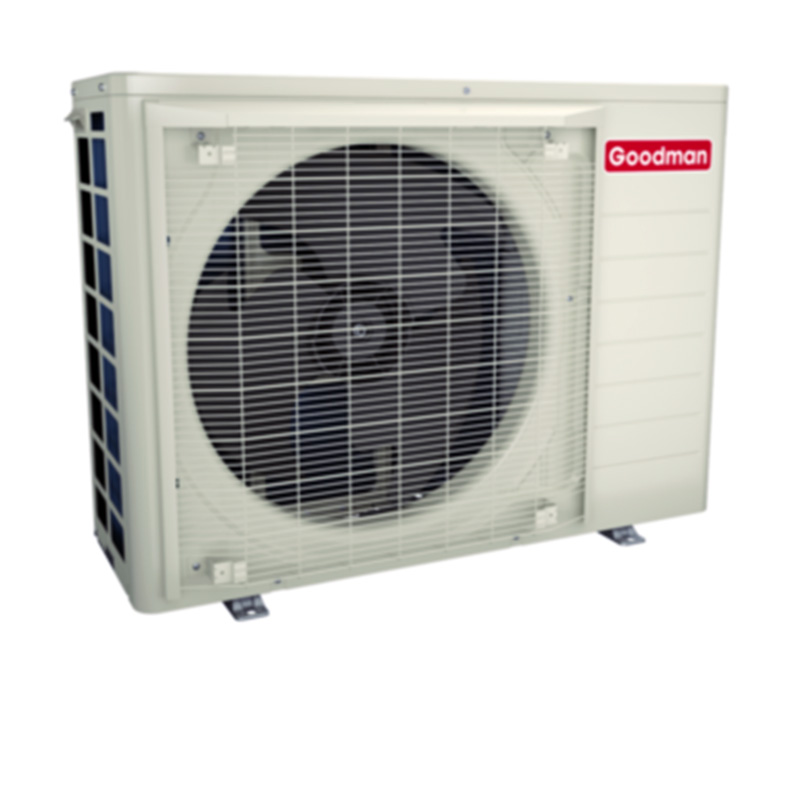
Goodman 2 Ton Variable-Speed Inverter Side Discharge Heat Pump, Up to 16.2 SEER2, High-Efficiency, R32 (GZV6SA2410)
View on AC Direct see your lowest price →Check current price on AC Direct →
Key features
- Variable-speed inverter compressor for precise capacity modulation and quieter part-load operation
- Up to 16.2 SEER2 efficiency rating, upper-mid tier above federal minimums
- R-32 refrigerant with lower global warming potential than R-410A
- Side-discharge cabinet design for installations with limited top clearance
- 2-ton (approximately 24,000 BTU) capacity suited to smaller or zoned applications
- Compatible with communicating thermostat controls that leverage inverter modulation
About this system
The Goodman GZV6SA2410 is a 2-ton variable-speed inverter heat pump rated up to 16.2 SEER2, using R-32 refrigerant and configured for side discharge. The variable-speed inverter compressor is the standout spec here: rather than cycling fully on and off like a single-stage unit, it ramps up and down to match the actual load in your home. That translates to steadier indoor temperatures, quieter operation at part load, and meaningfully lower runtime energy costs compared to single-stage or even two-stage alternatives. At 16.2 SEER2, this sits in the upper-mid efficiency tier, clearing the federal minimum by a solid margin without reaching the 18-plus SEER2 premium tier.
R-32 refrigerant is a forward-looking choice. It has a lower global warming potential than the R-410A it replaces, and it is increasingly the refrigerant manufacturers and technicians will stock as the industry moves away from R-410A. For a 2-ton application, this system is well suited to smaller homes, conditioned additions, or zones in a multi-system setup, roughly covering 800 to 1,200 square feet depending on your climate, insulation, and load calculation. The side-discharge configuration suits tight installations where top clearance is limited, but it does require more attention to airflow clearances on the sides during placement.
Goodman occupies a specific market position: equipment priced 15 to 25 percent below Trane, Lennox, and Carrier, with performance that depends heavily on installation quality. The GZV6SA2410 is no exception. The inverter technology raises the installation complexity bar compared to simpler units, so the caliber of your installer matters more here, not less.
The GZV6SA2410 delivers genuine variable-speed inverter performance and R-32 refrigerant at a price point that undercuts major premium brands by a noticeable margin. The trade-off is a brand track record that shows real reliability variance after year seven and documented failure modes that buyers should budget for. It is a solid choice for cost-conscious buyers who hire an experienced installer and keep up with maintenance.
Overall score is the average of the five ratings above.
What we like
- Variable-speed inverter compressor provides consistent temperatures and quieter part-load operation versus single-stage units
- 16.2 SEER2 rating offers meaningful energy savings over entry-level equipment
- R-32 refrigerant is lower-GWP and positions the system well ahead of the ongoing R-410A phase-down
- Priced 15 to 25 percent below comparable Trane, Carrier, and Lennox models, lowering upfront cost
- Side-discharge layout gives flexibility where vertical clearance is restricted
Trade-offs
- Dual-run capacitor failures are the most commonly reported Goodman repair, typically appearing within the first decade and costing 300 to 600 dollars to fix
- Evaporator coil leaks appear in a meaningful share of owner reviews, a more costly repair than a capacitor swap
- Compressor lifespan averages 10 to 14 years versus 15 to 20 years for premium-brand compressors, meaning earlier replacement is more likely
- Inverter variable-speed systems require a more experienced installer than simple single-stage units; a poor install amplifies every reliability risk the brand already carries
What homeowners and pros say about Goodman
Goodman’s reputation among homeowners is genuinely split, and the numbers reflect that split clearly. On ConsumerAffairs, the brand sits at roughly 2.5 out of 5, a score pulled down by owners who came back to report repair costs climbing after year seven or so. On Google dealer reviews, the picture is closer to 3.8 out of 5 across a broader sample, where the most common praise centers on the lower upfront price. For the GZV6SA2410 specifically, potential buyers should go in with eyes open about the documented failure modes: dual-run capacitor failures are the most frequently reported repair, typically a straightforward 300 to 600 dollar fix but one that tends to show up within the first decade. Evaporator coil leaks appear in a meaningful share of owner accounts and are a costlier fix. Goodman compressors have averaged 10 to 14 years in real-world use, noticeably shorter than the 15 to 20 years more commonly seen with premium-brand compressors.
HVAC technicians who work on Goodman equipment regularly note that the brand’s outcome variance traces back to installation more than almost any other factor. A variable-speed inverter system like the GZV6SA2410 raises the stakes on that point: the refrigerant charge, electrical connections, and control setup all matter more on an inverter unit than on a basic single-stage system. A small percentage of early refrigerant leak reports, often within the first year, point to installation or charge issues rather than manufacturing defects. The practical takeaway from both owner feedback and technician commentary is consistent: the GZV6SA2410 can deliver solid variable-speed comfort and efficiency at a real cost savings, but the installer you hire and the maintenance schedule you keep will shape the outcome more than the nameplate alone.
Sources: ConsumerAffairs Goodman owner reviews, AHRI Directory of Certified Product Performance, U.S. DOE appliance and equipment efficiency standards, Goodman product specification sheets.
What it costs to run
At 16.2 SEER2, cooling this 2-ton system for a typical 1200-hour cooling season at the U.S. average electricity rate of $0.17/kWh works out to roughly $302 per year in cooling, about $63 less per year than a minimum-efficiency 13.4 SEER2 unit of the same size. Your real cost depends on your climate and local rate.
Method: (24,000 BTU/hr ÷ 16.2 SEER2) × 1200 hours ÷ 1000 × $0.17/kWh. Rate source: U.S. EIA average; cooling hours: moderate-climate estimate.
How it compares
| Brand | Comparable model | SEER2 | Stage | Price position |
|---|---|---|---|---|
| Goodman | GZV6SA2410 | 16.2 | Variable-speed inverter | Value pick |
| Carrier | Infinity 16 Heat Pump (25VNA0) | Up to 17 SEER2 | Variable-speed | Approximately 20 to 25 percent higher than Goodman |
| Trane | XV17 Heat Pump | Up to 17.5 SEER2 | Variable-speed | Approximately 20 to 30 percent higher than Goodman |
| Lennox | XP16 Heat Pump | Up to 17 SEER2 | Variable-speed | Approximately 20 to 25 percent higher than Goodman |
Competitor rows are comparable single-stage units at similar efficiency; price is relative position, not a quote.
Questions about this system
What size home does a 2-ton heat pump actually cover?
As a rough guide, 2 tons handles approximately 800 to 1,200 square feet in a well-insulated home in a moderate climate. That range shifts significantly based on ceiling height, window area, insulation quality, and your local climate zone. A proper Manual J load calculation from your installer is the only reliable way to confirm a 2-ton unit is right for your specific space.
Does the variable-speed inverter on this Goodman require a special thermostat?
The system will operate with a standard 24-volt thermostat, but you will not capture the full benefit of inverter modulation without a compatible communicating or inverter-capable thermostat. Ask your installer which thermostat models are compatible with the GZV6SA2410 to get the most out of the variable-speed capability.
Why does Goodman score so low on ConsumerAffairs but better on Google dealer reviews?
ConsumerAffairs draws a complaint-skewed audience, so its roughly 2.5 out of 5 score reflects owners who had problems, not a random sample of all owners. Google dealer reviews average around 3.8 out of 5 and include a broader mix of experiences, with affordability cited most often as a positive. Neither score tells the whole story on its own.
What does R-32 refrigerant mean for service and future repairs?
R-32 is being adopted broadly as the industry phases down R-410A, so technician familiarity and refrigerant availability are both improving. It has a lower global warming potential than R-410A. The main practical note is that R-32 is mildly flammable, classified A2L, which means your service technician needs to follow updated handling procedures, but this is increasingly standard training in the trade.
What are the most likely repair costs I should budget for over the first ten years?
The most common Goodman repair is a dual-run capacitor failure, typically running 300 to 600 dollars including labor. Evaporator coil leaks are a less frequent but more expensive issue documented in owner reviews. A small percentage of owners also report refrigerant leaks within the first year, which is usually tied to the quality of the initial installation and refrigerant charge rather than a product defect.
Specifications
| Cooling capacity | 2 Ton |
| Efficiency | 16.2 SEER2 |
| Refrigerant | R-32 |
| Model | GZV6SA2410 |