Goodman 3.5 Ton Variable-Speed Inverter Side Discharge Heat Pump, Up to 16.2 SEER2, High-Efficiency, R32 (GZV6SA4210)
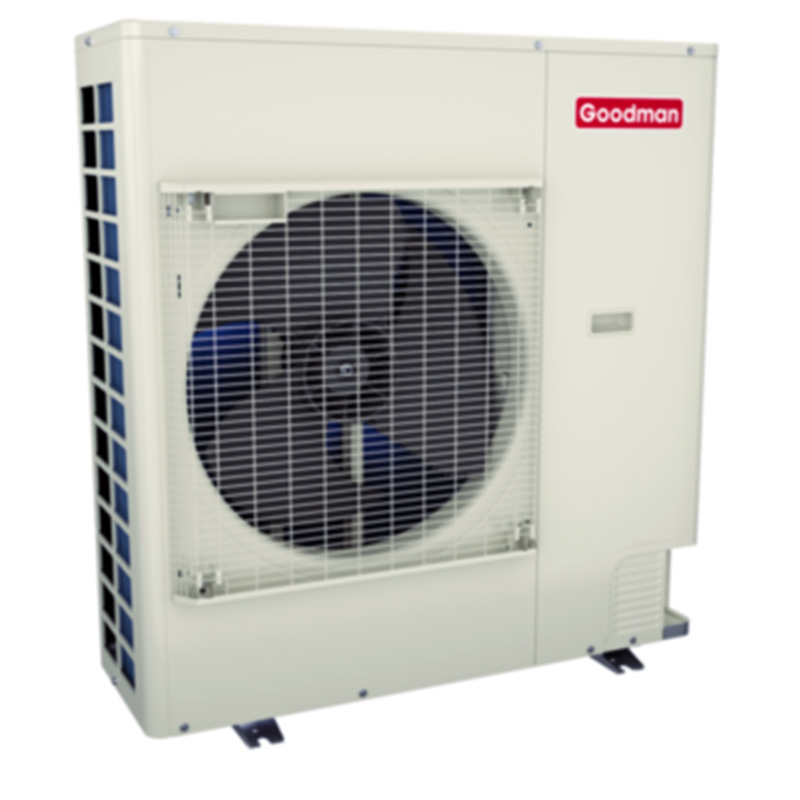
View on AC Direct see your lowest price →Check current price on AC Direct →
Key features
- Variable-speed inverter compressor for continuous capacity modulation and quieter operation
- Up to 16.2 SEER2 efficiency rating, meeting high-efficiency thresholds in most U.S. climate zones
- R-32 refrigerant with lower global warming potential than R-410A
- Side-discharge design for installations with restricted overhead clearance
- 3.5-ton capacity suited to homes roughly 1,800 to 2,400 square feet depending on insulation and climate
- 10-year parts warranty when registered within 60 days of installation by a licensed contractor
About this system
The Goodman GZV6SA4210 is a 3.5-ton variable-speed inverter heat pump designed for homes in the 1,800 to 2,400 square foot range that need serious heating and cooling capacity without the price tag of a premium brand. The inverter-driven compressor modulates output continuously rather than cycling on and off at full blast, which means steadier temperatures room to room, quieter operation compared to single-stage units, and lower utility bills during the long shoulder seasons when you only need partial capacity. At up to 16.2 SEER2, it clears the federal minimums for most U.S. climate zones with room to spare, landing in the high-efficiency tier without reaching the ultra-premium ratings of 18 SEER2 and above.
The switch to R-32 refrigerant is worth noting. R-32 has a lower global warming potential than the R-410A it replaces, and it operates at slightly higher pressures, which means any technician you hire must be equipped and trained for it. The side-discharge configuration suits installations where vertical airflow above the unit is obstructed, such as under a deck or close to a roof overhang, but it also requires more careful clearance planning on the sides to maintain proper airflow. This system is best paired with a communicating air handler and a matched Goodman coil to capture the full efficiency rating and to qualify for the 10-year parts warranty.
The GZV6SA4210 delivers genuine variable-speed efficiency at a price point that undercuts Carrier, Trane, and Lennox by a meaningful margin, making it a solid choice for budget-conscious buyers who hire a skilled installer. The trade-off is a documented history of component failures past year seven and compressor longevity that trails premium competitors, so the lower upfront cost needs to be weighed against a realistic service budget over the system's life.
Overall score is the average of the five ratings above.
What we like
- Variable-speed inverter operation delivers more consistent comfort and lower part-load energy use than single or two-stage alternatives
- 16.2 SEER2 is a legitimately high-efficiency rating, not just a box-checking number
- Priced roughly 15 to 25 percent below comparable Carrier, Trane, and Lennox models, leaving room in the budget for quality installation
- R-32 refrigerant is more environmentally responsible and is becoming the industry standard
- Side-discharge cabinet opens up installation locations that standard top-discharge units cannot use
Trade-offs
- Compressor lifespan averages 10 to 14 years versus 15 to 20 years for premium brands, meaning a higher probability of a major repair or replacement in the second decade
- Dual-run capacitor failures are the most common reported issue, typically appearing after year five and running 300 to 600 dollars per service call
- Evaporator coil leaks appear in a meaningful share of owner reviews, and a coil replacement on a variable-speed system is not a cheap repair
- R-32 requires specifically equipped technicians, which can limit your service options in some rural or smaller markets
What homeowners and pros say about Goodman
Homeowners who research Goodman online encounter a split picture. On ConsumerAffairs, the brand scores around 2.5 out of 5, a platform where dissatisfied owners are far more likely to post than satisfied ones. The recurring complaint in those reviews is not early failure so much as repair costs that start climbing after roughly year seven, with capacitor replacements and coil work being the most cited culprits. Dual-run capacitor failures are the most commonly documented issue across Goodman systems generally, typically a 300 to 600 dollar repair, and evaporator coil leaks appear in a meaningful share of owner accounts as well. Compressor longevity on Goodman equipment tends to land in the 10 to 14 year range, which is a real gap compared to the 15 to 20 years owners of premium brands often report. A smaller but notable group of owners also describe refrigerant leaks within the first year, which technicians generally attribute to installation or initial charge issues rather than a manufacturing defect.
On Google, Goodman dealer reviews average around 3.8 out of 5 across several hundred reviews per location, and the tone there is more balanced. Affordability is the most consistent praise, with many reviewers noting they got a variable-speed or higher-efficiency system they could not have afforded under a premium brand name. HVAC professionals tend to frame Goodman similarly: a workable system whose outcome depends heavily on who installs it and whether the homeowner budgets for routine maintenance and the occasional component replacement. For the GZV6SA4210 specifically, the inverter compressor and R-32 refrigerant add complexity that raises the stakes on installation quality even further, making contractor selection arguably as important as the equipment choice itself.
Sources: ConsumerAffairs Goodman owner reviews, AHRI Directory of Certified Product Performance, U.S. DOE appliance and equipment efficiency standards, Goodman product specification sheets.
What it costs to run
At 16.2 SEER2, cooling this 3.5-ton system for a typical 1200-hour cooling season at the U.S. average electricity rate of $0.17/kWh works out to roughly $529 per year in cooling, about $110 less per year than a minimum-efficiency 13.4 SEER2 unit of the same size. Your real cost depends on your climate and local rate.
Method: (42,000 BTU/hr ÷ 16.2 SEER2) × 1200 hours ÷ 1000 × $0.17/kWh. Rate source: U.S. EIA average; cooling hours: moderate-climate estimate.
How it compares
| Brand | Comparable model | SEER2 | Stage | Price position |
|---|---|---|---|---|
| Goodman | GZV6SA4210 | 16.2 | Variable-speed inverter | Value pick |
| Carrier | 24VNA0 (Infinity Series) | up to 17.5 | Variable-speed inverter | 20 to 30 percent above this Goodman |
| Trane | XV18 (TTV Series) | up to 17.5 | Variable-speed inverter | 20 to 30 percent above this Goodman |
| Lennox | XP16 (Merit Series) | up to 17.0 | Two-stage | 10 to 20 percent above this Goodman |
Competitor rows are comparable single-stage units at similar efficiency; price is relative position, not a quote.
Questions about this system
Does this unit work as a heat pump in cold climates, and what is the heating performance at low outdoor temperatures?
Goodman does not publish a rated heating capacity at low ambient temperatures for this model in publicly available spec sheets, so you should ask your contractor for the expanded performance data table before purchasing. Variable-speed inverter heat pumps generally perform better in cold weather than single-stage units, but if you live in a climate that regularly drops below 15 to 20 degrees Fahrenheit, confirm that the unit meets your heating load at those conditions or plan for supplemental heat.
What does the 10-year warranty actually cover, and are there conditions that can void it?
The 10-year parts warranty requires the unit to be registered with Goodman within 60 days of installation by a licensed HVAC contractor. Without registration it reverts to a 5-year limited parts warranty. Labor is not included, which is significant because labor on a variable-speed compressor or coil replacement can exceed the part cost itself.
Is R-32 refrigerant harder to find or more expensive to service than R-410A?
R-32 is widely available and its adoption is growing quickly as the industry phases out R-410A. The main practical difference is that R-32 is mildly flammable, classified A2L, which means technicians need specific equipment and some older recovery machines are not rated for it. In most metro areas this is not an issue, but in rural markets you should confirm your local service contractors are equipped for R-32 before buying.
How important is installer quality for this specific system compared to a simpler single-stage unit?
It matters more, not less. Variable-speed inverter systems have tighter refrigerant charge tolerances and more complex communicating controls than single-stage units. An imprecise charge or a wiring error that a single-stage unit might tolerate can cause an inverter system to fault repeatedly or underperform. HVAC technicians consistently cite installation quality as the single biggest factor in how long a Goodman system lasts.
What air handler or coil does this unit need to reach the 16.2 SEER2 rating?
The rated efficiency is only achievable with a matched, communicating Goodman or Daikin air handler and coil combination that has been tested together as a system. Pairing this outdoor unit with a mismatched or non-communicating air handler will lower actual efficiency, may prevent the variable-speed operation from functioning correctly, and can affect warranty eligibility. Ask your contractor to pull the AHRI certificate for the specific matched combination before the quote is finalized.
Specifications
| Cooling capacity | 3.5 Ton |
| Efficiency | 16.2 SEER2 |
| Refrigerant | R-32 |
| Model | GZV6SA4210 |