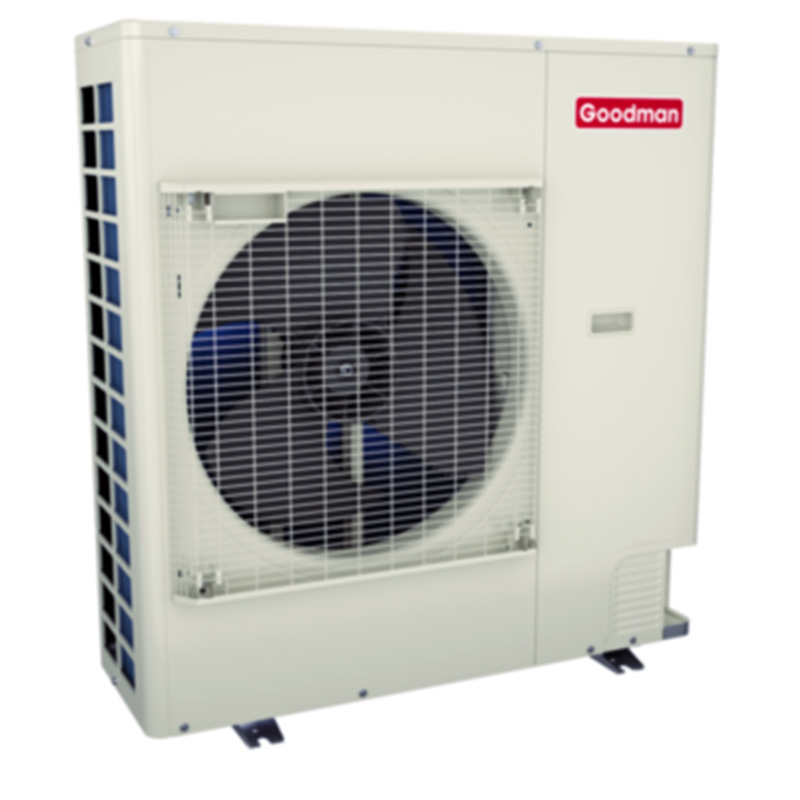
Goodman 5 Ton Variable-Speed Inverter Side Discharge Heat Pump, Up to 16.2 SEER2, High-Efficiency, R32 (GZV6SA6010)
View on AC Direct see your lowest price →Check current price on AC Direct →
Key features
- Variable-speed inverter compressor modulates capacity continuously for even temperatures and humidity control
- Up to 16.2 SEER2 efficiency rating, upper tier of Goodman's heat pump lineup
- R-32 refrigerant with lower global warming potential and reduced charge volume versus R-410A
- 5-ton capacity suited to larger homes, typically 2,400 to 3,200 sq ft depending on load calculation
- Side-discharge condenser design, requires careful clearance planning during installation
- Compatible with Goodman's 10-year parts warranty when registered within 60 days of install
About this system
The Goodman GZV6SA6010 is a 5-ton variable-speed inverter heat pump built around R-32 refrigerant and rated up to 16.2 SEER2. At 5 tons, it targets larger homes in the 2,400 to 3,200 square foot range, depending on climate and insulation, where a single-stage or two-stage unit would cycle on and off repeatedly instead of modulating output to match the actual load. The variable-speed inverter compressor does exactly that: it runs at partial capacity most of the time, which flattens humidity swings, reduces temperature overshoots, and cuts compressor wear compared to units that hammer on and off all day.
The 16.2 SEER2 rating sits at the upper edge of Goodman’s efficiency lineup, clearing the federal minimums by a comfortable margin and qualifying for the 25C tax credit in most cases (verify with a tax professional). R-32 refrigerant has a lower global warming potential than R-410A and requires a smaller refrigerant charge to do the same work, which is part of why this platform achieves higher efficiency figures. Side-discharge configuration is worth noting for install planning: it throws condenser air out the side rather than the top, so placement near fences, walls, or tight equipment pads needs clearance review before the unit ships. Buyers who want this level of efficiency in a 5-ton package and are willing to invest in a qualified installer will get a competitive-spec system at a price meaningfully below premium brands.
The GZV6SA6010 delivers genuine variable-speed performance and above-average efficiency at a price 15 to 25 percent below comparable Carrier, Trane, and Lennox units, making it a legitimate choice for budget-conscious buyers who hire a skilled installer. The trade-off is real: Goodman's documented history of capacitor failures, evaporator coil leaks, and compressor lifespans that average shorter than premium brands means the savings on day one can narrow over a 12 to 15 year horizon. How long this system lasts depends heavily on install quality and annual maintenance.
Overall score is the average of the five ratings above.
What we like
- Variable-speed inverter compressor provides precise capacity control, reducing humidity and temperature swings
- 16.2 SEER2 efficiency is competitive with premium brands and supports federal tax credit eligibility
- R-32 refrigerant is more environmentally responsible and future-friendly than R-410A
- Purchase price is substantially lower than equivalent-spec Trane, Lennox, or Carrier systems
- 10-year registered parts warranty covers major components including the compressor when installed and registered properly
Trade-offs
- Dual-run capacitor failures are the most commonly reported repair, typically appearing after year 5 and costing $300 to $600 per incident
- Evaporator coil leaks appear in a meaningful share of owner reviews and can be an expensive mid-life repair
- Compressor longevity averages 10 to 14 years versus 15 to 20 years for premium brands, meaning total-cost-of-ownership advantages shrink over time
- Side-discharge configuration adds site planning complexity and may not suit tight equipment pads or fence lines without careful clearance review
What homeowners and pros say about Goodman
Owners and contractors who follow Goodman across online forums and review platforms tend to land in the same place: the hardware is real, the specs are honest, and the price gap versus Carrier or Trane is not marketing noise. On Google dealer reviews, Goodman installations average around 3.8 out of 5 across hundreds of reviews per location, with affordability and accessibility of parts being the most consistent praise. The picture is less flattering on ConsumerAffairs, where the brand sits near 2.5 out of 5, though that channel skews heavily toward owners who had a problem and wanted somewhere to say so, rather than satisfied customers. Still, the documented failure patterns in those reviews are consistent enough to be taken seriously: dual-run capacitors failing in the $300 to $600 repair range after year five, evaporator coil leaks showing up in a meaningful share of units, and compressor lifespans that technicians put at roughly 10 to 14 years rather than the 15 to 20 years more common with premium brands.
For the GZV6SA6010 specifically, the variable-speed inverter platform adds a layer of complexity relative to Goodman’s basic single-stage lineup, which means install quality matters even more than it does on simpler equipment. Technicians who work on inverter systems regularly emphasize that a correct refrigerant charge, proper airflow, and a matched indoor coil are non-negotiable for this class of unit to perform close to its rated SEER2. Homeowners who chose Goodman inverter systems and paired them with experienced installers report performance broadly in line with what the spec sheet promises. Those who bought on price alone and hired whoever was cheapest report a different experience. That pattern, more than any single component issue, is what Goodman’s real-world reputation is built on.
Sources: ConsumerAffairs Goodman owner reviews, AHRI Directory of Certified Product Performance, U.S. DOE appliance and equipment efficiency standards, Goodman product specification sheets.
What it costs to run
At 16.2 SEER2, cooling this 5-ton system for a typical 1200-hour cooling season at the U.S. average electricity rate of $0.17/kWh works out to roughly $756 per year in cooling, about $157 less per year than a minimum-efficiency 13.4 SEER2 unit of the same size. Your real cost depends on your climate and local rate.
Method: (60,000 BTU/hr ÷ 16.2 SEER2) × 1200 hours ÷ 1000 × $0.17/kWh. Rate source: U.S. EIA average; cooling hours: moderate-climate estimate.
How it compares
| Brand | Comparable model | SEER2 | Stage | Price position |
|---|---|---|---|---|
| Goodman | GZV6SA6010 | 16.2 | Variable-speed inverter | Value pick |
| Carrier | Infinity 20 (25VNA0) | Up to 20 SEER2 | Variable-speed inverter | Significantly higher than Goodman |
| Trane | XV18 (4TWV8) | Up to 18 SEER2 | Variable-speed inverter | Notably higher than Goodman |
| Lennox | Signature XP21 | Up to 17.5 SEER2 | Variable-speed | Moderately to significantly higher than Goodman |
Competitor rows are comparable single-stage units at similar efficiency; price is relative position, not a quote.
Questions about this system
Why does side discharge matter for a 5-ton unit, and what clearances do I need?
Side-discharge units exhaust hot condenser air out the side panel rather than upward, so the area beside the unit needs to be free of obstructions like fences, walls, or dense shrubs. Goodman's installation manual specifies minimum clearances that your installer must follow; ignoring them can cause the unit to recirculate hot air, hurt efficiency, and accelerate compressor wear. Confirm your equipment pad location before ordering.
How does R-32 refrigerant affect service costs compared to R-410A?
R-32 has a lower global warming potential and requires a smaller charge volume, which can mean slightly lower material cost for a refrigerant top-off. However, R-32 is mildly flammable (A2L classification), so technicians need specific certification and equipment to handle it safely. Most established HVAC companies are already equipped for it, but confirm with your service provider before scheduling work.
The reviews mention capacitor failures. How worried should I be, and what does a repair cost?
Dual-run capacitor failure is the most commonly documented repair on Goodman heat pumps and is generally a quick fix in the $300 to $600 range including labor. It is not unique to Goodman, but it does show up with enough frequency in owner feedback to be worth budgeting for after year five. Keeping the unit on an annual maintenance plan helps catch early signs of capacitor degradation before it becomes a breakdown.
Does this system qualify for the federal 25C tax credit?
As of current IRS guidance, heat pumps meeting the 15 SEER2 threshold (which this unit clears) can qualify for the 25C tax credit up to $2,000 annually. Tax eligibility depends on your specific situation, income, and how the credit is applied in a given year, so confirm with a tax professional and keep your installation invoice and equipment specs on file.
What does the 10-year warranty actually cover, and what can void it?
When registered online within 60 days of installation, Goodman provides a 10-year parts warranty covering major components including the compressor, coil, and functional parts. The warranty requires installation by a licensed HVAC contractor and can be voided by improper refrigerant charge, installing the unit without following manufacturer specs, or failure to use a matched indoor coil or air handler. Keep your registration confirmation and installer documentation in a safe place.
Specifications
| Cooling capacity | 5 Ton |
| Efficiency | 16.2 SEER2 |
| Refrigerant | R-32 |
| Model | GZV6SA6010 |