Goodman 2 Ton Variable-Speed Inverter Side Discharge Heat Pump, Up to 19 SEER2, R32 (GZV7SA2410)
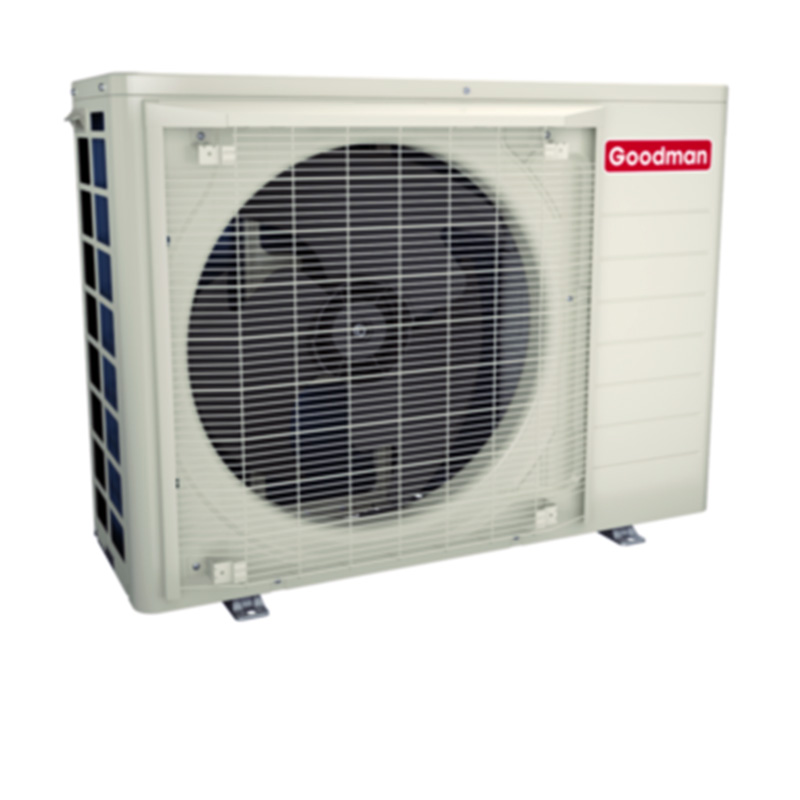
View on AC Direct see your lowest price →Check current price on AC Direct →
Key features
- Variable-speed inverter compressor for continuous capacity modulation and quieter partial-load operation
- Up to 19 SEER2 efficiency rating, qualifying for the federal 25C energy efficiency tax credit
- R-32 refrigerant with lower global warming potential than R-410A
- Side-discharge cabinet design for installations with overhead clearance or spacing constraints
- 2-ton (approximately 24,000 BTU/h) capacity suited to smaller conditioned spaces
- Compatible with communicating thermostat systems for tighter system-level control
About this system
The Goodman GZV7SA2410 is a 2-ton variable-speed inverter heat pump rated up to 19 SEER2, running on R-32 refrigerant and configured for side discharge. At this efficiency tier, a variable-speed compressor modulates output continuously rather than cycling on and off at full blast, which means more consistent indoor temperatures, quieter operation at partial load, and meaningfully lower electricity bills compared to single-stage equipment. R-32 has a lower global warming potential than the R-410A it replaces, and it also carries a slightly higher energy density, which contributes to the efficiency gains you see here.
This unit is sized for smaller homes, conditioned spaces roughly in the 900 to 1,200 square foot range depending on climate zone and insulation quality, though a proper Manual J load calculation should drive the final sizing decision. The side-discharge configuration suits installations where overhead clearance is limited or where the unit sits close to a fence or wall on one side. At the 19 SEER2 ceiling, this system qualifies for the federal 25C energy efficiency tax credit, which can offset a portion of the installed cost for eligible homeowners replacing existing equipment.
Goodman positions this as a high-efficiency product at a value price point, typically 15 to 25 percent below comparable Carrier, Trane, or Lennox variable-speed equipment. That gap is real, and so are the trade-offs. The brand’s long-term performance record is more variable than the premium tier, and getting the most out of this system depends heavily on the quality of the installation and the ongoing maintenance it receives.
The GZV7SA2410 delivers genuine high-efficiency variable-speed performance at a price that undercuts the major premium brands by a meaningful margin, making it a reasonable choice for budget-conscious buyers who can secure a skilled installer and commit to routine maintenance. The efficiency numbers are real, but so is Goodman's track record of higher repair frequency after the first several years compared to Trane, Carrier, or Lennox. This is a system where the installer and the maintenance schedule matter as much as the hardware.
Overall score is the average of the five ratings above.
What we like
- 19 SEER2 variable-speed operation delivers genuine efficiency gains and comfort improvements over single-stage equipment
- R-32 refrigerant is lower-impact environmentally and supports the efficiency rating
- Purchase price typically runs 15 to 25 percent below comparable Carrier, Trane, and Lennox variable-speed units
- Side-discharge configuration expands placement options where vertical clearance or rear access is restricted
- Qualifies for the federal 25C tax credit, reducing effective out-of-pocket cost for eligible replacements
Trade-offs
- Compressor lifespan averages 10 to 14 years versus 15 to 20 years typical of premium-brand compressors
- Dual-run capacitor failures are the most commonly reported repair, and evaporator coil leaks appear in a notable share of owner reports
- A minority of owners have reported refrigerant leaks within the first year, typically tied to installation or charging errors rather than defective components
- ConsumerAffairs reviews average around 2.5 out of 5, with recurring complaints about rising repair costs after roughly year 7
What homeowners and pros say about Goodman
Among homeowners, Goodman draws a predictable split of opinions. On Google dealer review pages, the brand averages around 3.8 out of 5 across hundreds of reviews per location, where the most common praise is straightforward: the equipment does what it is supposed to do at a price that fits the budget. On ConsumerAffairs, the score drops to roughly 2.5 out of 5, a channel that skews toward dissatisfied owners, and the recurring complaint there is not early failure so much as repair costs that start climbing after approximately year 7. Dual-run capacitor failures are the most frequently mentioned specific repair, typically a quick, relatively low-cost fix. Evaporator coil leaks show up with enough frequency in owner accounts to be worth noting, and a smaller group of owners have reported refrigerant leaks within the first year, an issue technicians most often trace back to installation or charging errors.
On the professional side, HVAC technicians tend to view Goodman as serviceable equipment whose outcome depends more on the installer than the factory. Variable-speed inverter systems like the GZV7SA2410 are less forgiving of sloppy setup than simpler single-stage units, so technicians with specific inverter system experience are the right call here. The compressor lifespan question is one pros raise consistently: Goodman compressors average 10 to 14 years in real-world reports, versus the 15 to 20 years more commonly associated with Trane, Carrier, and Lennox. That gap matters most in year 11 or 12 when a compressor replacement on an otherwise functioning system forces a cost-versus-replace decision earlier than premium-brand owners typically face it. For buyers who go in clear-eyed about that trade-off and prioritize a lower upfront number, this unit at 19 SEER2 represents a legitimate option rather than a compromise.
Sources: ConsumerAffairs Goodman owner reviews, AHRI Directory of Certified Product Performance, U.S. DOE appliance and equipment efficiency standards, Goodman product specification sheets.
What it costs to run
At 19 SEER2, cooling this 2-ton system for a typical 1200-hour cooling season at the U.S. average electricity rate of $0.17/kWh works out to roughly $258 per year in cooling, about $107 less per year than a minimum-efficiency 13.4 SEER2 unit of the same size. Your real cost depends on your climate and local rate.
Method: (24,000 BTU/hr ÷ 19 SEER2) × 1200 hours ÷ 1000 × $0.17/kWh. Rate source: U.S. EIA average; cooling hours: moderate-climate estimate.
How it compares
| Brand | Comparable model | SEER2 | Stage | Price position |
|---|---|---|---|---|
| Goodman | GZV7SA2410 | 19 | Variable-speed inverter | Value pick |
| Carrier | Infinity 20 (25VNA0) | 20 | Variable-speed inverter | 20 to 30 percent higher than this Goodman |
| Trane | XV20i (4TWV0) | 20 | Variable-speed inverter | 20 to 30 percent higher than this Goodman |
| Lennox | XP21 | 19.8 | Variable-speed inverter | 20 to 25 percent higher than this Goodman |
Competitor rows are comparable single-stage units at similar efficiency; price is relative position, not a quote.
Questions about this system
Does this unit qualify for the federal energy efficiency tax credit?
Yes. At up to 19 SEER2 with a variable-speed compressor, the GZV7SA2410 meets the efficiency thresholds for the 25C tax credit, which covers up to 30 percent of the installed cost (equipment and labor combined) up to a $2,000 annual cap for heat pumps. Confirm your specific tax situation with a tax professional and retain your contractor's itemized invoice.
What are the most common repairs owners report on Goodman heat pumps like this one?
Dual-run capacitor failures are the most frequently cited issue, typically a relatively affordable repair in the $300 to $600 range. Evaporator coil leaks and refrigerant leaks also appear in owner reports, with early refrigerant leaks most often attributed to installation or charge issues rather than factory defects. Compressors on Goodman units tend to average 10 to 14 years, which is shorter than the 15 to 20 years more commonly seen with premium-brand compressors.
Why does the side-discharge configuration matter for my installation?
Side-discharge units exhaust conditioned air out the side panel rather than upward through a top grille. This allows placement in tighter spaces where overhead clearance is limited, such as under a deck, in a utility corridor, or against a wall or fence with restricted top clearance. Your installer will still need adequate side clearance for airflow and service access, so confirm the specific spacing requirements in the installation manual.
R-32 is relatively new in residential heat pumps. Is it harder to find a technician who can service it?
R-32 adoption has grown steadily and most licensed HVAC technicians are now equipped and certified to handle it, but it is worth confirming with any service company before scheduling. R-32 is mildly flammable (A2L classification), which requires specific handling procedures and recovery equipment. In areas with older service fleets or rural markets, availability of technicians comfortable with A2L refrigerants may be more limited.
How much does install quality actually affect how long this system lasts?
HVAC technicians consistently cite installation quality as the single largest factor in Goodman equipment longevity, more so than with some premium brands that have more tolerance for suboptimal setup. Proper refrigerant charge, correct airflow across the coil, accurate load calculation, and tight electrical connections at startup all have a direct effect on compressor wear and coil integrity. Getting multiple bids and asking installers specifically about their experience with variable-speed inverter systems is a reasonable step before committing.
Specifications
| Cooling capacity | 2 Ton |
| Efficiency | 19 SEER2 |
| Refrigerant | R-32 |
| Model | GZV7SA2410 |