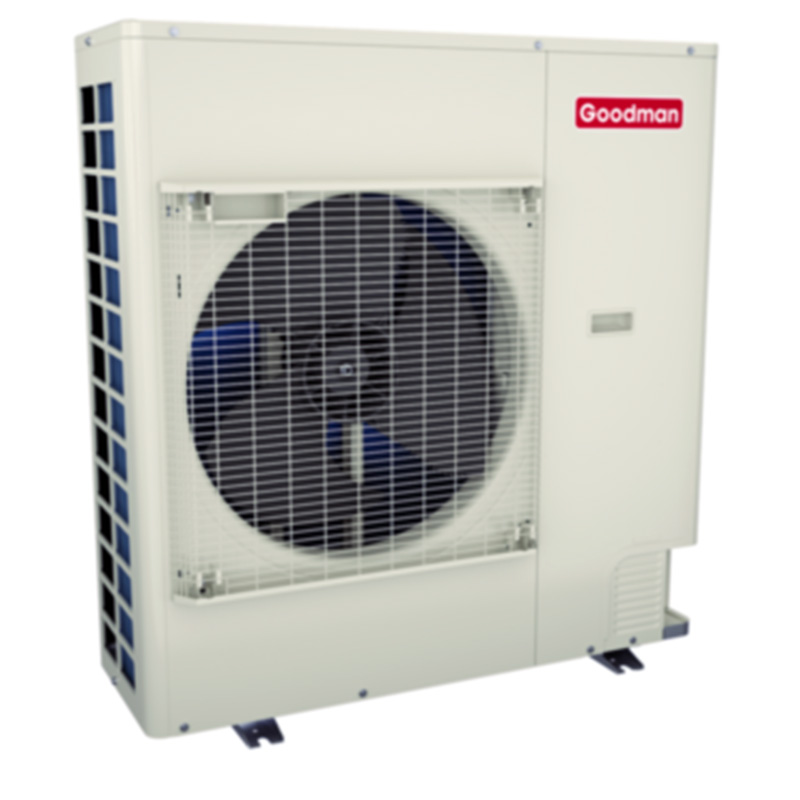
Goodman 3 Ton Variable-Speed Inverter Side Discharge Heat Pump, Up to 19 SEER2, R32 (GZV7SA3610)
View on AC Direct see your lowest price →Check current price on AC Direct →
Key features
- Variable-speed inverter compressor modulates continuously for precise temperature control
- Up to 19 SEER2 rated efficiency on R-32 refrigerant
- Side-discharge cabinet suits installations with limited overhead clearance
- R-32 refrigerant has roughly 68 percent lower global warming potential than R-410A
- Compatible with communicating thermostats for enhanced system monitoring
- Factory-installed filter drier and tested at the factory before shipment
About this system
The Goodman GZV7SA3610 is a 3-ton variable-speed inverter heat pump running on R-32 refrigerant with a rated efficiency of up to 19 SEER2. The variable-speed inverter compressor is the core selling point here: rather than cycling fully on and off, it modulates output continuously to match your home’s actual load, which translates to steadier indoor temperatures, quieter operation at partial capacity, and meaningfully lower monthly energy bills compared to single-stage or two-stage units. The side-discharge configuration works well in tight installations where overhead clearance is limited.
At 19 SEER2, this unit sits at the upper end of mid-tier efficiency for ducted residential heat pumps. That rating is achievable but depends heavily on a matched indoor coil, a properly sized refrigerant charge, and quality ductwork. R-32 refrigerant has a lower global warming potential than the R-410A it replaces and is the direction the industry is heading, though it requires technicians certified to handle its mildly flammable classification. This system suits homeowners in mixed climates who want inverter-level comfort and efficiency without paying Carrier, Trane, or Lennox premium prices, and who are prepared to budget for ongoing maintenance and potential mid-life repairs.
The GZV7SA3610 delivers genuine inverter-class comfort and solid efficiency at a price point well below comparable Carrier, Trane, or Lennox equipment, making it a credible choice for budget-conscious buyers willing to accept Goodman's historically shorter compressor lifespan and a repair record that gets bumpier after year seven. Install quality matters more here than with premium brands, so the contractor you hire is nearly as important as the unit itself.
Overall score is the average of the five ratings above.
What we like
- Variable-speed inverter operation provides consistent temperatures and quiet part-load running
- 19 SEER2 rating delivers real energy savings over single-stage or two-stage alternatives
- R-32 refrigerant is more environmentally responsible and increasingly supported by service technicians
- Priced 15 to 25 percent below comparable Carrier, Trane, and Lennox inverter heat pumps
- Side-discharge layout offers flexibility in space-constrained outdoor installations
Trade-offs
- Compressor longevity averages 10 to 14 years versus 15 to 20 years typical of premium brands
- Dual-run capacitors are a documented weak point and a likely repair within the first decade
- Evaporator coil leaks appear in a meaningful share of owner reports, a recurring reliability concern
- A minority of early owners report refrigerant leaks in year one, often tied to install or initial charge issues
What homeowners and pros say about Goodman
On ConsumerAffairs, Goodman as a brand scores around 2.5 out of 5, though that channel draws a disproportionate share of frustrated owners and is not a statistically clean sample. The recurring pattern in those reviews is not early catastrophic failure but rather repair costs that start accumulating after roughly year seven, with dual-run capacitor replacements and evaporator coil leaks among the most frequently named issues. Google dealer reviews tell a more balanced story, averaging around 3.8 out of 5 across locations, where the most consistent praise is straightforward: the systems are affordable, and for buyers who get a solid installation, they often deliver reliable cooling and heating through the mid-range of their expected lifespan.
HVAC technicians tend to have a nuanced view of Goodman equipment specifically when it involves variable-speed and inverter technology. The general consensus in the trades is that a Goodman unit installed carefully by an experienced technician who verifies the refrigerant charge, checks static pressure, and sets up the controls correctly will perform reasonably well for 10 to 12 years. The documented weak points on this platform are consistent with broader Goodman history: capacitors are a likely single repair at some point, a subset of owners will encounter an evaporator coil leak, and compressor longevity is expected to run shorter than what premium brands achieve. For the GZV7SA3610 specifically, the R-32 refrigerant adds a layer of install complexity that makes technician selection especially important, since an improperly charged R-32 system is one of the cited root causes of first-year refrigerant leak reports across the brand.
Sources: ConsumerAffairs Goodman owner reviews, AHRI Directory of Certified Product Performance, U.S. DOE appliance and equipment efficiency standards, Goodman product specification sheets.
What it costs to run
At 19 SEER2, cooling this 3-ton system for a typical 1200-hour cooling season at the U.S. average electricity rate of $0.17/kWh works out to roughly $387 per year in cooling, about $161 less per year than a minimum-efficiency 13.4 SEER2 unit of the same size. Your real cost depends on your climate and local rate.
Method: (36,000 BTU/hr ÷ 19 SEER2) × 1200 hours ÷ 1000 × $0.17/kWh. Rate source: U.S. EIA average; cooling hours: moderate-climate estimate.
How it compares
| Brand | Comparable model | SEER2 | Stage | Price position |
|---|---|---|---|---|
| Goodman | GZV7SA3610 | 19 | Variable-speed inverter | Value pick |
| Carrier | Infinity 20 (25VNA0) | 20 | Variable-speed inverter | 20 to 30 percent above Goodman |
| Trane | XV20i (4TWV0) | 20 | Variable-speed inverter | 25 to 35 percent above Goodman |
| Lennox | Signature XP21 | 19-20 | Variable-speed inverter | 20 to 30 percent above Goodman |
Competitor rows are comparable single-stage units at similar efficiency; price is relative position, not a quote.
Questions about this system
Does this unit work well as a primary heat source in cold climates, or do I need a backup furnace?
Variable-speed inverter heat pumps like this one maintain better heating output at lower outdoor temperatures than single-stage units, but Goodman does not publish low-ambient capacity data for this specific model. In climates where extended stretches below 15 to 20 degrees Fahrenheit are common, pairing it with a gas furnace in a dual-fuel setup or a supplemental electric strip is the safer approach.
My technician said he is not certified for R-32. Is that a problem?
Yes, it matters. R-32 has an A2L flammability classification, which requires technicians to use specific handling procedures and, in some jurisdictions, additional certification. Before purchasing, confirm your installer is trained and equipped for R-32 service, because the pool of certified technicians is smaller than for R-410A right now, and an improperly handled charge is one documented cause of early refrigerant leaks.
What does the Goodman warranty actually cover on this model, and are there conditions I need to meet?
Goodman typically offers a 10-year parts limited warranty when you register the unit within 60 days of installation, dropping to 5 years if you skip registration. The compressor is covered under parts, but labor is not included, so a compressor replacement after year five would still carry a significant labor bill. Confirm the exact warranty terms on Goodman's current registration page, as coverage details can vary.
How likely am I to need a capacitor repair, and what does that typically cost?
Dual-run capacitors are the most commonly reported failure point across Goodman heat pumps and air conditioners. A capacitor replacement is generally a straightforward repair in the 300 to 600 dollar range including labor, and many owners encounter it at least once over a decade of ownership. Keeping up with annual tune-ups can catch a weakening capacitor before it causes a compressor start failure.
Will a 3-ton unit be the right size for my home, or should I upsize to handle summer humidity?
Sizing should be based on a Manual J load calculation performed by your contractor, not on square footage rules of thumb. Oversizing a variable-speed unit is less disruptive than oversizing a single-stage unit because it can modulate down, but it will still reduce dehumidification efficiency if the unit short-cycles even at minimum speed. Ask your installer for the actual Manual J report before committing to a tonnage.
Specifications
| Cooling capacity | 3 Ton |
| Efficiency | 19 SEER2 |
| Refrigerant | R-32 |
| Model | GZV7SA3610 |