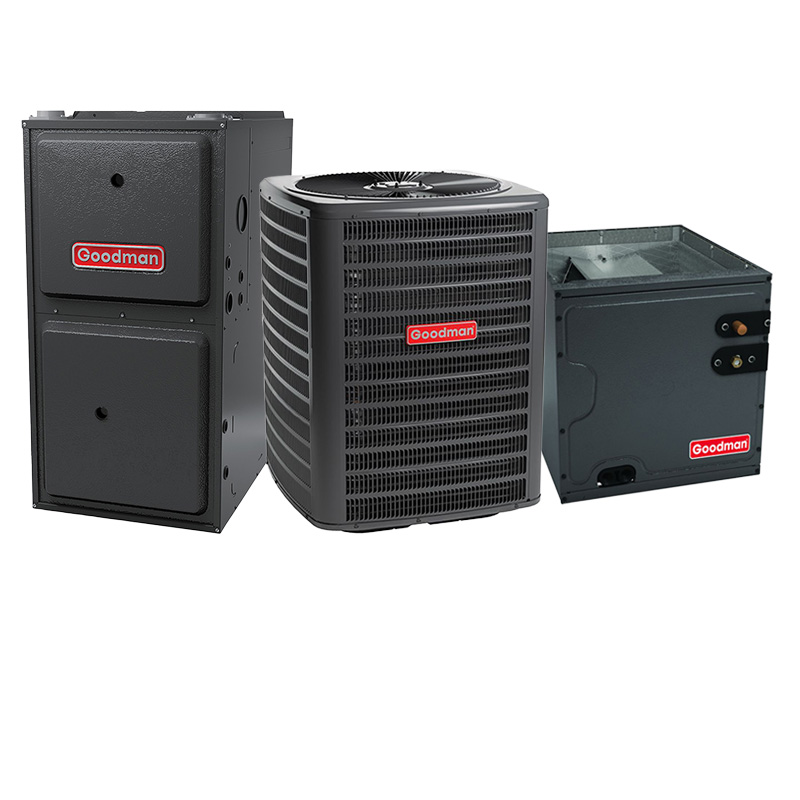
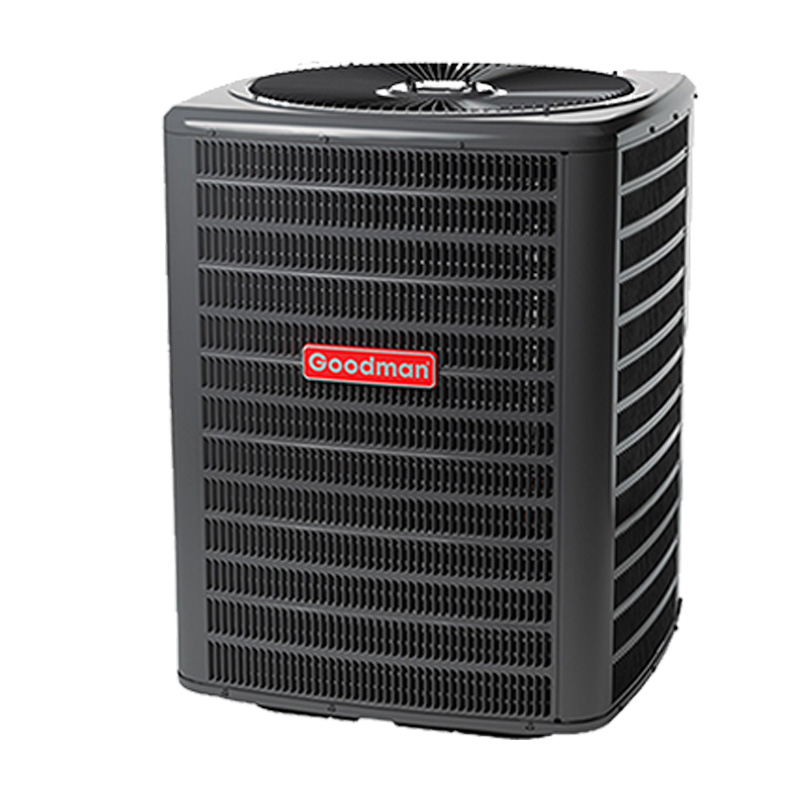
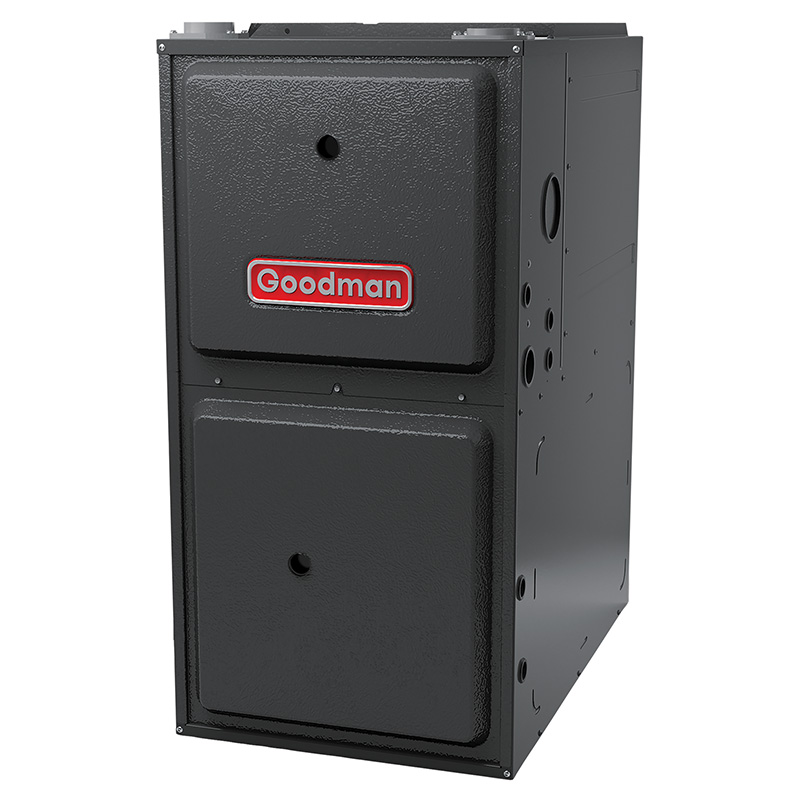
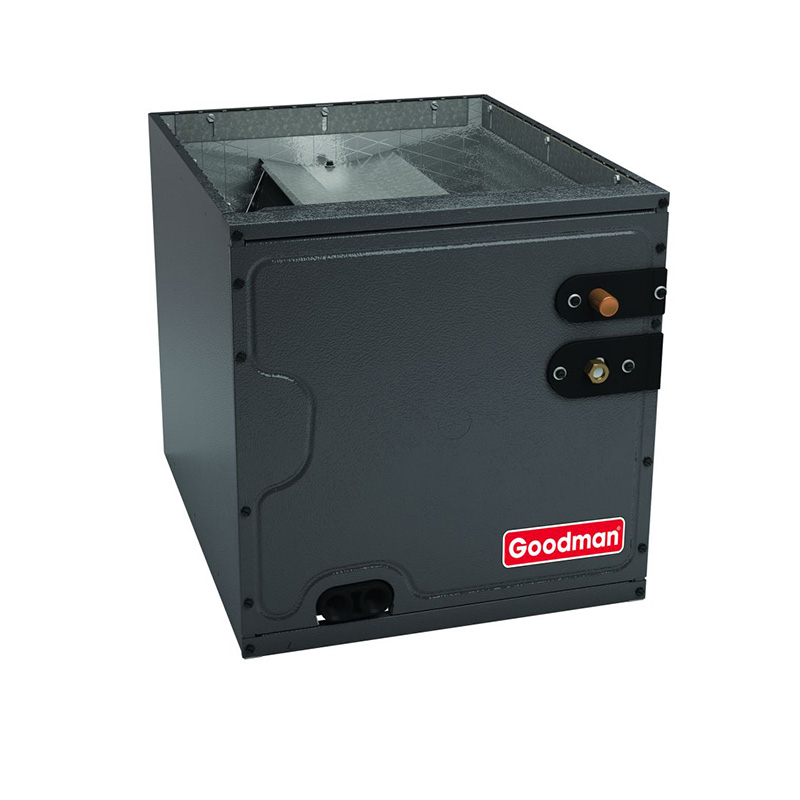
Goodman 5 Ton 13.4 SEER2 100000 BTU 96% AFUE Multi-Speed ECM Gas Furnace System – Upflow | R32
View on AC Direct see your lowest price →Check current price on AC Direct →
Key features
- 96% AFUE gas furnace for high-efficiency heating in a 100,000 BTU output
- 13.4 SEER2 cooling efficiency, meeting federal minimums for most U.S. regions
- R-32 refrigerant with lower global warming potential than R-410A
- Multi-speed ECM blower motor for quieter operation and improved humidity control
- Upflow configuration suited for basement and ground-level mechanical room installs
- Matched system design simplifies warranty registration and coil compatibility
About this system
The Goodman 5-ton, 13.4 SEER2, 96% AFUE upflow system bundles a central air conditioner with a high-efficiency gas furnace into a single matched package aimed at larger homes, typically in the 2,400 to 3,200 square foot range depending on climate and insulation. The 96% AFUE rating means the furnace converts 96 cents of every fuel dollar into usable heat, putting it firmly in the high-efficiency tier and making it eligible for federal tax credits under current energy efficiency incentive programs. The 13.4 SEER2 cooling rating clears the federal minimum for most U.S. regions, though it sits at the entry end of the efficiency range rather than the top.
R-32 refrigerant is a meaningful step forward from the older R-410A that dominated the market for years. It carries a significantly lower global warming potential and requires less refrigerant by weight to do the same job, which reduces both environmental impact and long-term refrigerant costs if a leak ever needs recharging. The multi-speed ECM blower motor improves both comfort and energy use compared to a single-speed PSC motor, running at lower speeds during mild conditions and ramping up only when needed. Upflow configuration means conditioned air exits the top of the air handler, making this the right fit for installations in a basement, crawl space, or ground-level utility closet where ductwork runs up through the floor system. This system suits budget-conscious homeowners in larger homes who want real high-efficiency furnace performance and a refrigerant-future-proofed cooling side without paying premium-brand prices.
This Goodman system delivers genuine high-efficiency furnace performance and a forward-looking refrigerant choice at a price point that undercuts comparable Carrier, Trane, and Lennox packages by a meaningful margin. The trade-off is a compressor and coil track record that lags premium brands, and a brand reputation that depends heavily on the quality of whoever installs and maintains it. Buyers who prioritize upfront cost savings and are comfortable budgeting for potential mid-life repairs will find this a defensible choice.
Overall score is the average of the five ratings above.
What we like
- 96% AFUE furnace performance is genuine high-efficiency, not a marketing step above minimum
- R-32 refrigerant is more environmentally responsible and less expensive to recharge than R-410A
- Multi-speed ECM motor improves comfort and dehumidification compared to single-speed alternatives
- Priced 15 to 25 percent below comparable Trane, Lennox, and Carrier systems
- Matched system simplifies coil selection and supports a single-source warranty registration
Trade-offs
- Compressor lifespan averages 10 to 14 years versus 15 to 20 years for premium brands
- Evaporator coil leaks are a documented recurring complaint among owners
- Dual-run capacitor failures are common after several years, and while the repair is usually low-cost, they signal broader component quality concerns
- A minority of owners report refrigerant leaks in the first year, typically tied to install or factory charge issues rather than a clear manufacturing defect
What homeowners and pros say about Goodman
On ConsumerAffairs, Goodman as a brand scores around 2.5 out of 5, a channel that skews toward dissatisfied owners and where the recurring pattern is repair costs escalating after roughly year seven. On Google dealer reviews, the brand sits around 3.8 out of 5 across hundreds of location-level reviews, where affordability is consistently the most praised attribute. Neither score reflects a brand punching above its price class on quality, but the gap between the two ratings tells a real story: buyers who get a competent install and manage routine maintenance tend to have a workable experience, while those who encounter install shortcuts or skip servicing run into the documented failure points sooner.
Among technicians and owners, the dual-run capacitor is the Goodman repair that comes up most often. It is a known wear item, generally inexpensive to replace, and experienced HVAC pros factor it into their maintenance schedules on Goodman equipment. The more consequential concerns are evaporator coil leaks, which show up in a meaningful share of owner reviews and can mean a significant out-of-pocket cost depending on warranty status, and compressor longevity that tends to top out around 10 to 14 years rather than the 15 to 20 years more commonly seen with Trane or Carrier compressors. For this specific system, the R-32 refrigerant and ECM motor are genuine positives that sit above what the brand’s base-tier equipment offers, but buyers should go in clear-eyed that Goodman’s value proposition is about upfront price, not long-term parts durability.
Sources: ConsumerAffairs Goodman owner reviews, AHRI Directory of Certified Product Performance, U.S. DOE appliance and equipment efficiency standards, Goodman product specification sheets.
What it costs to run
At 13.4 SEER2, cooling this 5-ton system for a typical 1200-hour cooling season at the U.S. average electricity rate of $0.17/kWh works out to roughly $913 per year in cooling, about $0 less per year than a minimum-efficiency 13.4 SEER2 unit of the same size. Your real cost depends on your climate and local rate.
Method: (60,000 BTU/hr ÷ 13.4 SEER2) × 1200 hours ÷ 1000 × $0.17/kWh. Rate source: U.S. EIA average; cooling hours: moderate-climate estimate.
How it compares
| Brand | Comparable model | SEER2 | Stage | Price position |
|---|---|---|---|---|
| Goodman | 5-Ton 13.4 SEER2 / 96% AFUE Multi-Speed ECM Upflow Bundle | 13.4 | Multi-speed | Value pick |
| Carrier | Performance 13 (24ACC6 / 59SC2) | 13.4 | Single-stage | Moderately higher than Goodman |
| Trane | XR13 / S9X2 (matched split system) | 13.4 | Single-stage | Moderately to noticeably higher than Goodman |
| Lennox | Merit 13ACX / ML96V (matched split system) | 13.4 | Single-stage / variable-speed furnace | Noticeably higher than Goodman |
Competitor rows are comparable single-stage units at similar efficiency; price is relative position, not a quote.
Questions about this system
Is 13.4 SEER2 going to be enough efficiency to keep my energy bills reasonable in a 2,800 square foot house?
13.4 SEER2 meets federal efficiency minimums and will operate more efficiently than older 10 or 13 SEER equipment, but it is the entry tier of the current market. Homeowners in hot climates who run the system heavily for six or more months a year will see more meaningful savings by stepping up to a 16 or 18 SEER2 unit, while those in moderate climates with shorter cooling seasons will see less difference in real dollar terms.
What does R-32 mean for me if I ever need a refrigerant recharge?
R-32 is available from most HVAC suppliers and is generally less expensive per pound than R-410A was at its peak. Any certified HVAC technician with the right equipment can handle it, though some older recovery machines need an adapter or upgrade. The lower charge weight required by R-32 systems also means a recharge typically costs less in refrigerant volume than an equivalent R-410A system.
How worried should I be about the dual-run capacitor and coil leak issues I keep reading about with Goodman?
Capacitor failures are the most commonly reported Goodman repair and are worth knowing about, but they are also a low-cost fix, usually in the 300 to 600 dollar range, and a standard part of any good annual maintenance visit. Evaporator coil leaks are a more serious concern because they can mean a refrigerant loss and a costly coil replacement, so it is worth confirming that your Goodman warranty covers the coil and understanding exactly what documentation is required to make a claim.
Does Goodman's warranty on this system require anything from me to stay valid?
Goodman's full parts warranty, typically 10 years on registered systems, requires online registration within a set window after installation, usually 60 days. It also generally requires that the system be installed by a licensed HVAC contractor and that maintenance records be kept, since warranty claims can be denied if the failure is attributed to improper installation or lack of servicing. Read the specific warranty document for this model before signing off on the install.
Why does upflow configuration matter, and will this unit work if my furnace closet is on the main floor?
Upflow means the furnace pulls return air in from the bottom and pushes conditioned air out the top, so the ductwork must connect above the unit. This works well in basements and ground-level utility rooms where supply ducts run through the floor joists above. A main-floor closet can work if the supply plenum and ducts run upward into the ceiling, but if your duct system enters from the side or below, you would need a horizontal or downflow configuration instead.
Specifications
| Cooling capacity | 5 Ton |
| Efficiency | 13.4 SEER2 |
| Furnace output | 100000 BTU |
| Furnace efficiency | 96% AFUE |
| Configuration | Upflow |
| Refrigerant | R-32 |