Goodman 80000 BTU Gas Furnace – 97% Efficient Modulating Variable-Speed ECM Gas Furnace Upflow / Horizontal | R32 (GRVM970803BN)
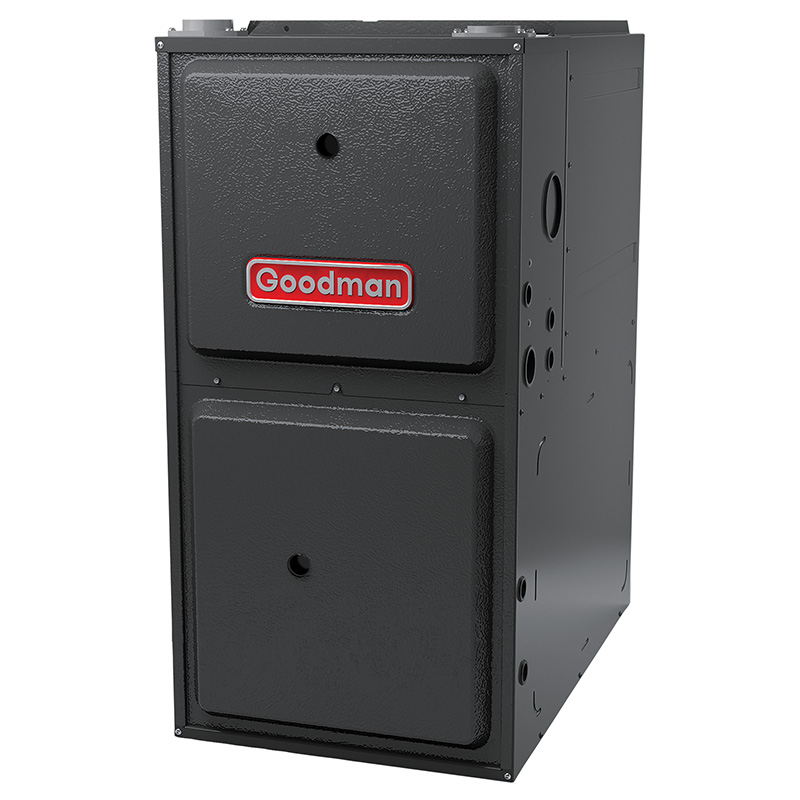
View on AC Direct see your lowest price →Check current price on AC Direct →
Key features
- 97% AFUE modulating burner adjusts output continuously for fuel savings and even heat distribution
- Variable-speed ECM blower motor reduces electricity consumption and minimizes airflow noise
- 80,000 BTU capacity suits mid-size homes in moderately to severely cold climates
- Upflow and horizontal configurations supported, accommodating basement, closet, or attic installs
- Stainless steel secondary heat exchanger resists corrosion from condensate produced at high efficiency
- Goodman's 10-year parts limited warranty applies when the unit is registered within 60 days of install
About this system
The Goodman GRVM970803BN is a 97% AFUE modulating gas furnace rated at 80,000 BTU, designed for upflow or horizontal installation. The modulating burner adjusts heat output in small increments rather than simply cycling on and off, which means the system spends more time running at lower firing rates. That approach reduces temperature swings, lowers fuel consumption compared to single- or two-stage units, and makes the variable-speed ECM blower motor a meaningful partner: the blower ramps airflow to match the burner output, cutting electricity use and improving comfort on shoulder-season days when only a fraction of full capacity is needed.
At 97% AFUE, this furnace sits at the top tier of gas heating efficiency. For every dollar of natural gas burned, roughly 97 cents becomes usable heat in the living space. That matters most in climates with long, cold winters where the furnace runs hundreds of hours per season. The 80,000 BTU output is a common mid-range size, well matched to homes in the 1,500 to 2,500 square foot range depending on insulation, climate zone, and load calculation. The R-32 refrigerant designation listed in the specs is unusual for a standalone furnace and likely reflects a platform or bundle classification rather than a refrigerant circuit in the furnace itself. Buyers pairing this unit with a cooling coil should verify refrigerant compatibility with their installer before purchasing.
This furnace suits homeowners who want near-top-tier efficiency and comfort features at a price point well below Carrier, Trane, or Lennox equivalents. The trade-off is a brand reputation that sits closer to the middle of the pack on long-term reliability, with performance outcomes heavily influenced by installation quality. It is a sensible buy when the installing contractor is experienced with Goodman equipment and the homeowner plans to keep up with annual maintenance.
The GRVM970803BN delivers genuinely top-tier efficiency and real comfort improvements over single-stage furnaces at a price that undercuts the major premium brands by a meaningful margin. The honest caveat is that Goodman's long-term reliability record is average at best, and the value proposition depends almost entirely on a quality installation and consistent annual maintenance. Buyers who accept that trade-off and choose a skilled contractor will likely be satisfied; those who prioritize long-term peace of mind may prefer a premium brand.
Overall score is the average of the five ratings above.
What we like
- 97% AFUE is among the highest efficiency ratings available for residential gas furnaces, reducing monthly heating bills in cold climates
- Modulating operation delivers more consistent room temperatures than single- or two-stage furnaces
- Variable-speed ECM motor uses significantly less electricity than PSC motors found in lower-tier units
- Retail price runs 15 to 25 percent below comparable Trane, Lennox, and Carrier modulating furnaces
- Upflow and horizontal flexibility makes it usable in a wider range of installation locations
Trade-offs
- Goodman's ConsumerAffairs score sits around 2.5 out of 5, with repair cost complaints becoming more common after year 7
- Dual-run capacitors are the most frequently reported failure point across Goodman equipment, typically adding a repair bill even if the fix itself is relatively inexpensive
- Modulating variable-speed systems are more mechanically complex than basic furnaces, meaning diagnostic and repair costs when something does go wrong tend to be higher
- Brand reputation and resale perception lag behind Carrier, Trane, and Lennox, which can matter if the home is sold while the system is still relatively new
What homeowners and pros say about Goodman
Homeowners who have installed Goodman equipment often land in one of two camps, and that split shows up clearly in the ratings. Google dealer reviews average around 3.8 out of 5, where affordability is the most repeated praise. Buyers who got a good installer and registered the warranty tend to report solid performance for the first several years. The ConsumerAffairs picture is rougher, sitting around 2.5 out of 5, and the complaint pattern is specific: repair costs that creep up after roughly year 7, which suggests the components holding up adequately early on but not matching the durability of premium-tier brands over the full system life.
HVAC professionals who work on Goodman equipment frequently point to two recurring issues on the repair side. Dual-run capacitors are the most commonly reported failure point across the Goodman line, and while the repair itself usually runs in the 300 to 600 dollar range and is straightforward for a technician, it tends to happen more often than on premium equipment. A meaningful share of owner reports also mention evaporator coil leaks showing up over time. For a high-efficiency modulating furnace specifically, the complexity of the variable-speed controls and modulating gas valve means that when something beyond a capacitor does fail, diagnostics and parts replacement are more involved than on a basic single-stage unit. Technicians consistently say that installation quality is the single biggest variable in how a Goodman system performs long-term, which makes contractor selection as important as the equipment choice itself.
Sources: ConsumerAffairs Goodman owner reviews, AHRI Directory of Certified Product Performance, U.S. DOE appliance and equipment efficiency standards, Goodman product specification sheets.
How it compares
| Brand | Comparable model | SEER2 | Stage | Price position |
|---|---|---|---|---|
| Goodman | GRVM970803BN | N/A (furnace only) | Modulating variable-speed | Value pick |
| Carrier | Infinity 98 (59MN7) | N/A (furnace only) | Modulating variable-speed | Approximately 20 to 30 percent higher than this Goodman |
| Trane | XV95 (S9X2) | N/A (furnace only) | Modulating variable-speed | Approximately 20 to 30 percent higher than this Goodman |
| Lennox | SLP99V | N/A (furnace only) | Modulating variable-speed | Approximately 25 to 35 percent higher than this Goodman |
Competitor rows are comparable single-stage units at similar efficiency; price is relative position, not a quote.
Questions about this system
What does 'modulating' actually mean on this furnace, and is it worth the extra cost over a two-stage unit?
A modulating furnace adjusts its burner output in small steps, often from around 40% up to 100% of rated capacity, rather than locking into just two firing levels. In practice this means the furnace runs longer cycles at lower output, which reduces temperature swings and is quieter. For homes in climates with long heating seasons, the additional efficiency and comfort are generally worth the cost difference over a two-stage unit; in milder climates with shorter seasons, the payback period stretches out and a two-stage furnace may make more financial sense.
The spec sheet lists R-32 refrigerant. Does this furnace actually use refrigerant?
No standard gas furnace contains refrigerant. The R-32 notation in this listing most likely reflects a product platform classification or a bundle configuration that pairs with a compatible cooling coil. Before purchasing, confirm with your contractor or the distributor exactly what the R-32 designation refers to and whether any coil or system bundle is included, especially if you are replacing an existing cooling system at the same time.
Goodman's ConsumerAffairs reviews look pretty bad. Should I be worried?
ConsumerAffairs skews toward complaints by design, so a 2.5 out of 5 score there does not represent the full owner population. The more useful signal is the recurring theme in those complaints: repair costs tend to climb after roughly year 7, which aligns with Goodman's position as a value brand with average rather than premium-tier component longevity. Pairing this furnace with a reputable contractor, registering the warranty on time, and scheduling annual tune-ups genuinely reduces the likelihood of hitting those failure patterns.
What is covered under the Goodman warranty, and are there conditions I need to meet?
Goodman offers a 10-year parts limited warranty on this furnace, but registration within 60 days of installation is required to receive that coverage. Without registration the warranty period typically drops to five years. The warranty covers parts only, not labor, so a repair during the warranty period can still carry a significant service call and labor charge depending on your contractor's rates.
How important is installer choice with this specific furnace?
Very important, arguably more so than with premium brands. Goodman equipment is consistently cited by HVAC technicians as highly sensitive to installation quality, meaning proper sizing, correct gas pressure, flue venting, and airflow setup have an outsized effect on how long the system lasts and how efficiently it runs. A poorly installed 97% AFUE furnace can perform worse and fail sooner than a well-installed 80% unit, so choosing an experienced contractor who is familiar with Goodman products is not optional if you want the rated performance.
Specifications
| Furnace output | 80000 BTU |
| Configuration | Upflow |
| Refrigerant | R-32 |
| Model | GRVM970803BN |