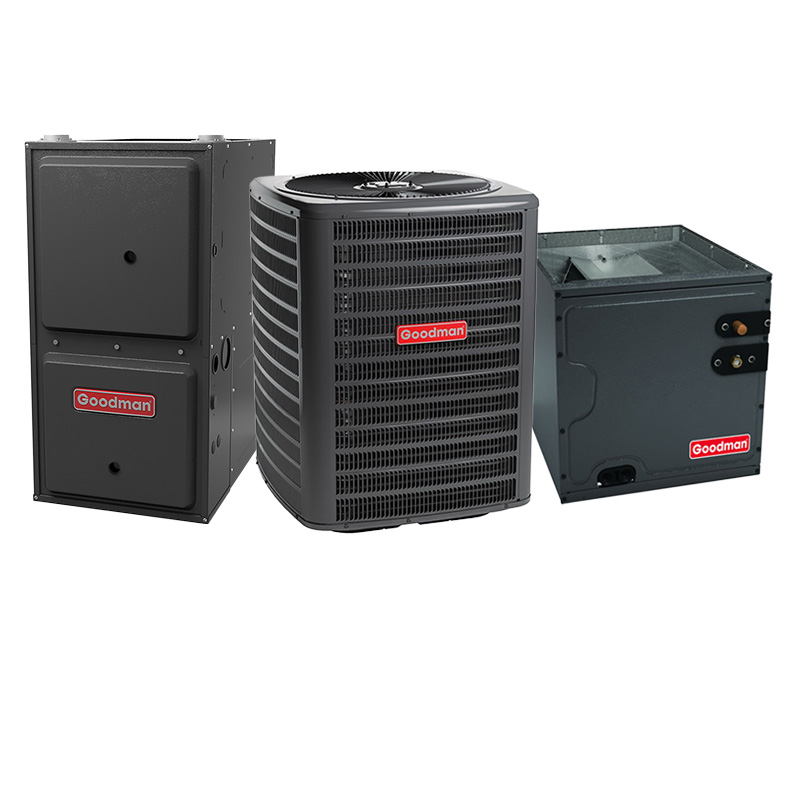
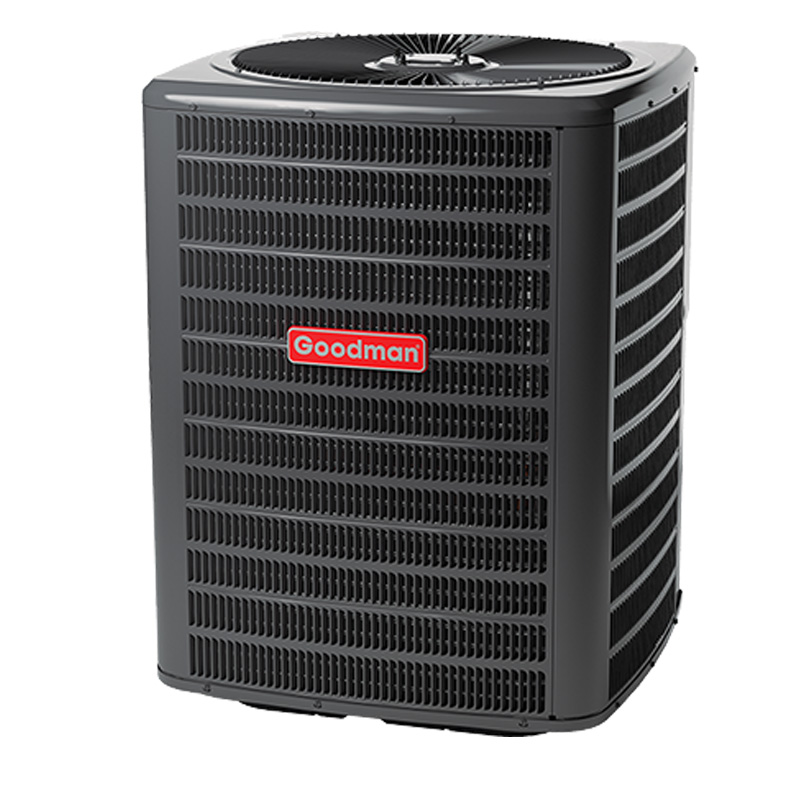
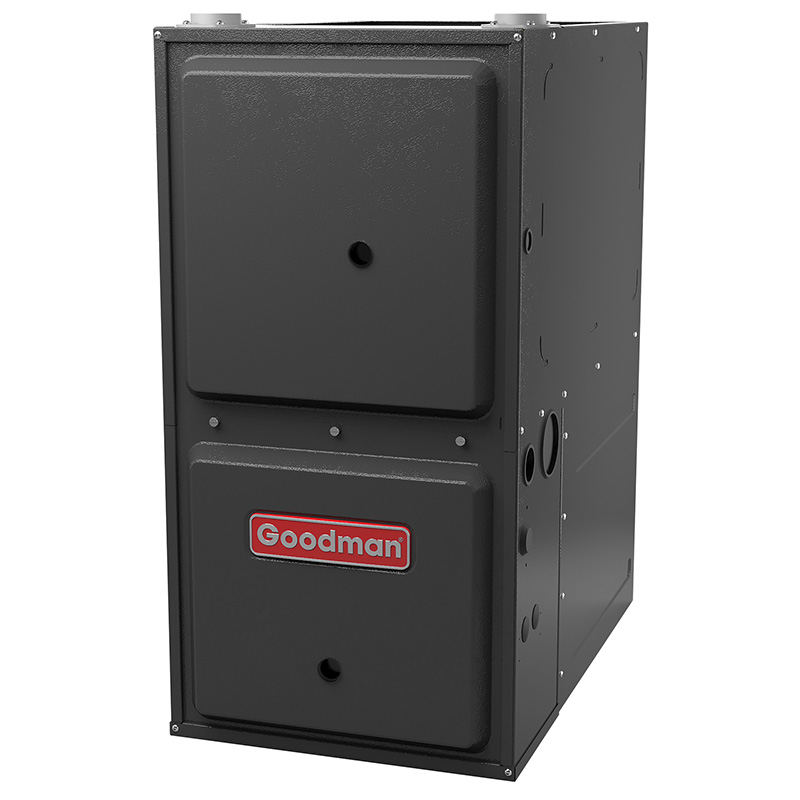
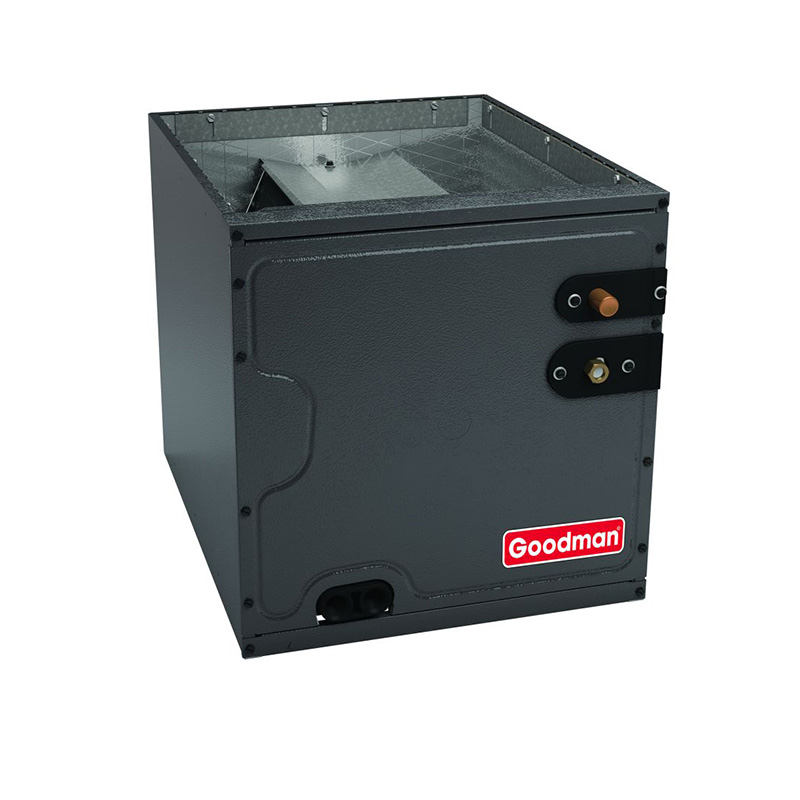
Goodman 3.5 Ton 15.2 SEER2 100000 BTU 80% AFUE Multi-Speed ECM Gas Furnace System – Downflow | R32
View on AC Direct see your lowest price →Check current price on AC Direct →
Key features
- 3.5-ton cooling capacity with 15.2 SEER2 efficiency rating
- 100,000 BTU gas furnace at 80% AFUE heating efficiency
- Multi-speed ECM blower motor for improved airflow and lower fan electricity use
- Downflow configuration designed for basement or closet installations with downward duct discharge
- R-32 refrigerant, a lower-GWP alternative to R-410A meeting current regulatory direction
- Factory-matched system designed to meet AHRI-certified performance ratings when properly installed
About this system
The Goodman 3.5-ton, 15.2 SEER2 downflow system pairs a multi-speed ECM air handler with a 100,000 BTU, 80% AFUE gas furnace and uses R-32 refrigerant, a lower-global-warming-potential refrigerant that is becoming standard as R-410A is phased out. This configuration is sized for homes roughly in the 1,800 to 2,400 square foot range depending on climate zone, insulation quality, and duct layout, and it is particularly well suited to installations where the air handler sits in a basement or utility closet that requires airflow directed downward through the duct system.
The 15.2 SEER2 rating clears the federal minimum for most U.S. regions and delivers moderate cooling efficiency, though it sits at the lower end of mid-efficiency territory rather than near the top. The 80% AFUE furnace means roughly 20 cents of every dollar spent on gas escapes as exhaust, a trade-off worth noting for homeowners in cold climates who run heat heavily. The ECM (electronically commutated motor) blower improves airflow consistency and reduces electricity draw compared to a standard PSC motor, which is a genuine comfort and operating-cost benefit even at this price tier.
This system appeals most to budget-conscious homeowners replacing aging equipment, landlords managing rental properties, or buyers in mild climates where extreme efficiency gains would take many years to offset the cost of a premium unit. It is not the right pick for someone prioritizing the longest possible equipment life, the quietest operation, or the lowest utility bills in a heating-heavy northern climate.
This Goodman system delivers a workable mid-efficiency package at a price point that is genuinely 15 to 25 percent below comparable Carrier, Trane, or Lennox equipment, making it a reasonable choice for cost-sensitive buyers. The 80% AFUE furnace and 15.2 SEER2 rating are functional rather than impressive, and long-term ownership costs hinge heavily on installation quality and whether you budget for potential component repairs after year seven. It is a solid value buy with real trade-offs, not a premium product at a discount price.
Overall score is the average of the five ratings above.
What we like
- Significantly lower upfront cost than Trane, Carrier, or Lennox systems of similar capacity
- ECM blower motor improves comfort and reduces fan operating costs versus standard PSC motors
- R-32 refrigerant positions the system ahead of the R-410A phase-out curve
- Factory-matched system simplifies AHRI rating compliance for permit and rebate purposes
- Downflow configuration fills a specific installation niche that not all systems accommodate
Trade-offs
- 80% AFUE is the minimum efficiency tier; homeowners in cold climates will pay meaningfully more in gas costs than with a 96% AFUE alternative
- Dual-run capacitors are the most commonly reported failure point, and compressor lifespan averages 10 to 14 years versus 15 to 20 years for premium brands
- Evaporator coil leaks appear in a notable share of owner reports, and a minority of owners have reported refrigerant leaks within the first year
- ConsumerAffairs scores average around 2.5 out of 5, with repair cost complaints clustering after year seven of ownership
What homeowners and pros say about Goodman
Homeowners who chose Goodman equipment consistently cite upfront affordability as the deciding factor, and that pattern holds across Google dealer reviews that average around 3.8 out of 5 stars. Positive feedback tends to focus on the price gap versus brand-name competitors and the straightforward installation experience when a knowledgeable contractor handles the job. The ECM blower in this particular configuration earns quiet appreciation from owners who notice steadier airflow and lower fan noise compared to older single-speed systems they replaced.
The more critical feedback, concentrated in the ConsumerAffairs rating that sits around 2.5 out of 5, reflects a pattern worth taking seriously: repair costs that feel manageable in the first few years can accumulate after year seven. Dual-run capacitor failures are the most frequently mentioned issue, a relatively inexpensive fix but an annoyance that some owners report more than once. Evaporator coil leaks and early refrigerant loss in the first year appear in a smaller but notable share of accounts, usually pointing back to installation or initial charge quality rather than the equipment itself. Compressor longevity is the longer-term concern, with Goodman units averaging 10 to 14 years compared to 15 to 20 years commonly cited for Trane, Carrier, and Lennox compressors. HVAC technicians tend to sum it up plainly: a Goodman installed well by an experienced contractor performs close to its spec sheet; one rushed through a low-bid installation is where the reputation problems begin.
Sources: ConsumerAffairs Goodman owner reviews, AHRI Directory of Certified Product Performance, U.S. DOE appliance and equipment efficiency standards, Goodman product specification sheets.
What it costs to run
At 15.2 SEER2, cooling this 3.5-ton system for a typical 1200-hour cooling season at the U.S. average electricity rate of $0.17/kWh works out to roughly $564 per year in cooling, about $75 less per year than a minimum-efficiency 13.4 SEER2 unit of the same size. Your real cost depends on your climate and local rate.
Method: (42,000 BTU/hr ÷ 15.2 SEER2) × 1200 hours ÷ 1000 × $0.17/kWh. Rate source: U.S. EIA average; cooling hours: moderate-climate estimate.
How it compares
| Brand | Comparable model | SEER2 | Stage | Price position |
|---|---|---|---|---|
| Goodman | 3.5T 15.2 SEER2 100K BTU 80% AFUE Downflow R-32 | 15.2 | Multi-speed | Value pick |
| Carrier | Comfort Series (24ACC636 with 80% furnace) | 15.2 | Single-stage | Typically 15 to 25 percent above this Goodman |
| Trane | XR15 with S8X1 80% furnace | 15.0 to 15.5 | Single-stage | Typically 20 to 30 percent above this Goodman |
| Lennox | Merit Series ML15XC1 with 80% Merit furnace | 15.0 to 15.5 | Single-stage | Typically 20 to 30 percent above this Goodman |
Competitor rows are comparable single-stage units at similar efficiency; price is relative position, not a quote.
Questions about this system
Is 80% AFUE going to cost me significantly more to heat my home compared to a high-efficiency furnace?
Yes, in cold climates the difference between 80% and 96% AFUE is meaningful over a full heating season. A rough rule of thumb is that upgrading to 96% AFUE saves roughly 16 cents per dollar spent on gas, so if your annual gas bill is $1,500 for heat, you could save $240 or more per year. In mild climates with short heating seasons, the payback period on the higher-efficiency unit stretches out considerably.
What does downflow configuration mean and how do I know if my installation needs it?
Downflow means the air handler discharges conditioned air downward into the duct system below the unit, which suits basement installations or first-floor closets where supply ducts run under the floor. If your duct system discharges upward or horizontally, you need a different configuration. Your HVAC contractor can confirm the correct orientation during a site visit before ordering.
R-32 refrigerant is new to me. Can any technician service it or does it require special handling?
R-32 requires EPA Section 608 certified technicians, which covers most licensed HVAC professionals, but it is mildly flammable (A2L classification), so technicians need specific training and the right recovery equipment. Availability is expanding quickly as the industry moves away from R-410A, but you should confirm your service contractor is already working with R-32 or A2L refrigerants before you commit to this system.
What are the most likely repair costs I should budget for over the first ten years?
Based on documented failure patterns, dual-run capacitors are the most common issue and typically run $300 to $600 including labor. Evaporator coil leaks and refrigerant issues are less frequent but more expensive, often $800 to $1,500 or more depending on the scope. Setting aside a small annual service budget and getting annual maintenance done by a qualified technician is the most effective way to catch capacitor and refrigerant issues early.
Does Goodman's warranty require professional installation and annual maintenance to stay valid?
Yes, Goodman's registered warranty typically requires installation by a licensed contractor and may require proof of registration within a specified window after installation. Failing to register, using an unlicensed installer, or skipping maintenance documentation can affect your ability to make a warranty claim. Read the warranty card that ships with your specific unit and register it promptly after installation.
Specifications
| Cooling capacity | 3.5 Ton |
| Efficiency | 15.2 SEER2 |
| Furnace output | 100000 BTU |
| Furnace efficiency | 80% AFUE |
| Configuration | Downflow |
| Refrigerant | R-32 |