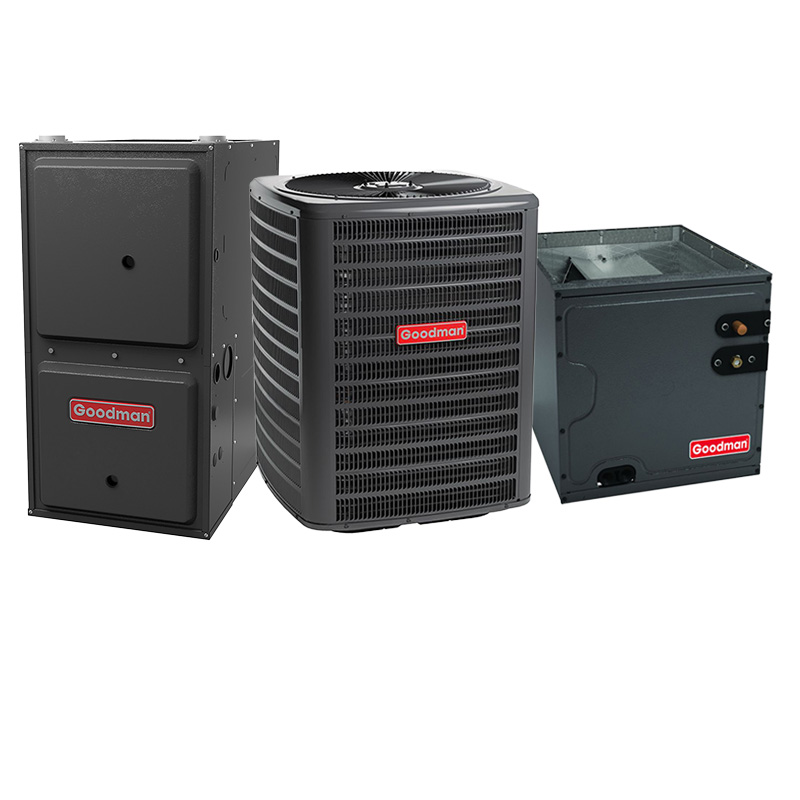
Goodman 4 Ton 14.5 SEER2 100000 BTU 80% AFUE Two Stage Multi-Speed ECM Gas Furnace System – Low NOX For California Downflow | R32
View on AC Direct see your lowest price →Check current price on AC Direct →
Key features
- 4-ton, 14.5 SEER2 cooling with R-32 refrigerant (California Low NOX certified)
- 100,000 BTU two-stage gas furnace reduces runtime noise and improves temperature consistency
- 80% AFUE single-stage heat exchanger uses existing B-vent flue, no condensate drain required
- Multi-speed ECM blower motor for improved humidity control and lower blower energy use
- Downflow configuration for installations where supply air exits through floor registers
- Goodman 10-year parts limited warranty when registered within 60 days of installation
About this system
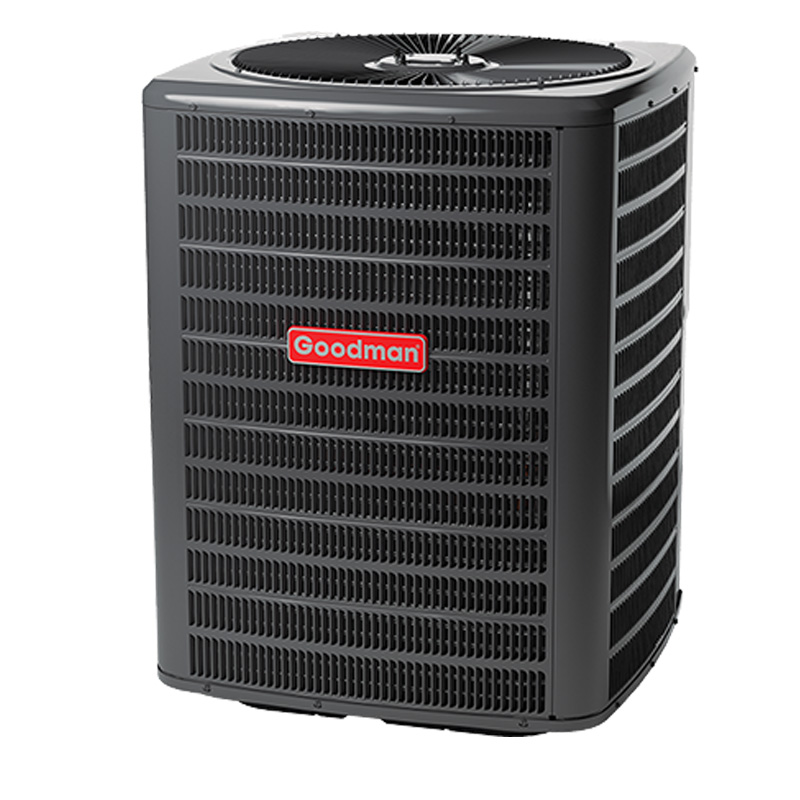
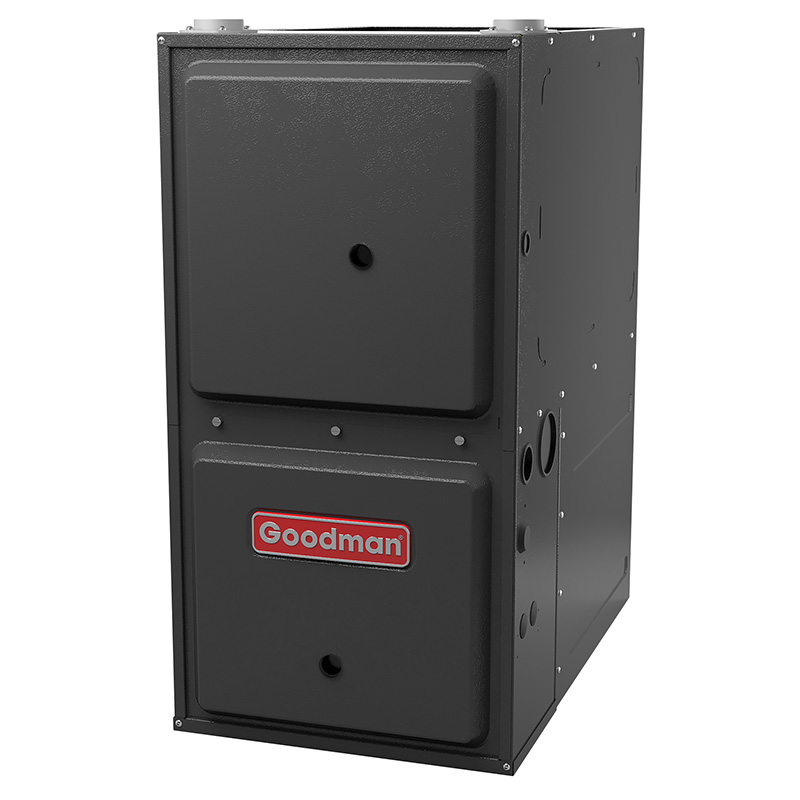
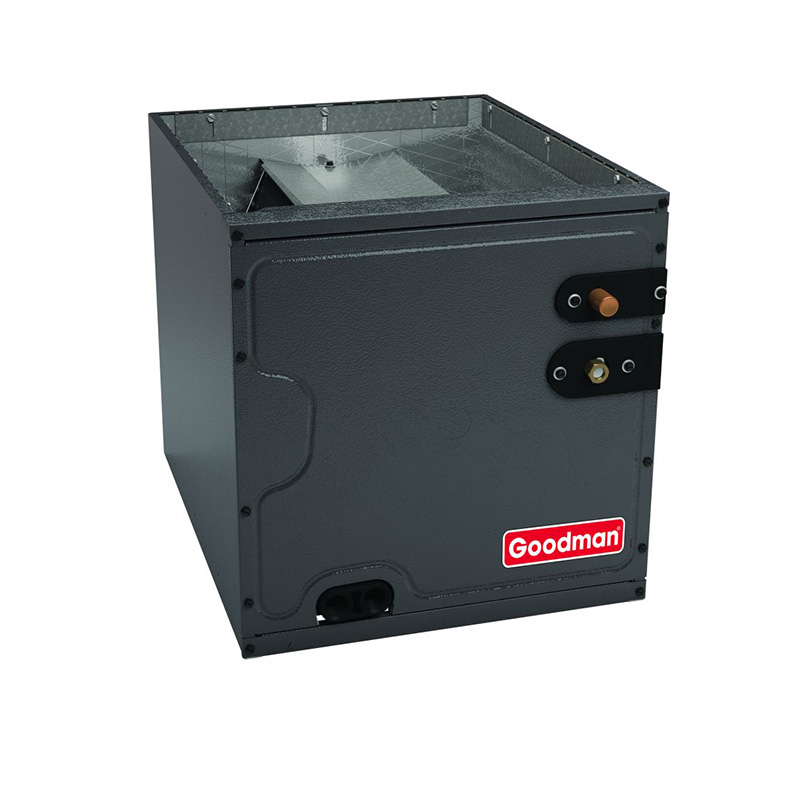
The Goodman GLXS4BA4810 is a complete split system built around a 4-ton, 14.5 SEER2 cooling unit paired with a 100,000 BTU, 80% AFUE two-stage furnace in a downflow configuration. It uses R-32 refrigerant, which has a lower global warming potential than the R-410A it replaces, and is certified Low NOX for sale and installation in California. The downflow orientation directs conditioned air downward through floor registers, making it the correct choice for homes where the air handler sits in a closet, utility room, or crawl-space platform above the living area.
The two-stage furnace runs at a reduced capacity most of the time and steps up to full output only during the coldest stretches, which tends to produce steadier indoor temperatures and quieter operation compared with single-stage equipment. The multi-speed ECM blower motor adjusts airflow to match demand, and that combination helps with humidity control during shoulder-season cooling. At 80% AFUE, the furnace converts 80 cents of every fuel dollar into heat; it is not a high-efficiency condensing unit, so no PVC drain lines or secondary heat exchanger are required, which simplifies installation in homes that already have a conventional flue. Buyers in mild to moderately cold climates will find 80% AFUE a reasonable fit; those in colder regions should compare the long-term fuel savings of a 96% or higher furnace against the lower upfront cost here.
The GLXS4BA4810 delivers a solid feature set at a price point 15 to 25 percent below comparable Carrier, Trane, and Lennox systems, making it a practical choice for budget-conscious owners who want two-stage heating and ECM blower performance. Its real-world longevity depends heavily on installation quality and which components eventually need service, and it carries the trade-offs typical of the Goodman line. It is honest value, not premium reliability.
Overall score is the average of the five ratings above.
What we like
- Priced 15 to 25 percent below comparable Trane, Lennox, and Carrier systems
- Two-stage furnace operation improves comfort and reduces temperature swings versus single-stage
- ECM blower motor lowers blower electricity consumption compared with PSC motors
- R-32 refrigerant has a lower environmental impact than R-410A and meets California Low NOX rules
- 80% AFUE vents with conventional flue, avoiding condensate drain complexity during a swap
Trade-offs
- 80% AFUE means roughly 20% of fuel energy is lost up the flue; high-efficiency alternatives recover more in colder climates
- Goodman compressors average 10 to 14 years versus 15 to 20 years for premium brands, a meaningful gap over the system's life
- Dual-run capacitor failures and evaporator coil leaks are the documented weak points, and repair costs tend to climb after year 7
- Performance is strongly installation-dependent, so a poor setup can undermine the value proposition entirely
What homeowners and pros say about Goodman
Goodman earns consistent praise for affordability across Google dealer reviews, where it averages around 3.8 out of 5 stars and lower installed cost is the most repeated compliment. That reputation holds for this system: the two-stage furnace and ECM blower are features that competing brands charge significantly more for at comparable tonnage. HVAC technicians who work on Goodman equipment regularly point out that the brand rewards a careful installation and penalizes a rushed one, so the contractor choice matters as much as the equipment choice when it comes to how this system performs over time.
The longer-term picture is more mixed. On ConsumerAffairs, Goodman sits at roughly 2.5 out of 5 stars, a complaint-heavy channel where the recurring theme is repair costs rising after year 7 or so. The documented failure points are specific: dual-run capacitors are the most commonly reported breakdown and are usually an affordable fix, but evaporator coil leaks and compressor failures are more costly when they occur. Goodman compressors tend to average 10 to 14 years in service, compared with 15 to 20 years for premium brands, which is a real consideration for owners planning to stay in a home long term. A small share of owners also report refrigerant leaks within the first year, which technicians generally attribute to installation or initial charge issues rather than a component defect. Taken together, the picture is of a system that delivers genuine value at purchase but asks for attentive installation and budgeted maintenance to reach its potential service life.
Sources: ConsumerAffairs Goodman owner reviews, AHRI Directory of Certified Product Performance, U.S. DOE appliance and equipment efficiency standards, Goodman product specification sheets.
What it costs to run
At 14.5 SEER2, cooling this 4-ton system for a typical 1200-hour cooling season at the U.S. average electricity rate of $0.17/kWh works out to roughly $675 per year in cooling, about $56 less per year than a minimum-efficiency 13.4 SEER2 unit of the same size. Your real cost depends on your climate and local rate.
Method: (48,000 BTU/hr ÷ 14.5 SEER2) × 1200 hours ÷ 1000 × $0.17/kWh. Rate source: U.S. EIA average; cooling hours: moderate-climate estimate.
How it compares
| Brand | Comparable model | SEER2 | Stage | Price position |
|---|---|---|---|---|
| Goodman | GLXS4BA4810 (this system) | 14.5 | two-stage | Value pick |
| Carrier | Performance 16 / 59TP6 series bundle | 15-16 | two-stage | Approximately 20 to 25 percent higher than this system |
| Trane | XR15 / S9V2 series bundle | 15 | two-stage | Approximately 20 to 30 percent higher than this system |
| Lennox | Merit 14ACX / ML180 series bundle | 14.3-15 | single-stage | Approximately 15 to 25 percent higher than this system |
Competitor rows are comparable single-stage units at similar efficiency; price is relative position, not a quote.
Questions about this system
Why does this system use a downflow furnace and is it compatible with my house?
Downflow furnaces push conditioned air downward into the duct system, which is correct when supply ducts run under the floor or through a crawl space. If your existing furnace sits in a first-floor closet or utility room and blows down, this configuration is likely a direct match. If your ducts go up into the attic, you need an upflow or horizontal unit instead.
What does 80% AFUE actually mean for my gas bill compared with a high-efficiency furnace?
At 80% AFUE, 20 cents of every fuel dollar exits the flue as exhaust. A 96% AFUE furnace wastes only 4 cents per dollar, so in a climate with significant heating demand the annual fuel savings can offset the higher upfront cost within several years. In mild California climates with limited heating hours, the payback period is longer and 80% AFUE is more commonly a reasonable trade-off.
R-32 refrigerant is new to me. Is it harder to service or more expensive to recharge than R-410A?
R-32 requires EPA Section 608 certification to handle, which any licensed HVAC technician already holds. It operates at similar pressures to R-410A and is increasingly stocked by wholesale suppliers, so availability is not a practical concern. The main difference is that it is mildly flammable (A2L classification), which requires technicians to follow updated handling procedures, but this is now standard practice in the industry.
What are the most likely repair costs I should budget for over the first 10 years?
Across Goodman owner feedback, dual-run capacitor failure is the most commonly reported issue and typically costs 300 to 600 dollars to repair. Evaporator coil leaks appear in a meaningful share of reviews and are more expensive to address. A compressor replacement, if needed, is a major expense. Setting aside a modest service reserve after year 5 is a reasonable precaution with this brand.
How important is the contractor I hire, and does it affect the warranty?
Installation quality is the single biggest factor in how long a Goodman system performs, according to technicians who work on them regularly. Improper refrigerant charge, poor duct connections, and incorrect airflow setup all accelerate component wear. For the 10-year parts warranty to remain valid, the unit must be registered within 60 days of installation and installed by a licensed HVAC contractor, so cutting corners on the installer puts both the equipment and the warranty at risk.
Specifications
| Cooling capacity | 4 Ton |
| Efficiency | 14.5 SEER2 |
| Furnace output | 100000 BTU |
| Furnace efficiency | 80% AFUE |
| Configuration | Downflow |
| Refrigerant | R-32 |
| Model | GLXS4BA4810 |