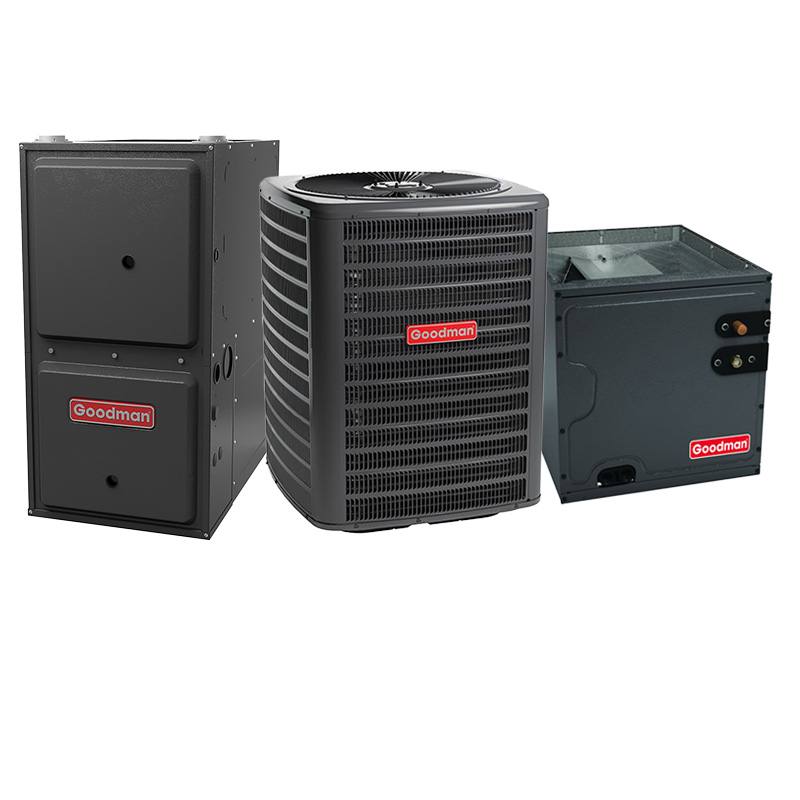
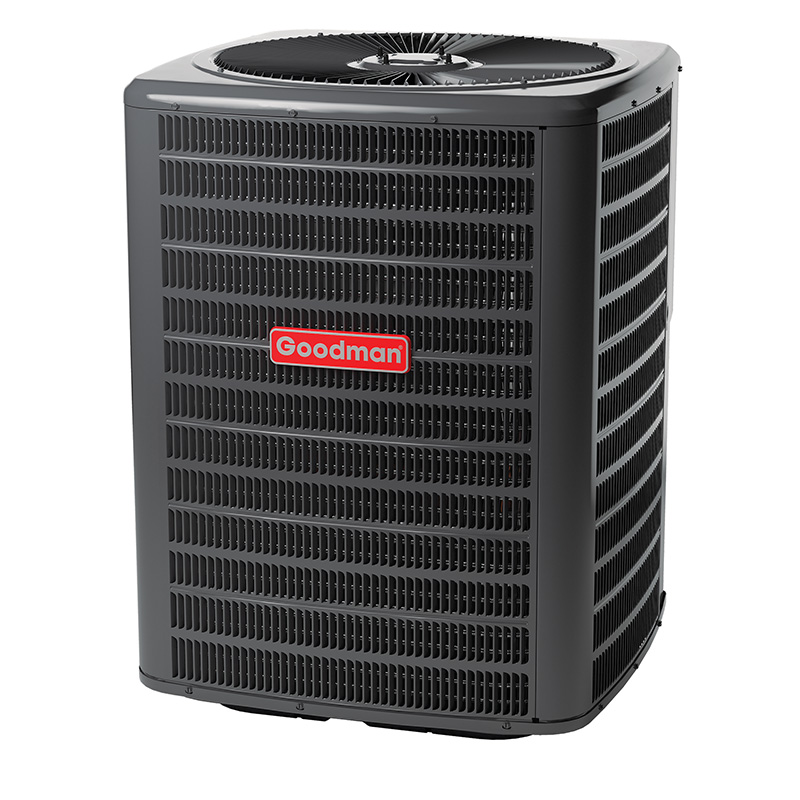
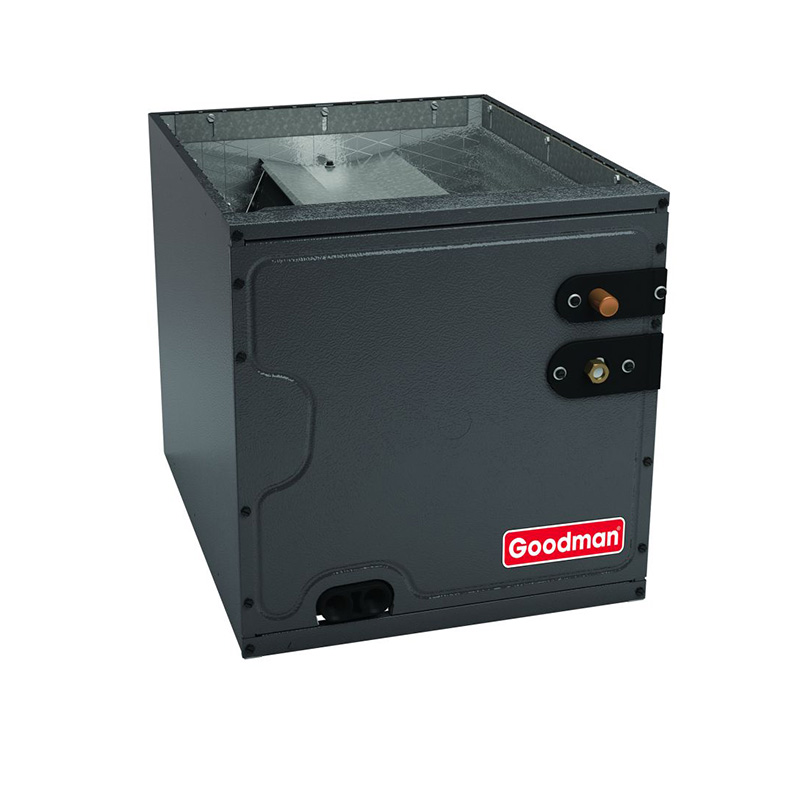
Goodman Furnace AC – 3.5 Ton 15.2 SEER2 AC With 80000 BTU 96% AFUE Multi-Speed ECM Gas Furnace System – Downflow | R32
View on AC Direct see your lowest price →Check current price on AC Direct →
Key features
- 3.5-ton cooling capacity suited to roughly 1,800 to 2,600 sq ft depending on climate and insulation
- 15.2 SEER2 rated efficiency, meeting current federal minimums with a modest efficiency margin
- 96% AFUE gas furnace recovers 96 cents of every dollar of fuel burned
- Multi-speed ECM blower motor reduces electricity use and improves humidity control
- Downflow configuration for homes with floor-level supply ducts or crawl-space ductwork
- R-32 refrigerant with lower global-warming potential than outgoing R-410A
About this system
This Goodman bundle pairs a 3.5-ton, 15.2 SEER2 central air conditioner with an 80,000 BTU, 96% AFUE multi-speed ECM gas furnace in a downflow configuration, using R-32 refrigerant. The package is aimed at mid-size homes in the 1,800 to 2,600 square foot range that need both heating and cooling replaced at once, want to avoid the lower 80% AFUE tier, and are working with a budget that does not stretch to premium brands. The downflow orientation means the furnace discharges air downward through floor or crawl-space ductwork, so this setup is specifically for homes where the air handler sits above the duct system, such as a utility closet on the main floor with ducts running beneath it.
The 96% AFUE rating is a genuine high-efficiency figure; it recovers 96 cents of every dollar of gas consumed and qualifies for many utility rebates. The multi-speed ECM blower motor runs at varying speeds rather than full blast every cycle, which reduces electricity consumption on the furnace side, smooths out temperature swings, and supports better dehumidification. On the cooling side, 15.2 SEER2 clears the current federal minimum for most regions by a modest margin, meaning operating costs will be meaningfully lower than a baseline system but not as low as a variable-speed or two-stage unit at 17 SEER2 or above. R-32 refrigerant has a lower global-warming potential than the R-410A it is replacing across the industry, and servicing costs should remain stable as R-410A becomes harder to source.
This Goodman bundle is a competent, no-frills system that delivers real high-efficiency heating and code-compliant cooling at a price point noticeably below Trane, Carrier, and Lennox equivalents. The trade-off is a brand with a mixed long-term reliability record, where component failures after year 7 and a compressor lifespan shorter than premium competitors are well-documented. It is a reasonable choice when budget is the primary constraint and a qualified installer handles the job.
Overall score is the average of the five ratings above.
What we like
- 96% AFUE furnace delivers genuine high-efficiency heating and qualifies for utility rebates in most regions
- Price comes in roughly 15 to 25 percent below comparable Trane, Carrier, and Lennox systems
- ECM multi-speed blower lowers furnace operating costs and reduces hot and cold spots compared to single-speed units
- R-32 refrigerant future-proofs the system as R-410A availability tightens over coming years
- Complete matched system reduces compatibility guesswork and supports warranty coverage
Trade-offs
- Dual-run capacitor failures are the most commonly reported issue, typically appearing after year 5 and costing 300 to 600 dollars to repair
- Evaporator coil leaks appear in a meaningful share of owner reviews and can be costly outside the warranty window
- Compressor lifespan averages 10 to 14 years versus 15 to 20 for premium brands, meaning a shorter expected system life
- 15.2 SEER2 is modest; homeowners in hot climates who run the AC heavily for many months per year will see smaller energy-bill savings than with a higher-efficiency unit
What homeowners and pros say about Goodman
Homeowners who chose Goodman most often cite the lower upfront cost as the deciding factor, and Google dealer reviews averaging around 3.8 out of 5 reflect a generally satisfied customer base when systems are installed correctly and maintained regularly. The praise tends to cluster in the first several years of ownership, when the equipment runs reliably and the savings versus premium brands feel like a clear win. The picture changes somewhat in the mid-term: ConsumerAffairs shows roughly 2.5 out of 5, weighted by owners who experienced rising repair costs after about year 7. The most frequently named culprits are dual-run capacitor failures, which are common across all brands but cited often enough with Goodman to be considered a planning item, and evaporator coil leaks, which appear in a notable share of longer-term owner accounts and can turn into significant out-of-pocket costs once the parts warranty window closes.
HVAC technicians who work on Goodman equipment regularly make a consistent point: installation quality drives outcomes more than the brand name on the unit. A properly sized, correctly charged, and well-commissioned Goodman system can run solidly for a decade or more, while a rushed install creates the conditions for the early refrigerant leaks and performance problems that show up in negative reviews. Technicians also note that compressor lifespan on Goodman equipment tends to average 10 to 14 years in real-world conditions, compared to the 15 to 20 years more commonly seen on Trane, Carrier, and Lennox compressors, which is worth factoring into a total cost-of-ownership calculation for anyone planning a long stay in their home.
Sources: ConsumerAffairs Goodman owner reviews, AHRI Directory of Certified Product Performance, U.S. DOE appliance and equipment efficiency standards, Goodman product specification sheets.
What it costs to run
At 15.2 SEER2, cooling this 3.5-ton system for a typical 1200-hour cooling season at the U.S. average electricity rate of $0.17/kWh works out to roughly $564 per year in cooling, about $75 less per year than a minimum-efficiency 13.4 SEER2 unit of the same size. Your real cost depends on your climate and local rate.
Method: (42,000 BTU/hr ÷ 15.2 SEER2) × 1200 hours ÷ 1000 × $0.17/kWh. Rate source: U.S. EIA average; cooling hours: moderate-climate estimate.
How it compares
| Brand | Comparable model | SEER2 | Stage | Price position |
|---|---|---|---|---|
| Goodman | GSXH5 / GCVC96 Series (this system) | 15.2 | Single-stage AC / Multi-speed furnace | Value pick |
| Carrier | Comfort 24ACC636 with 59SC5 furnace | 15.2 | Single-stage AC / Multi-speed furnace | Roughly 15 to 20 percent more than this Goodman bundle |
| Trane | XR15 with S9X2 furnace | 15.0 to 16.0 | Single-stage AC / Multi-speed furnace | Roughly 20 to 25 percent more than this Goodman bundle |
| Lennox | Merit ML15XC1 with ML196E furnace | 15.2 | Single-stage AC / Multi-speed furnace | Roughly 20 to 25 percent more than this Goodman bundle |
Competitor rows are comparable single-stage units at similar efficiency; price is relative position, not a quote.
Questions about this system
Is downflow the right configuration for my home, and how do I know?
Downflow furnaces discharge heated and cooled air through the bottom of the unit into ductwork below, which is typical in homes where the furnace sits on the main level above a crawl space or basement duct system. If your current furnace has the supply plenum at the bottom and the return air enters from the top or sides, downflow is likely correct. Confirm with your installer before ordering, because swapping configurations after purchase is not practical.
What does the 96% AFUE rating actually mean for my gas bill?
AFUE measures how efficiently the furnace converts fuel to usable heat; at 96%, only 4% of the gas burned escapes as exhaust rather than heating your home. Compared to an older 80% AFUE furnace, you could see roughly 20% lower gas consumption for the same amount of heat delivered, though actual savings depend on local gas prices, home insulation, and thermostat habits.
Goodman has mixed reviews online. Should that change my decision?
Goodman carries about a 2.5 out of 5 on ConsumerAffairs, a channel that skews toward frustrated owners, and around 3.8 out of 5 on Google dealer reviews where affordability is the most common praise. The recurring complaint on ConsumerAffairs is repair costs climbing after roughly year 7, often tied to capacitor failures and evaporator coil leaks. If you budget for one or two service calls over a 10-year ownership window and hire a quality installer, the value proposition holds up; if you want a worry-free 15-plus year system, the premium brands have a stronger track record.
What is the warranty on this system, and what do I need to do to keep it valid?
Goodman typically offers a 10-year parts limited warranty when registered within 60 days of installation. Failure to register usually drops coverage to 5 years on parts. The warranty covers parts but not labor, which means a coil leak or compressor failure outside of labor warranty coverage can still cost several hundred to over a thousand dollars in technician fees. Confirm current warranty terms at registration, as Goodman has updated its warranty structure in recent years.
Does this system use R-32 refrigerant, and will that affect service costs?
Yes, this unit uses R-32, which is becoming the industry standard replacement for R-410A. R-32 requires technicians certified to handle it and slightly different service procedures, but it is widely stocked and should remain readily available and competitively priced. One practical note: a small share of Goodman owners report refrigerant leaks in the first year, which is generally a sign of an installation or charge issue rather than a product defect, so choosing an experienced installer matters.
Specifications
| Cooling capacity | 3.5 Ton |
| Efficiency | 15.2 SEER2 |
| Furnace output | 80000 BTU |
| Furnace efficiency | 96% AFUE |
| Configuration | Downflow |
| Refrigerant | R-32 |