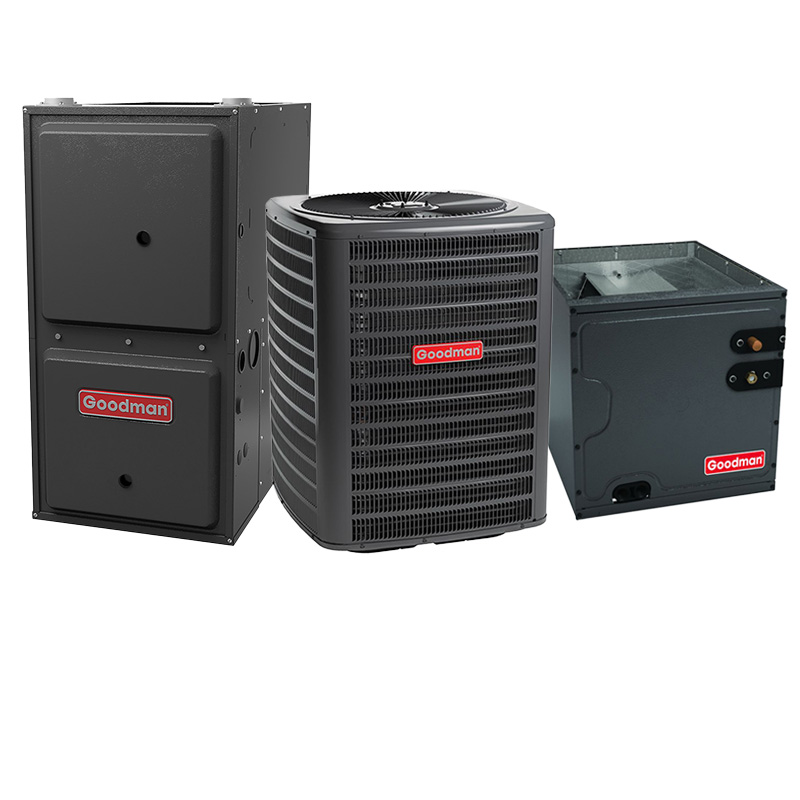
Goodman Furnace AC Combo – 2.5 Ton 14 SEER2 AC With 60000 BTU 97% AFUE Modulating Variable-Speed ECM Gas Furnace System – Downflow | R32
View on AC Direct see your lowest price →Check current price on AC Direct →
Key features
- 97% AFUE modulating gas furnace burns nearly all available fuel, minimizing heating waste
- Variable-speed ECM blower motor reduces electricity use and improves humidity control
- 14 SEER2 central AC meets current federal minimum efficiency for cooling
- Downflow configuration designed for installations where supply air exits the bottom of the unit
- R-32 refrigerant with a lower global warming potential than legacy R-410A systems
- Modulating burner stages heat output gradually, reducing temperature swings and cycling noise
About this system
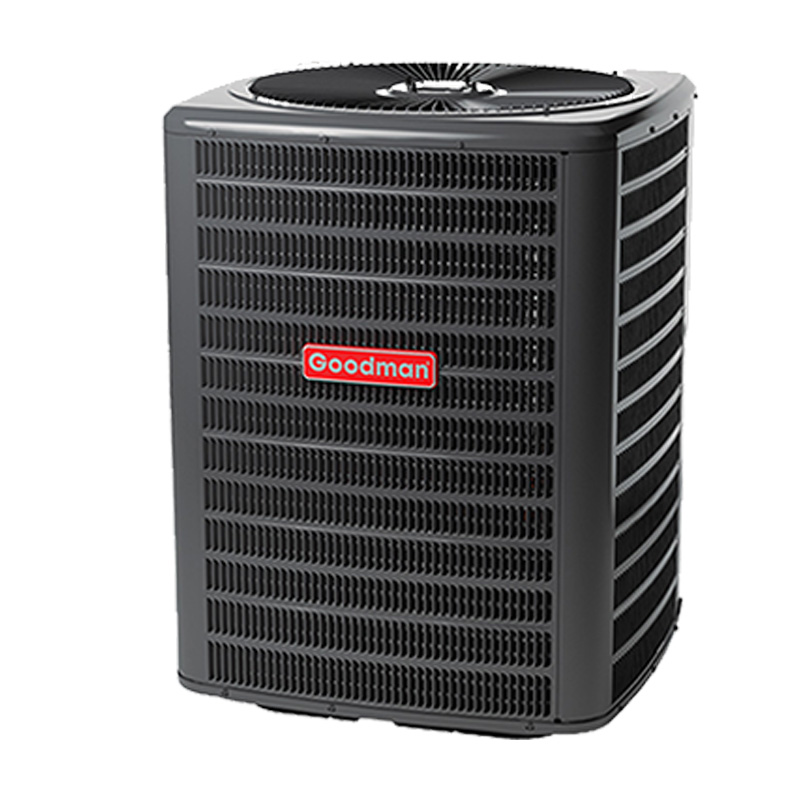
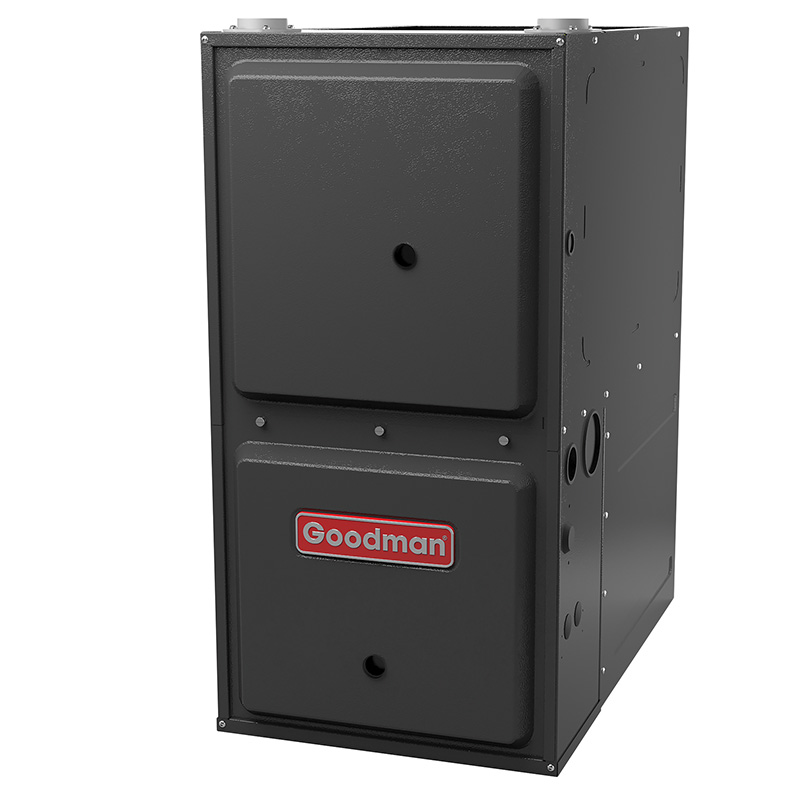
This Goodman combo pairs a 2.5-ton, 14 SEER2 central air conditioner with a 60,000 BTU, 97% AFUE modulating gas furnace in a downflow configuration, making it a strong fit for homes where the air handler sits in an upper-level closet or above a crawlspace and conditioned air flows downward into the duct system. The R-32 refrigerant charge is a notable spec: R-32 has a lower global warming potential than the R-410A it replaces and is increasingly common as the industry moves away from older refrigerants, though it does require technicians who are current on R-32 handling procedures.
The 97% AFUE modulating furnace is the headline component here. Modulating burners adjust heat output in small increments rather than simply switching on at full capacity, which reduces temperature swings, lowers noise, and wrings nearly all available heat from every cubic foot of gas burned. The variable-speed ECM blower motor complements this by running at lower speeds for longer cycles, improving humidity control and air distribution while using significantly less electricity than a standard PSC motor. The 14 SEER2 cooling rating lands at the current federal minimum efficiency tier, so it is adequate but not exceptional for cooling-heavy climates. Buyers in the Sun Belt who prioritize summer cooling costs may want to weigh a higher SEER2 unit, while those in colder, heating-dominant regions will likely find the furnace specs the more meaningful number.
This system suits a mid-size home in the 1,200 to 1,800 square foot range depending on local climate, insulation, and load calculations. It is a reasonable choice for homeowners replacing aging equipment on a defined budget who want premium furnace efficiency without paying Carrier or Trane prices, and who understand that Goodman’s value proposition depends heavily on hiring a thorough, experienced installer.
This combo delivers a genuinely high-efficiency furnace at a price point that undercuts comparable Trane and Carrier systems by a meaningful margin, and the modulating variable-speed setup is a real upgrade over entry-level single-stage equipment. The 14 SEER2 cooling side is functional but not a standout, and Goodman's documented reliability record means the long-term value of this purchase depends more on installer quality and maintenance habits than the nameplate alone.
Overall score is the average of the five ratings above.
What we like
- 97% AFUE modulating furnace is top-tier heating efficiency at a value-brand price
- Variable-speed ECM motor meaningfully improves comfort and lowers blower electricity costs
- R-32 refrigerant is a forward-looking choice as the industry phases out older refrigerants
- Downflow design covers a configuration often underserved by budget competitors
- System pricing typically runs 15 to 25 percent below equivalent Trane, Lennox, and Carrier combos
Trade-offs
- 14 SEER2 is the federal minimum efficiency floor; homeowners in hot climates will see limited cooling savings versus a 16 or 17 SEER2 alternative
- Dual-run capacitor failures are the most frequently reported repair issue, typically surfacing within the first decade and costing $300 to $600 to fix
- Compressor lifespan averages 10 to 14 years versus 15 to 20 years on premium-brand compressors, raising the odds of a mid-life replacement
- A minority of owners have reported refrigerant leaks in the first year, generally tied to installation or initial charge quality rather than a manufacturing defect, underscoring how critical installer selection is
What homeowners and pros say about Goodman
Homeowners who praise this type of Goodman setup consistently point to the upfront cost savings relative to Carrier, Trane, and Lennox equipment as the primary reason for choosing it, and Google dealer reviews for Goodman installers average around 3.8 out of 5, with affordability appearing as the most repeated compliment. The modulating furnace in particular draws positive feedback for quieter, steadier heat compared to single-stage units owners previously lived with. That said, ConsumerAffairs scores sit at roughly 2.5 out of 5, and the reviews there skew toward owners who encountered repair bills after the seven-year mark, painting a picture of a brand where the first several years can go smoothly but where cumulative maintenance costs start climbing in the back half of the expected lifespan.
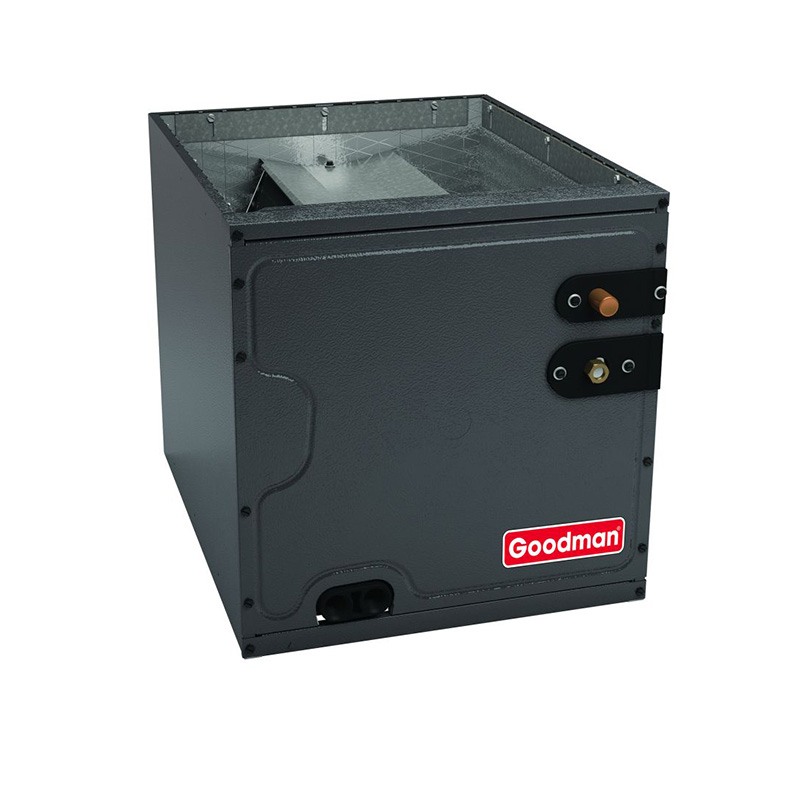
HVAC technicians who work on Goodman equipment regularly point to two recurring issues: dual-run capacitor failures, which are among the most commonly reported repair calls and typically cost $300 to $600 to resolve, and evaporator coil leaks, which appear often enough in owner accounts to warrant attention during annual maintenance visits. Compressor longevity is another honest trade-off; Goodman compressors tend to average 10 to 14 years in real-world use, versus 15 to 20 years on premium-brand units, which affects how you think about the total cost of ownership over a 15-plus year horizon. A small but documented subset of owners have also reported refrigerant leaks within the first year, and technicians consistently attribute these to installation or initial charge problems rather than factory defects, which reinforces the point that no amount of good specs substitutes for a careful, experienced installer on day one.
Sources: ConsumerAffairs Goodman owner reviews, AHRI Directory of Certified Product Performance, U.S. DOE appliance and equipment efficiency standards, Goodman product specification sheets.
What it costs to run
At 14 SEER2, cooling this 2.5-ton system for a typical 1200-hour cooling season at the U.S. average electricity rate of $0.17/kWh works out to roughly $437 per year in cooling, about $20 less per year than a minimum-efficiency 13.4 SEER2 unit of the same size. Your real cost depends on your climate and local rate.
Method: (30,000 BTU/hr ÷ 14 SEER2) × 1200 hours ÷ 1000 × $0.17/kWh. Rate source: U.S. EIA average; cooling hours: moderate-climate estimate.
How it compares
| Brand | Comparable model | SEER2 | Stage | Price position |
|---|---|---|---|---|
| Goodman | GSXH5 + GMVM97 (this system) | 14 | Modulating / Variable-speed | Value pick |
| Carrier | Comfort 24ACC6 + 59MN7 furnace | 14-15 | Single-stage / Variable-speed | Approximately 20 to 25 percent above this Goodman system |
| Trane | XR14c + S9V2 furnace | 14-15 | Single-stage / Variable-speed | Approximately 20 to 30 percent above this Goodman system |
| Lennox | Merit ML14XC1 + SLP98V furnace | 14-15 | Single-stage / Variable-speed | Approximately 25 to 35 percent above this Goodman system |
Competitor rows are comparable single-stage units at similar efficiency; price is relative position, not a quote.
Questions about this system
Is a downflow furnace harder to find installers for than a standard upflow unit?
Most licensed HVAC contractors work with both configurations, but downflow installs are less common and require the technician to be familiar with the specific venting and clearance requirements. Confirm your installer has downflow experience before booking, and make sure the existing duct layout actually calls for downflow before purchasing, since swapping configurations mid-job adds cost.
Does my HVAC technician need special certification to handle R-32 refrigerant?
Technicians need an EPA Section 608 certification to handle any refrigerant, but R-32 also has specific handling considerations because it is mildly flammable (A2L classification). Not every contractor is currently equipped or trained for A2L refrigerants, so confirm R-32 competency explicitly when getting quotes.
The 97% AFUE sounds impressive, but how much will I actually save over a 96% or 80% AFUE furnace?
Compared to an 80% AFUE furnace, a 97% unit converts roughly 17 more cents of every gas dollar into heat, which adds up significantly in cold climates over a heating season. The gap between 96% and 97% is small on its own, but the modulating burner's ability to run at partial capacity for longer cycles typically delivers additional comfort and efficiency gains beyond what the AFUE number alone captures.
What is the most likely repair I should budget for on this Goodman system?
Dual-run capacitor failure is the most commonly reported issue across Goodman equipment, and it typically shows up somewhere in the first decade of use. The repair generally runs $300 to $600 and is straightforward for any qualified technician. Keeping an eye on evaporator coil condition during annual maintenance is also worthwhile, as coil leaks appear in a meaningful share of Goodman owner reports.
Will 2.5 tons and 60,000 BTU be the right size for my home?
Sizing depends on your local climate, square footage, ceiling height, insulation quality, window area, and orientation, not just square footage alone. A proper Manual J load calculation is the only reliable way to confirm the right size. Oversizing a modulating system wastes money upfront and can cause humidity problems; undersizing leaves the system running constantly on peak days. Ask your contractor to provide the load calculation in writing before the install.
Specifications
| Cooling capacity | 2.5 Ton |
| Efficiency | 14 SEER2 |
| Furnace output | 60000 BTU |
| Furnace efficiency | 97% AFUE |
| Configuration | Downflow |
| Refrigerant | R-32 |