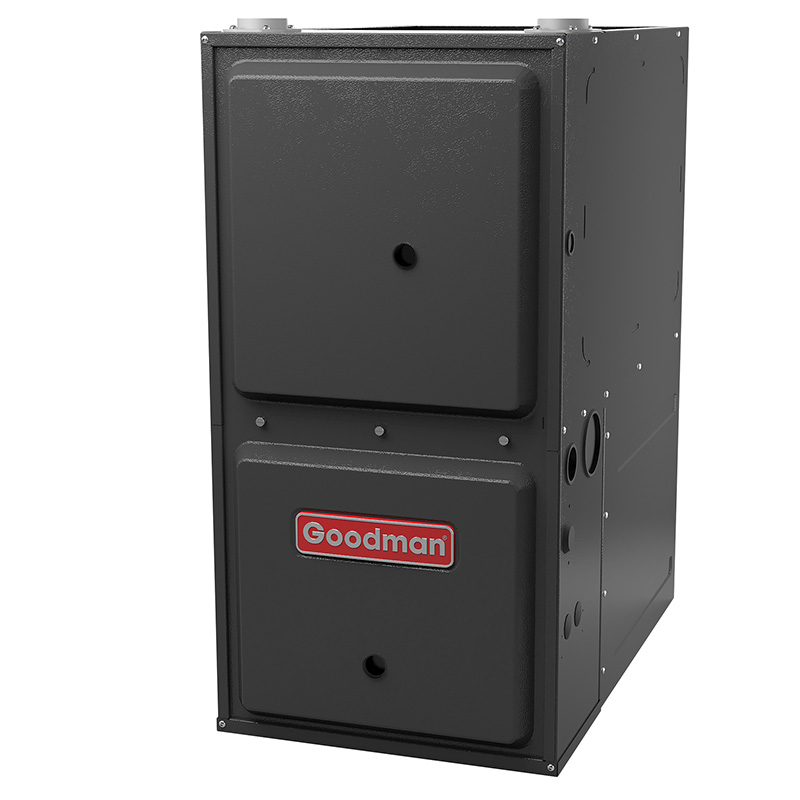
Goodman 40000 BTU Gas Furnace – 2 Stage 96% Efficient Variable Speed ECM Upflow / Horizontal | R32 (GDVT960403BN)
View on AC Direct see your lowest price →Check current price on AC Direct →
Key features
- 96% AFUE two-stage gas furnace for high-efficiency heating
- Variable-speed ECM blower motor reduces electricity use and noise
- 40,000 BTU output suited to smaller or well-insulated homes
- Upflow and horizontal installation configurations supported
- Two-stage burner provides more consistent temperatures than single-stage units
- Compatible with communicating system setups for integrated HVAC control
About this system
The Goodman GDVT960403BN is a 40,000 BTU, 96% AFUE two-stage gas furnace with a variable-speed ECM blower motor, configured for upflow or horizontal installation. At 96% AFUE, it sits in the upper tier of residential gas furnace efficiency, meaning roughly 96 cents of every dollar spent on natural gas is converted to usable heat. The two-stage burner runs at a lower firing rate most of the time, reducing temperature swings and operating noise compared to single-stage units, while the variable-speed ECM motor adjusts airflow continuously to match demand and cuts electrical consumption significantly over a standard PSC blower.
The 40,000 BTU output is on the smaller end of the residential furnace spectrum, making this unit appropriate for well-insulated homes roughly in the 1,000 to 1,600 square foot range depending on climate zone, local heat loss calculations, and duct layout. It is worth noting that R-32 is listed in the specs, which is unusual for a gas furnace and likely refers to a refrigerant circuit in a dual-fuel or communicating system context rather than the furnace combustion side itself. Buyers pairing this furnace with a heat pump or air handler that uses R-32 refrigerant should verify component compatibility with their installer before purchase.
This model is a practical choice for homeowners replacing an older 80% AFUE furnace in a tight budget, or for contractors building out a value-tier system where upfront cost matters more than brand prestige. It will not match the build tolerances or typical longevity of a Trane S Series or Lennox SLP99, but it delivers genuine high-efficiency performance at a price point those brands rarely touch.
The GDVT960403BN delivers legitimate 96% AFUE efficiency and a variable-speed motor at a price well below comparable Carrier, Trane, or Lennox units, making it a reasonable choice for cost-conscious buyers. The trade-off is a brand track record that shows higher-than-average repair frequency after year seven and compressor and component longevity that lags premium competitors. Installation quality will determine more about this furnace's lifespan than any spec on the sheet.
Overall score is the average of the five ratings above.
What we like
- 96% AFUE rating meaningfully reduces gas bills versus 80% AFUE equipment
- Variable-speed ECM blower cuts electrical operating costs and improves comfort
- Two-stage operation reduces temperature swings and cycling noise
- Priced 15 to 25 percent below equivalent Trane, Lennox, and Carrier models
- Upflow and horizontal flexibility suits a range of duct configurations
Trade-offs
- Dual-run capacitors are the most frequently reported failure point, typically arising within the first decade
- Goodman's ConsumerAffairs score of about 2.5 out of 5 reflects a pattern of rising repair costs after roughly year seven
- Component longevity, particularly for heat exchangers and blower assemblies, generally trails premium brands over a 15-plus year horizon
- A minority of owners have reported refrigerant-related issues in the first year, most often traced to installation quality rather than the unit itself
What homeowners and pros say about Goodman
Homeowners discussing Goodman equipment online tend to split along a predictable line. Those who had a skilled installer and kept up with routine maintenance often report years of trouble-free service and consistently praise the value for money, a sentiment echoed in Google dealer reviews where Goodman scores around 3.8 out of 5 across hundreds of ratings and affordability is the most common theme. On the other side, ConsumerAffairs aggregates a complaint-heavier audience and shows a score of roughly 2.5 out of 5, where the dominant frustration is repair costs that begin to accumulate after about year seven, with dual-run capacitor failures and evaporator coil issues named most often.
Among HVAC professionals, the consensus is nuanced rather than dismissive. Many technicians will install Goodman without hesitation for budget-conscious customers, but they are consistent in noting that the brand’s performance leans harder on installation quality than premium competitors do. Compressor lifespan averaging 10 to 14 years versus the 15 to 20 years more typical of Trane or Lennox equipment is a real consideration for buyers planning to stay in a home long-term. For this specific furnace, the 96% AFUE rating and variable-speed ECM motor are legitimate features that pros acknowledge as genuine efficiency gains, not marketing padding. The practical advice from the field is simple: spend on a qualified installer, register the warranty the day the unit is commissioned, and budget for a capacitor replacement somewhere in the first decade.
Sources: ConsumerAffairs Goodman owner reviews, AHRI Directory of Certified Product Performance, U.S. DOE appliance and equipment efficiency standards, Goodman product specification sheets.
How it compares
| Brand | Comparable model | SEER2 | Stage | Price position |
|---|---|---|---|---|
| Goodman | GDVT960403BN | N/A (gas furnace) | Two-stage | Value pick |
| Carrier | Performance 96 (59TP6) | N/A (gas furnace) | Two-stage | Moderately higher than Goodman, mid-tier positioning |
| Trane | S Series (TUD2) | N/A (gas furnace) | Two-stage | Notably higher than Goodman, upper mid-tier positioning |
| Lennox | ML296V | N/A (gas furnace) | Two-stage | Moderately to notably higher than Goodman depending on dealer |
Competitor rows are comparable single-stage units at similar efficiency; price is relative position, not a quote.
Questions about this system
Is 40,000 BTU enough for my home?
At 96% AFUE, this furnace delivers about 38,400 BTU of usable heat output. A proper Manual J load calculation is the only reliable way to size a furnace for your space, but as a rough guide, 40,000 BTU input is typically appropriate for well-insulated homes in the 1,000 to 1,600 square foot range in moderate climates. An oversized furnace cycles too frequently and an undersized one runs constantly, so have your installer run the numbers before committing.
What does R-32 have to do with a gas furnace?
R-32 is a refrigerant, not a combustion fuel, so it is not used in the furnace's heating process itself. Its presence in the spec listing most likely indicates this unit is designed to communicate with or be paired alongside a heat pump or air handler that uses R-32 refrigerant. Confirm with your installer that all system components, including the coil and outdoor unit, are rated for R-32 before purchasing.
What are the most common repairs on Goodman furnaces like this one?
Dual-run capacitors are the most frequently reported failure point across Goodman equipment and are usually a straightforward repair in the 300 to 600 dollar range. Evaporator coil leaks also appear in a meaningful share of owner reports over time. Goodman's ConsumerAffairs reviews, which score around 2.5 out of 5, show a recurring pattern of repair costs climbing after roughly year seven of ownership.
Does Goodman's warranty cover parts and labor?
Goodman's standard warranty covers parts, but labor is typically not included unless you purchase an extended labor warranty through a registered dealer. Registration within a specified window after installation is usually required to receive the full parts warranty term, so confirm the registration deadline with your installer at the time of setup.
How much does installation quality actually matter with this furnace?
HVAC technicians consistently cite installation quality as the single largest factor in how long a Goodman unit lasts and how efficiently it operates. Proper duct sizing, correct gas pressure, accurate refrigerant charge on any paired cooling equipment, and flue venting all affect both performance and longevity. Choosing an experienced, licensed installer is arguably more important than the brand name on the equipment itself.
Specifications
| Furnace output | 40000 BTU |
| Configuration | Upflow |
| Refrigerant | R-32 |
| Model | GDVT960403BN |