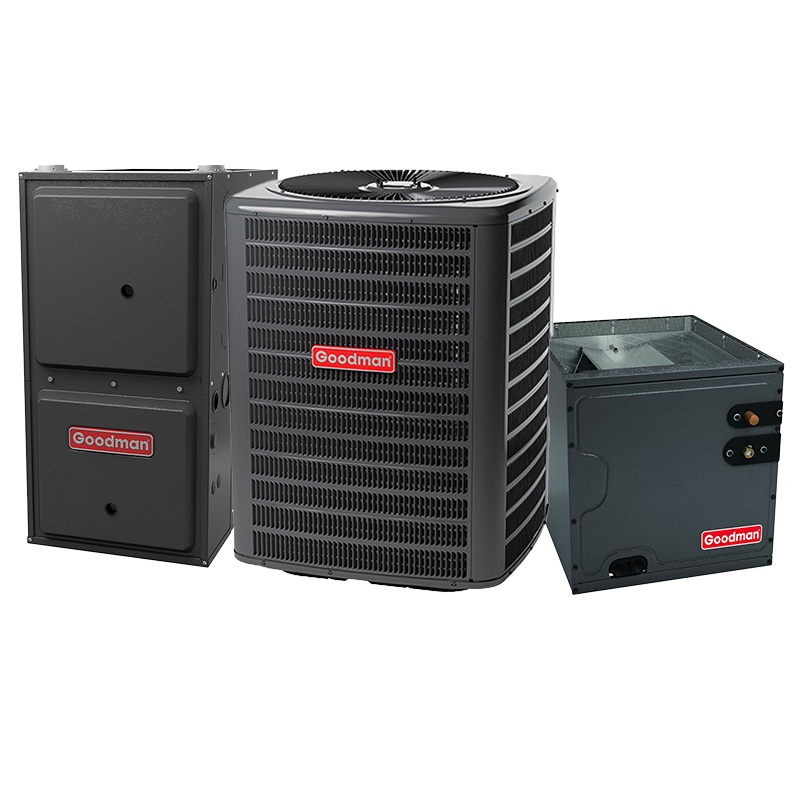
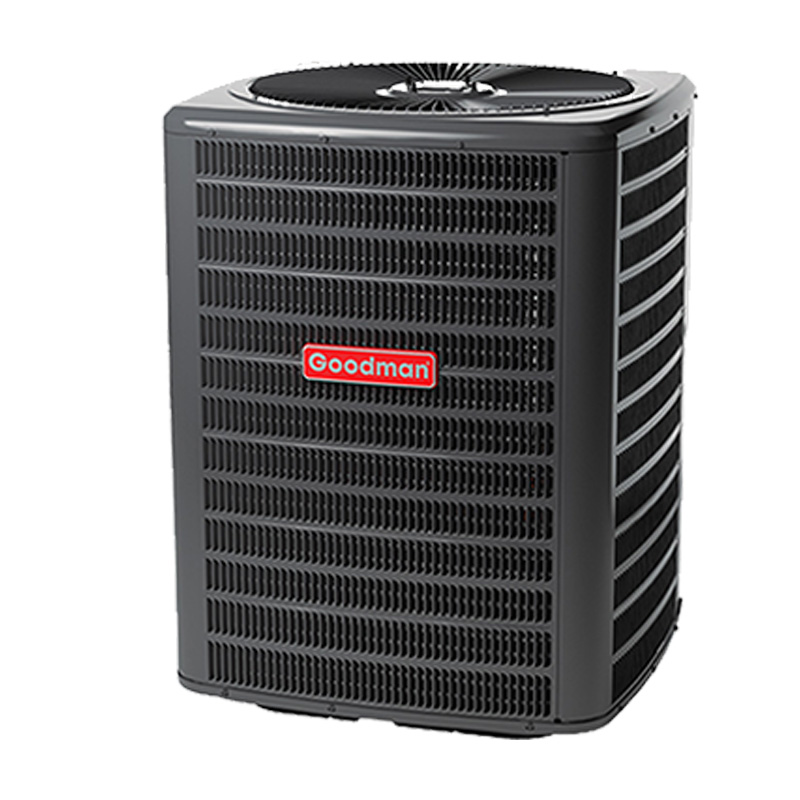
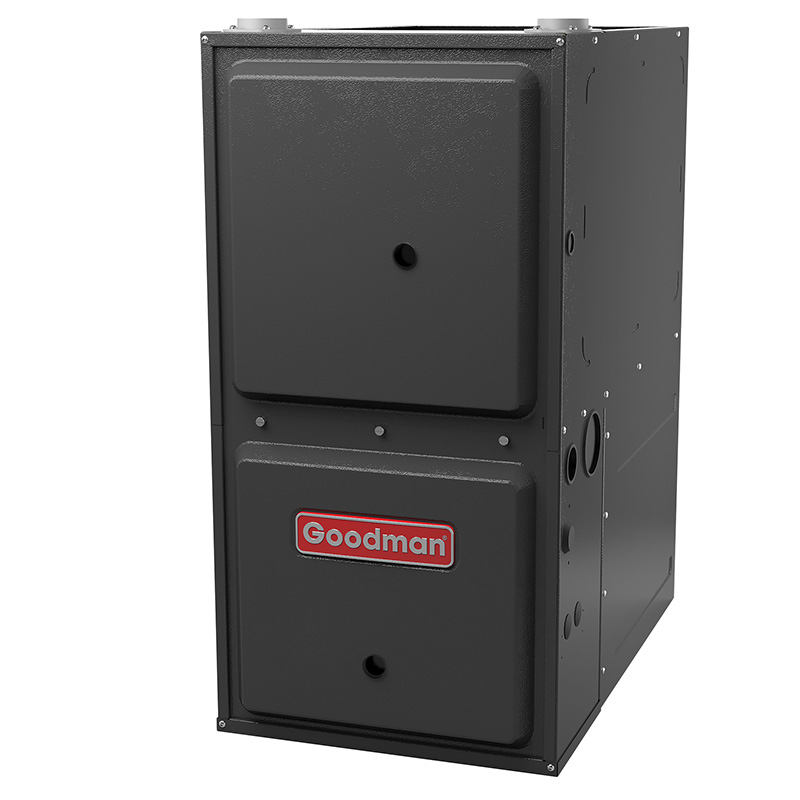
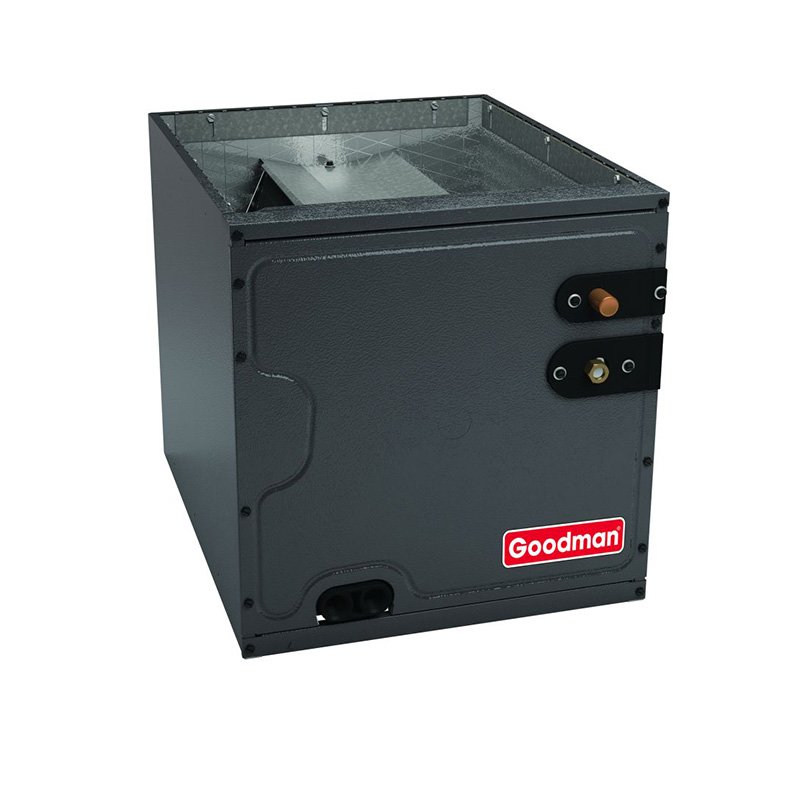
Goodman 4 Ton 13.5 SEER2 AC With 100000 BTU 96% AFUE 2-Stage Variable-Speed ECM Gas Furnace System – Downflow | R32
View on AC Direct see your lowest price →Check current price on AC Direct →
Key features
- 4-ton cooling capacity rated at 13.5 SEER2 under current DOE test standards
- 100,000 BTU two-stage gas furnace at 96% AFUE for high-efficiency winter heating
- Variable-speed ECM blower motor reduces energy use and improves humidity control
- Downflow configuration for installations where supply air exits through the floor
- R-32 refrigerant with lower global warming potential than R-410A
- Two-stage furnace operation lowers cycling frequency and reduces temperature swings
About this system
This Goodman package pairs a 4-ton, 13.5 SEER2 air conditioner with a 100,000 BTU, 96% AFUE two-stage, variable-speed ECM gas furnace in a downflow configuration, making it a strong candidate for homes where the air handler sits above a crawlspace or in a closet and air is delivered downward through the floor system. The R-32 refrigerant charge is a forward-looking choice: R-32 has a lower global warming potential than the R-410A it replaces, and it is becoming the industry standard as older refrigerants are phased out. At 4 tons, this system is sized for larger homes, typically in the 2,000 to 2,600 square foot range depending on climate, insulation, and ceiling height, though a proper Manual J load calculation should always confirm sizing before purchase.
The 96% AFUE two-stage furnace is where this system earns its keep on cold nights. Two-stage operation means the furnace runs at a lower fire rate most of the time, reducing temperature swings and cycling noise, and only steps up to full 100,000 BTU output during peak demand. The variable-speed ECM blower motor amplifies that comfort benefit by ramping airflow gradually rather than blasting on and off, which also improves humidity control and air filtration. The 13.5 SEER2 cooling efficiency is solidly code-compliant across most U.S. climate zones, though it sits at the entry tier of current efficiency levels rather than mid or premium. Buyers prioritizing lower utility bills over a long ownership horizon may want to consider stepping up to a higher SEER2 rating.
This Goodman system delivers a capable combination of high-efficiency heating and code-compliant cooling at a price point that undercuts comparable Trane, Carrier, and Lennox packages by a meaningful margin. The two-stage, variable-speed furnace is a genuine comfort upgrade over single-stage alternatives, and the R-32 refrigerant keeps the system current with evolving environmental standards. The trade-off is a brand track record that shows more durability variance than premium competitors, with compressor lifespan and component quality that average shorter than top-tier brands.
Overall score is the average of the five ratings above.
What we like
- 96% AFUE two-stage furnace significantly lowers heating fuel costs versus 80% AFUE alternatives
- Variable-speed ECM blower improves comfort and reduces blower energy consumption
- R-32 refrigerant is lower-GWP and better aligned with long-term regulatory direction
- Priced 15 to 25 percent below comparable Carrier, Trane, and Lennox systems
- Downflow design addresses a specific installation need not all systems accommodate
Trade-offs
- 13.5 SEER2 is entry-level efficiency for cooling; higher SEER2 options exist at moderate cost increases
- Compressor lifespan averages 10 to 14 years versus 15 to 20 years for premium-brand compressors
- Dual-run capacitors are a documented common failure point, typically requiring service around or after year 7
- Evaporator coil leaks and first-year refrigerant charge issues appear in a meaningful share of owner reports, often tied to install quality
What homeowners and pros say about Goodman
Homeowners discussing Goodman equipment online tend to split along a familiar line: those who got a clean installation at a fair price and had a largely trouble-free first several years, and those who hit component issues after year 7 and found the repair costs frustrating relative to the original savings. Goodman’s ConsumerAffairs score sits around 2.5 out of 5, a channel that skews toward complaints, where rising repair bills after roughly year 7 are the most repeated grievance. Google dealer reviews paint a more moderate picture at around 3.8 out of 5, with affordability consistently cited as the brand’s primary draw. Neither number reflects a premium reliability story, and buyers should budget accordingly for components like dual-run capacitors, which are the most commonly documented failure point and typically run 300 to 600 dollars to address.
HVAC technicians tend to describe Goodman as a workmanlike brand whose longevity depends heavily on how well the system was installed and commissioned, not just on what came in the box. Evaporator coil leaks show up in a meaningful share of owner reports over the system’s life, and compressor lifespan on Goodman equipment tends to average 10 to 14 years versus 15 to 20 years on premium-brand compressors. A small but documented minority of owners also report refrigerant leaks in the first year, which technicians generally attribute to charging errors or line-set issues at installation rather than factory defects. The practical takeaway for this specific system is to invest in a qualified installer, schedule annual maintenance to catch capacitor wear early, and treat the lower purchase price as a starting point rather than a total cost of ownership guarantee.
Sources: ConsumerAffairs Goodman owner reviews, AHRI Directory of Certified Product Performance, U.S. DOE appliance and equipment efficiency standards, Goodman product specification sheets.
What it costs to run
At 13.5 SEER2, cooling this 4-ton system for a typical 1200-hour cooling season at the U.S. average electricity rate of $0.17/kWh works out to roughly $725 per year in cooling, about $6 less per year than a minimum-efficiency 13.4 SEER2 unit of the same size. Your real cost depends on your climate and local rate.
Method: (48,000 BTU/hr ÷ 13.5 SEER2) × 1200 hours ÷ 1000 × $0.17/kWh. Rate source: U.S. EIA average; cooling hours: moderate-climate estimate.
How it compares
| Brand | Comparable model | SEER2 | Stage | Price position |
|---|---|---|---|---|
| Goodman | 4-Ton 13.5 SEER2 AC with 96% AFUE 2-Stage Variable-Speed Furnace (Downflow, R-32) | 13.5 | Two-stage furnace / single-stage AC | Value pick |
| Carrier | Comfort 14 Series (24ACC4) with 96% AFUE Performance Gas Furnace | 14+ | Single-stage AC / two-stage furnace | Moderately higher than Goodman |
| Trane | XR14c with S9V2 96% AFUE Variable-Speed Furnace | 14+ | Single-stage AC / two-stage variable-speed furnace | Noticeably higher than Goodman |
| Lennox | Merit ML14XC1 with SLP98V Variable-Speed Furnace | 14+ | Single-stage AC / variable-capacity furnace | Significantly higher than Goodman |
Competitor rows are comparable single-stage units at similar efficiency; price is relative position, not a quote.
Questions about this system
Why does this system use R-32 refrigerant and what does that mean for future service?
R-32 is a lower global warming potential refrigerant that is replacing R-410A industry-wide as regulations tighten. Technicians servicing R-32 systems need an updated certification and R-32 compatible tools, so confirm your HVAC contractor is equipped before scheduling maintenance or repairs. R-32 is widely available and its adoption is accelerating, so supply should not be an issue going forward.
What does downflow configuration mean and how do I know if this is the right orientation for my home?
A downflow furnace is designed so that supply air exits from the bottom of the unit and is distributed through ductwork running under the floor, typically in a crawlspace. This is the correct orientation for installations in a main-floor closet or utility room where the duct system is below the equipment. If your ducts run overhead through an attic or the unit sits in a basement, you likely need an upflow or horizontal configuration instead.
The two-stage furnace is rated at 100,000 BTU. How do I know that is the right size for my house?
Furnace and AC sizing should be confirmed with a Manual J heat load calculation performed by your installer, which accounts for your home's square footage, insulation levels, window area, local climate, and infiltration rate. A 100,000 BTU furnace is commonly appropriate for larger homes in cold climates, but installing an oversized furnace leads to short cycling and reduced comfort. Do not skip the load calculation.
Goodman gets mixed reviews online. What are the most common things that go wrong and when?
Based on documented owner and technician reports, dual-run capacitors are the most frequently reported failure, usually a straightforward repair costing roughly 300 to 600 dollars, and this tends to surface after year 7. Evaporator coil leaks appear in a notable share of reviews, and a minority of owners report refrigerant leaks within the first year, which is most often traceable to installation quality rather than a manufacturing defect. Goodman's ConsumerAffairs rating sits around 2.5 out of 5, with repair costs after year 7 as the recurring theme, while Google dealer reviews average closer to 3.8 out of 5 where affordability is frequently cited positively.
Does the variable-speed ECM blower actually make a noticeable difference compared to a standard blower motor?
Yes, in practical terms. A variable-speed ECM motor ramps up and down gradually rather than switching between full-on and full-off, which reduces the abrupt airflow surges that cause cold spots and noise. It also runs at low speed for extended periods to continuously circulate and filter air, which helps with humidity control in summer. Energy consumption for blower operation drops significantly compared to a standard PSC motor, typically accounting for real savings on your electric bill over the course of a year.
Specifications
| Cooling capacity | 4 Ton |
| Efficiency | 13.5 SEER2 |
| Furnace output | 100000 BTU |
| Furnace efficiency | 96% AFUE |
| Configuration | Downflow |
| Refrigerant | R-32 |