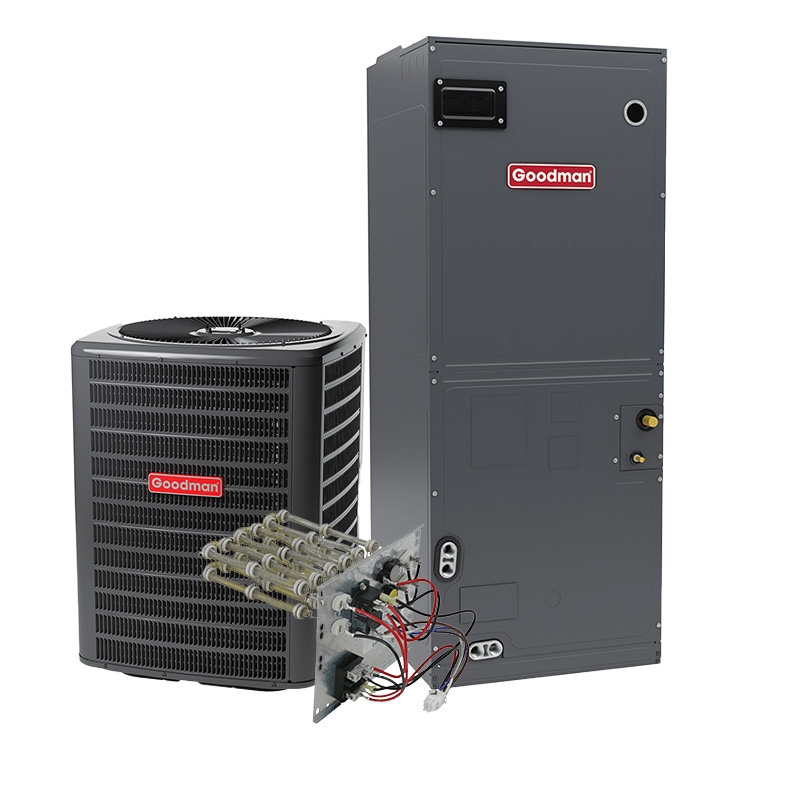
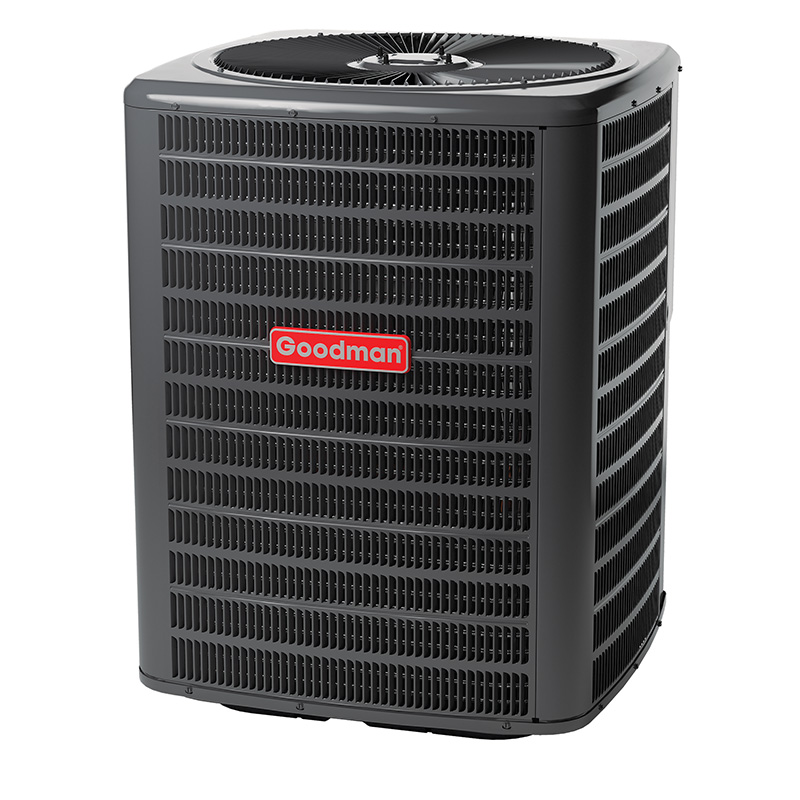
Goodman 2.5 Ton 14.3 SEER2 R32 Heat Pump Split System
View on AC Direct see your lowest price →Check current price on AC Direct →
Key features
- 2.5-ton capacity suited to approximately 1,200 to 1,600 sq ft homes depending on load
- 14.3 SEER2 efficiency rating meets current federal minimums for most U.S. regions
- R-32 refrigerant with lower global-warming potential than R-410A
- Single-stage compressor operation for straightforward, no-frills cooling and heating
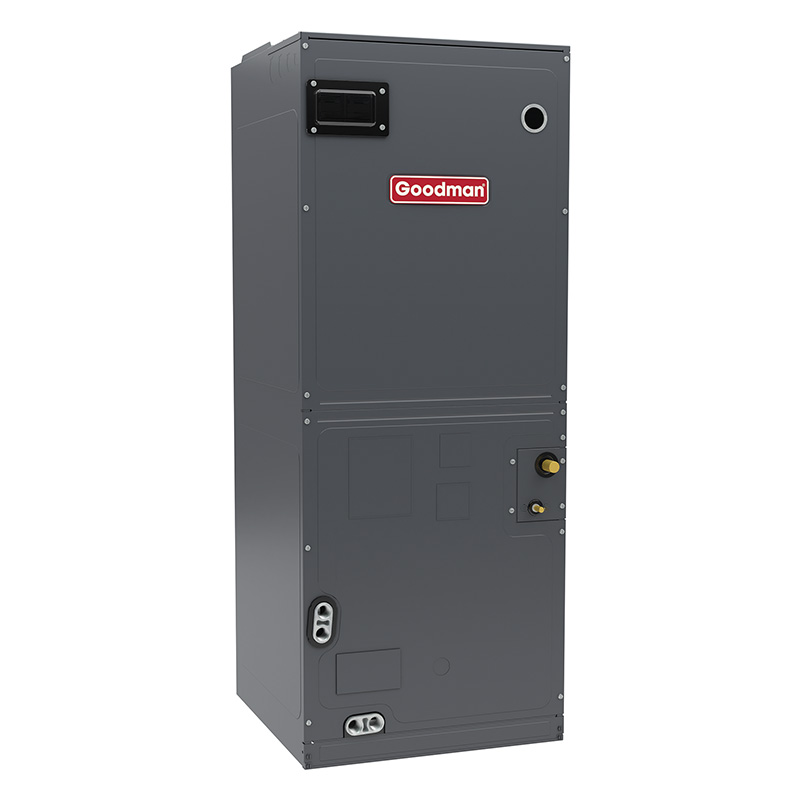
- Split-system configuration requires a matched indoor air handler or coil for full installation
- Priced roughly 15 to 25 percent below comparable Carrier, Trane, and Lennox equipment
About this system
The Goodman 2.5-ton 14.3 SEER2 heat pump split system is an entry-level ducted system built around R-32 refrigerant, a lower-GWP alternative to R-410A that is becoming standard as the industry moves away from older blends. At 2.5 tons it is sized for homes roughly in the 1,200 to 1,600 square foot range, depending on climate zone, insulation quality, and window load. The 14.3 SEER2 rating sits right at the federal minimum for most U.S. regions, meaning you get code-compliant cooling and heating efficiency without paying for the premium efficiency tiers that come with variable-speed or two-stage compressor technology.
This system suits buyers who want a functional, code-legal replacement at the lowest reasonable entry price and who understand that the savings up front come with trade-offs in long-run efficiency and, according to real-world owner data, a somewhat shorter expected compressor lifespan than premium brands. It is a single-stage system, so it runs at full capacity or not at all, which is less comfortable and less efficient in mild shoulder-season weather than staged or variable-speed alternatives. Homeowners in moderate climates with a tight budget and access to a skilled installer will get the most out of it.
The Goodman 2.5-ton 14.3 SEER2 R-32 heat pump is a serviceable budget option for homeowners who need a code-compliant replacement without a large upfront outlay. It delivers what it promises on paper, but the real-world experience depends heavily on installer quality, and documented failure patterns, particularly capacitors and evaporator coil leaks, mean maintenance costs can rise noticeably after year seven. Buyers who prioritize long-term reliability or comfort consistency over purchase price should consider stepping up.
Overall score is the average of the five ratings above.
What we like
- Lowest purchase price in its class, typically 15 to 25 percent below Trane, Lennox, and Carrier equivalents
- R-32 refrigerant is more environmentally responsible than R-410A and is becoming the industry standard
- 14.3 SEER2 meets federal minimum efficiency requirements in most regions
- Widespread dealer and parts network makes service and capacitor replacements relatively accessible
- Simple single-stage design is straightforward for experienced technicians to diagnose and service
Trade-offs
- Compressor lifespan averages 10 to 14 years versus 15 to 20 years for premium-brand compressors
- Evaporator coil leaks appear in a meaningful share of owner reports, potentially a costly mid-life repair
- Single-stage operation provides less precise humidity and temperature control than two-stage or variable-speed systems
- A minority of owners report refrigerant leaks in the first year, typically tied to installation or initial charge quality
What homeowners and pros say about Goodman
On ConsumerAffairs, Goodman scores around 2.5 out of 5, though that channel skews heavily toward owners who are frustrated enough to write a review. The recurring theme in those write-ups is that repair costs start accumulating after roughly year seven, with dual-run capacitor failures cited most often as the first sign of trouble and evaporator coil leaks appearing in a meaningful share of longer-term accounts. Google dealer reviews tell a more balanced story, averaging around 3.8 out of 5 across locations, where affordability is consistently the most praised quality and installers are frequently credited when the system performs well.
HVAC technicians tend to view Goodman as a workable budget option with a clear caveat: the outcome is disproportionately tied to the quality of the installation. Pros point to the dual-run capacitor as a routine service item and note that compressor longevity, which typically runs 10 to 14 years on Goodman units versus 15 to 20 on premium-brand equipment, is a real consideration for anyone planning to stay in their home for the long haul. The shift to R-32 on newer units adds a refrigerant-handling variable that not every shop is fully equipped for yet, so confirming your contractor has A2L certification before scheduling the install is a practical first step.
Sources: ConsumerAffairs Goodman owner reviews, AHRI Directory of Certified Product Performance, U.S. DOE appliance and equipment efficiency standards, Goodman product specification sheets.
What it costs to run
At 14.3 SEER2, cooling this 2.5-ton system for a typical 1200-hour cooling season at the U.S. average electricity rate of $0.17/kWh works out to roughly $428 per year in cooling, about $29 less per year than a minimum-efficiency 13.4 SEER2 unit of the same size. Your real cost depends on your climate and local rate.
Method: (30,000 BTU/hr ÷ 14.3 SEER2) × 1200 hours ÷ 1000 × $0.17/kWh. Rate source: U.S. EIA average; cooling hours: moderate-climate estimate.
How it compares
| Brand | Comparable model | SEER2 | Stage | Price position |
|---|---|---|---|---|
| Goodman | 2.5-Ton 14.3 SEER2 R-32 Heat Pump Split System | 14.3 | Single-stage | Value pick |
| Carrier | Performance 14 Heat Pump (25HPB6) | 14.3 | Single-stage | Moderately higher than Goodman |
| Trane | XR14c Heat Pump | 14.3 | Single-stage | Moderately to significantly higher than Goodman |
| Lennox | ML14XP1 Heat Pump | 14.3 | Single-stage | Moderately higher than Goodman |
Competitor rows are comparable single-stage units at similar efficiency; price is relative position, not a quote.
Questions about this system
Will this heat pump work as my primary heat source in cold winters, or do I need a backup?
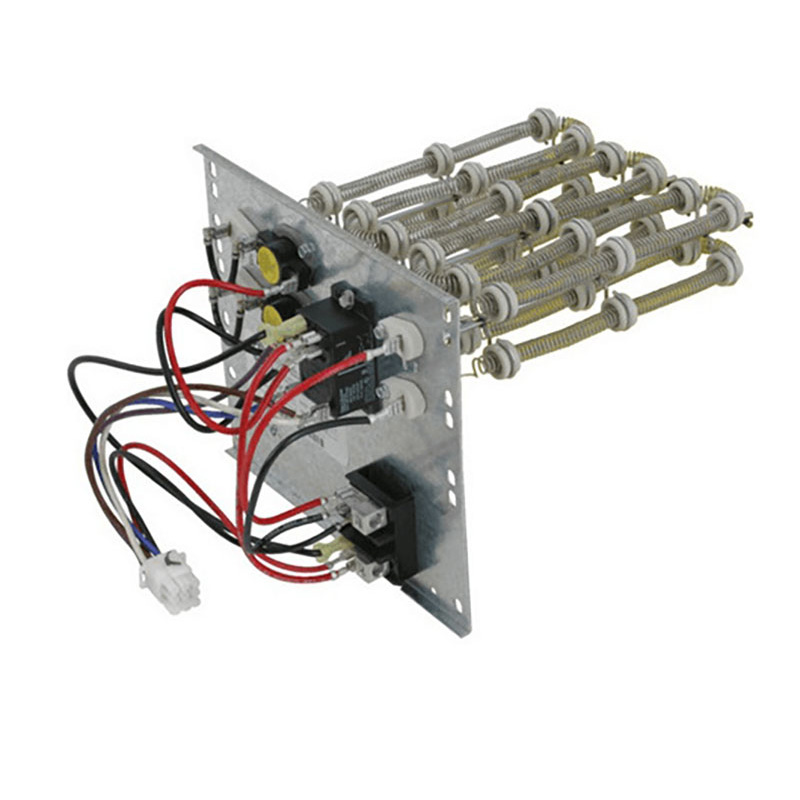
Single-stage heat pumps at this efficiency tier lose meaningful heating capacity as outdoor temperatures drop below about 35 to 40 degrees Fahrenheit. In cold climates you will almost certainly need an electric or gas auxiliary heat source paired with it. In mild Sun Belt climates it can handle most of the heating load on its own.
Why are some Goodman owners reporting refrigerant leaks in the first year?
The documented pattern points to installation and initial charge issues rather than a factory defect in most cases. Hiring an EPA 608-certified technician who pressure-tests the line set before startup and verifies the refrigerant charge to manufacturer specs is the most direct way to avoid this problem.
How does R-32 refrigerant affect servicing costs compared to R-410A?
R-32 is mildly flammable (A2L classification), so technicians need specific training and equipment to handle it safely. As R-32 becomes more widespread that is less of an issue, but you should confirm your service contractor is already working with A2L refrigerants before committing to this system.
What is the most likely repair I will face in the first 10 years, and how much will it cost?
Dual-run capacitor failure is the most commonly reported issue on Goodman heat pumps. It is generally a straightforward repair in the 300 to 600 dollar range including labor. Evaporator coil leaks are a less frequent but more expensive problem, and compressor replacement after roughly 10 to 14 years represents the largest potential cost.
Does Goodman require me to register the equipment to get the full warranty?
Yes, Goodman typically requires online registration within a set window after installation to unlock the longest warranty term. Failure to register usually drops coverage to a shorter base period, so registering promptly after the system is commissioned is important.
Specifications
| Cooling capacity | 2.5 Ton |
| Efficiency | 14.3 SEER2 |
| Refrigerant | R-32 |