Goodman 2.5 Ton Package Unit Heat Pump & AC | 13.4 SEER2 Horizontal Discharge | R32
View on AC Direct see your lowest price →Check current price on AC Direct →
Key features
- 2.5-ton capacity in a single horizontal-discharge outdoor cabinet
- 13.4 SEER2 efficiency rating — meets current federal minimum standard
- R-32 refrigerant with roughly 68% lower global warming potential than R-410A
- Combines heat pump heating and air conditioning in one packaged unit
- Horizontal airflow configuration for under-deck, crawl space, or rooftop installs
- Goodman factory warranty covers compressor, parts, and unit replacement (registration required)
About this system
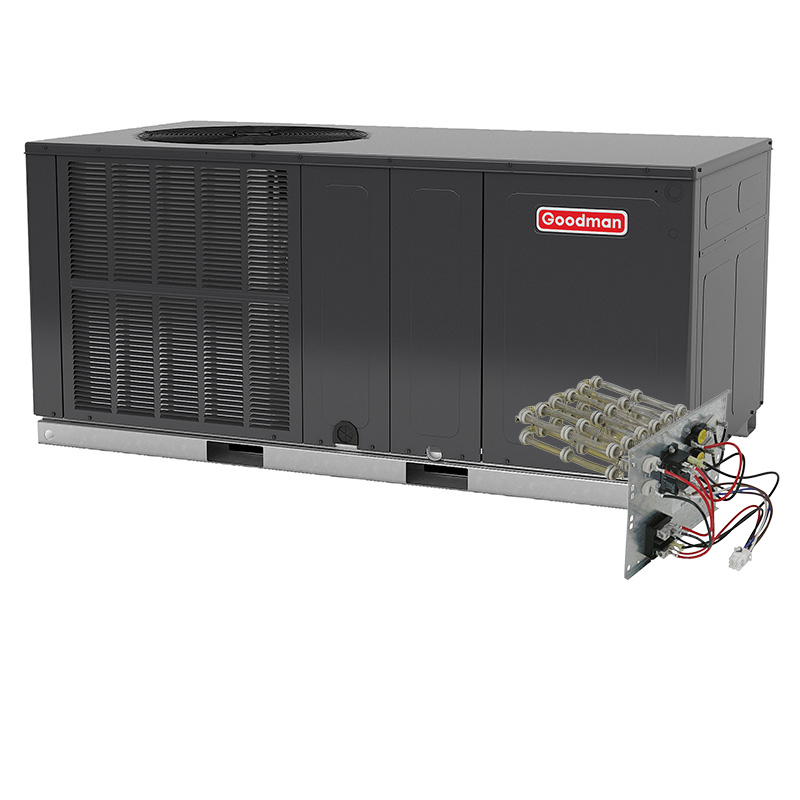
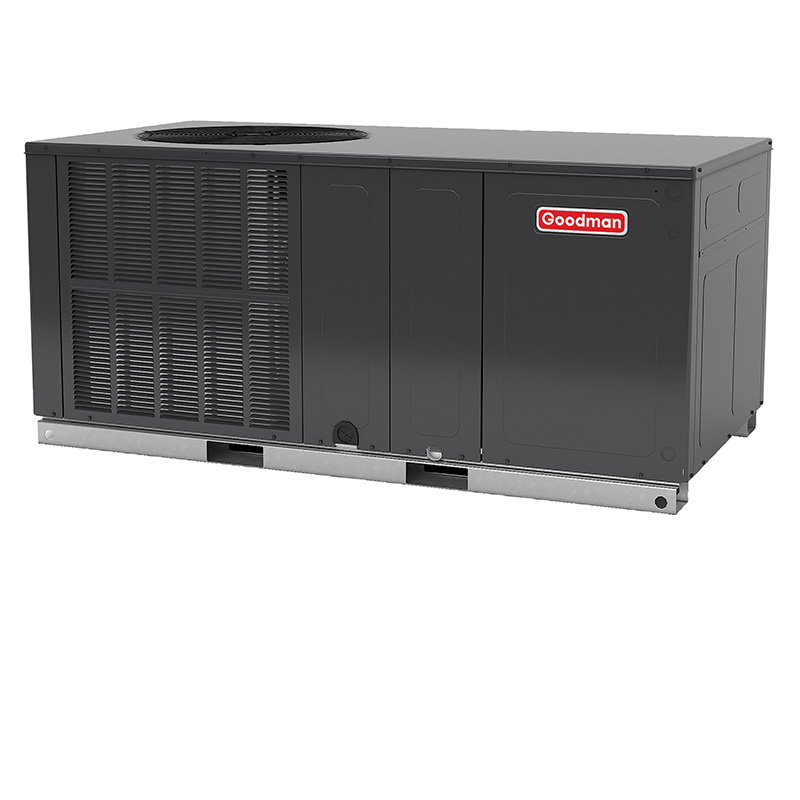
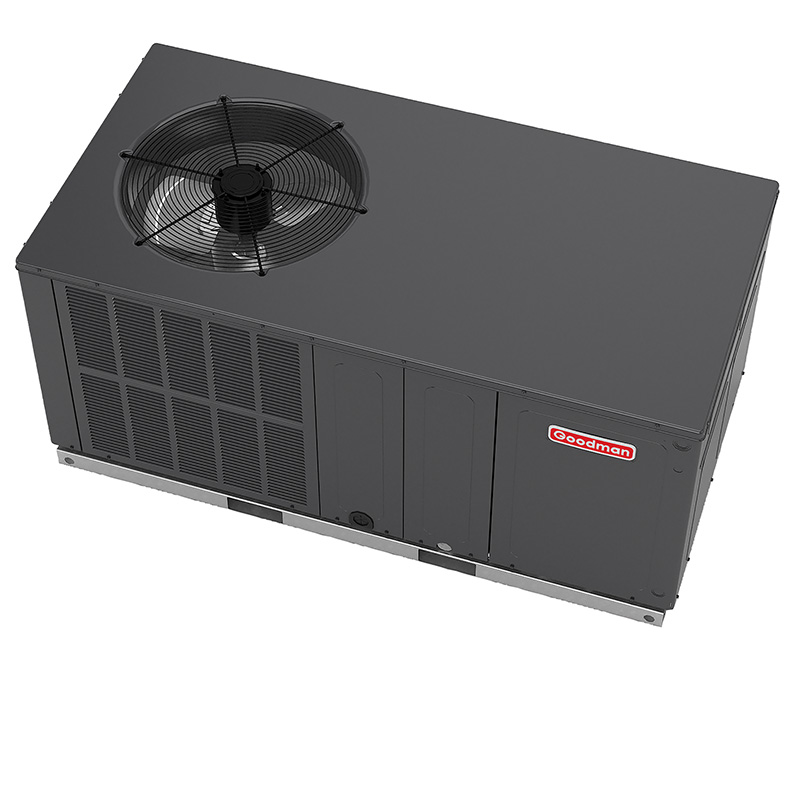
The Goodman 2.5-ton horizontal-discharge heat pump package unit is a self-contained system where the compressor, air handler, and coil all live in a single outdoor cabinet. Horizontal discharge makes it the right fit for installations where the unit sits under a deck, in a crawl space, or on a roof with side-exit ductwork — situations where a vertical-discharge unit simply cannot be positioned correctly. At 2.5 tons, it is sized for homes roughly in the 1,200 to 1,600 square foot range, though a proper Manual J load calculation should always confirm that figure before purchase.
The 13.4 SEER2 efficiency rating sits at the current federal minimum baseline, which means operating costs are honest but not exceptional. Homeowners in mild climates or those replacing an aging R-22 or R-410A system will see a real improvement over equipment that is 10 or more years old, but buyers prioritizing low utility bills in hot or cold climates should weigh whether a higher-efficiency unit pays back over time. The shift to R-32 refrigerant is a meaningful step forward: R-32 has a global warming potential roughly two-thirds lower than R-410A, and its higher energy density means the system needs less of it by weight. On the trade side, R-32 is mildly flammable (A2L classification), so technicians need to be certified and equipped to handle it, which can affect future service availability in some rural markets.
This Goodman package unit delivers reliable baseline comfort at a price point 15 to 25 percent below comparable Trane, Carrier, or Lennox offerings, making it a practical choice for budget-conscious buyers who are not chasing low utility bills. The 13.4 SEER2 rating is entry-level rather than standout, and the brand's documented track record of capacitor failures and shorter-than-premium compressor lifespans means factoring in a service budget after year seven. When installed by a skilled technician and properly maintained, it performs its core job well; cut corners on installation and the savings can evaporate quickly.
Overall score is the average of the five ratings above.
What we like
- Purchase price is meaningfully lower than Trane, Lennox, or Carrier equivalents at similar efficiency
- Horizontal discharge opens up installation sites that vertical-only units cannot serve
- R-32 refrigerant is more environmentally responsible than R-410A and requires less charge by weight
- All-in-one package unit simplifies installation compared to split systems requiring matched indoor and outdoor components
- Goodman parts are widely stocked, and dual-run capacitor replacements — the most common failure — are typically a low-cost repair
Trade-offs
- 13.4 SEER2 is the regulatory floor, so monthly operating costs will be higher than mid- or high-efficiency alternatives
- Compressor lifespan averages 10 to 14 years versus 15 to 20 years documented for premium brands, raising long-term replacement risk
- Evaporator coil leaks appear with enough frequency in owner feedback to warrant attention, particularly past the warranty period
- R-32 (A2L) refrigerant requires specially certified technicians, which can limit service options in rural or smaller markets
What homeowners and pros say about Goodman
On Google dealer review pages, Goodman equipment consistently pulls scores around 3.8 out of 5 across hundreds of reviews per location, and the pattern is clear: buyers who got a competitive price and a competent installer tend to be satisfied, at least in the early years. Affordability comes up repeatedly as the reason someone chose Goodman over a premium brand, and for package unit buyers who are working with a fixed budget or replacing a unit in a rental property, that math is hard to argue with. HVAC technicians who work on Goodman equipment regularly will tell you the same thing in different words: the equipment is acceptable, but installation quality is the single biggest variable in how long one lasts and how few service calls it generates.
Where the picture gets more complicated is in the longer ownership window. ConsumerAffairs ratings for Goodman sit around 2.5 out of 5, and while that platform skews toward people who are frustrated enough to write a review, the recurring complaint is service costs climbing after roughly year seven. The documented failure modes are specific and consistent: dual-run capacitors are the most common breakdown, usually a manageable low-cost fix, but evaporator coil leaks also appear with enough regularity to take seriously, and compressor lifespans averaging 10 to 14 years fall notably short of the 15 to 20 years owners of Carrier, Trane, or Lennox equipment tend to report. A small share of owners have also reported refrigerant leaks within the first year, which technicians attribute to installation or initial charge issues rather than the unit itself. For this specific horizontal-discharge package unit, where you are also adding R-32 servicing requirements to the equation, building a relationship with a certified and experienced local contractor is not optional — it is the most important thing you can do to protect what you paid for.
Sources: ConsumerAffairs Goodman owner reviews, AHRI Directory of Certified Product Performance, U.S. DOE appliance and equipment efficiency standards, Goodman product specification sheets.
What it costs to run
At 13.4 SEER2, cooling this 2.5-ton system for a typical 1200-hour cooling season at the U.S. average electricity rate of $0.17/kWh works out to roughly $457 per year in cooling, about $0 less per year than a minimum-efficiency 13.4 SEER2 unit of the same size. Your real cost depends on your climate and local rate.
Method: (30,000 BTU/hr ÷ 13.4 SEER2) × 1200 hours ÷ 1000 × $0.17/kWh. Rate source: U.S. EIA average; cooling hours: moderate-climate estimate.
How it compares
| Brand | Comparable model | SEER2 | Stage | Price position |
|---|---|---|---|---|
| Goodman | 2.5-Ton Horizontal Package Heat Pump (this unit) | 13.4 | Single-stage | Value pick |
| Carrier | WeatherMaster 50XC Series Package Heat Pump | 14.0–15.0 | Single-stage | Priced 15 to 25 percent higher than this Goodman |
| Trane | Precedent XR14 Package Heat Pump | 14.0 | Single-stage | Priced 20 to 30 percent higher than this Goodman |
| Lennox | Elite XP14 Package Heat Pump | 14.0–15.0 | Single-stage | Priced 20 to 35 percent higher than this Goodman |
Competitor rows are comparable single-stage units at similar efficiency; price is relative position, not a quote.
Questions about this system
What kind of warranty does this Goodman package unit come with, and do I have to register it?
Goodman's standard warranty coverage on heat pump package units typically includes a 10-year parts warranty and compressor coverage when you register the unit within a set window after installation. Without registration, coverage usually drops to a shorter base period. Confirm the exact terms for this specific model number before purchase, because warranty tiers do vary.
Is R-32 refrigerant safe, and will any HVAC technician be able to service it?
R-32 is classified A2L — mildly flammable but low toxicity — and it requires technicians to hold appropriate certification and use compatible equipment. In most metropolitan and suburban areas this is increasingly routine, but in rural markets you may want to confirm your local service companies are already equipped before committing to an R-32 system.
My installation site is under a deck. Will horizontal discharge actually work there, and what clearances do I need?
Horizontal discharge is specifically designed for tight or covered spaces like under-deck and crawl space locations where vertical airflow would be blocked. You still need to observe the manufacturer's minimum clearances on all sides for proper airflow and serviceability — check the installation manual for exact dimensions, since blocking discharge even partially will hurt efficiency and can cause the unit to short-cycle.
How often do the dual-run capacitors fail, and what does that repair typically cost?
Dual-run capacitor failure is the single most frequently reported repair issue for Goodman equipment. It is also one of the least expensive: most technicians price the part and labor in the 300 to 600 dollar range, and the repair is usually completed in a single visit. Keeping a spare capacitor on hand or scheduling a preventive tune-up annually can catch a weakening capacitor before it causes a no-cooling call on the hottest day of summer.
Is 13.4 SEER2 going to cost me noticeably more to run than a higher-efficiency unit?
Yes, though the real-world difference depends on your local electricity rate and how many hours per year the system runs. Compared to a 16 SEER2 unit, a 13.4 SEER2 system uses roughly 16 to 18 percent more electricity for the same cooling output. In a mild climate with modest run hours that gap may be 50 to 100 dollars a year; in a hot climate with long cooling seasons it can be substantially more, which is worth calculating against the lower purchase price.
Specifications
| Cooling capacity | 2.5 Ton |
| Efficiency | 13.4 SEER2 |
| Configuration | Horizontal |
| Refrigerant | R-32 |