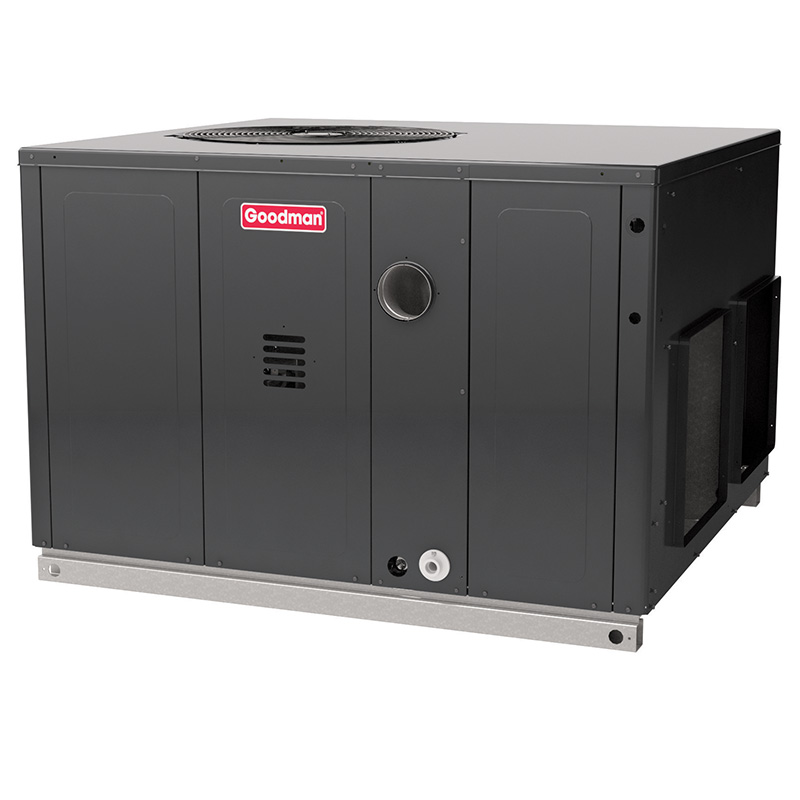
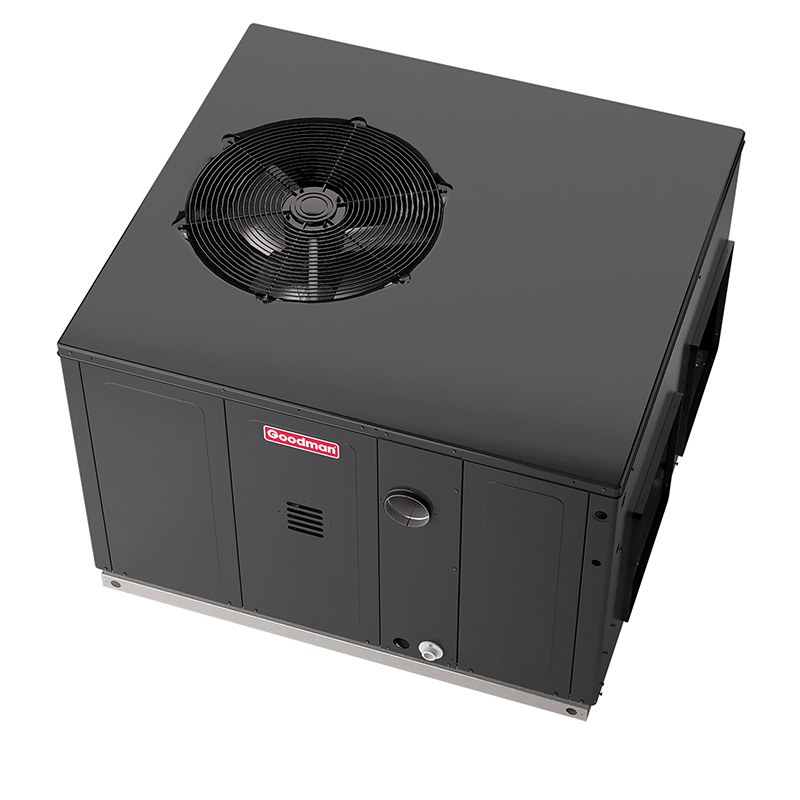
Goodman 4 Ton Package Unit Gas / Electric AC – 81% Efficiency 80000 BTU | 13.4 SEER2 Multi-Positional | R32
View on AC Direct see your lowest price →Check current price on AC Direct →
Key features
- 4-ton cooling capacity, 80,000 BTU gas heat in a single cabinet
- 13.4 SEER2 single-stage cooling meets 2023 federal minimum efficiency standards
- 81% AFUE gas heating, standard efficiency for package units
- Multi-positional design supports rooftop horizontal or ground-level vertical installation
- R-32 refrigerant with lower global warming potential than R-410A
- Single-unit cabinet simplifies service access and reduces refrigerant line runs
About this system
The Goodman GPGM34808031 is a 4-ton gas/electric package unit that handles both heating and cooling in a single rooftop or ground-mounted cabinet. At 80,000 BTU of gas heat and 13.4 SEER2 cooling efficiency, it targets homes and light commercial spaces in the 1,800 to 2,400 square foot range that need an all-in-one solution, particularly where indoor mechanical space is limited or a traditional split system is impractical. The multi-positional configuration means it can be installed horizontally on a rooftop curb or vertically on a concrete pad with a downflow duct connection, giving installers real flexibility on retrofit or new-construction jobs.
The heating side runs at 81% AFUE, which is standard efficiency for a gas package unit and meets minimum federal requirements for most northern climate zones. It is not a high-efficiency furnace, so buyers in very cold climates with high gas costs should weigh that carefully. On the cooling side, 13.4 SEER2 clears the 2023 federal minimum for most U.S. regions but sits at entry-level efficiency rather than mid-grade or premium. The system uses R-32 refrigerant, a lower global-warming-potential option compared to the R-410A it replaces, and one that is increasingly supported by technicians and parts distributors. Overall, this unit is built for buyers who prioritize upfront cost savings and simplified installation over peak long-run efficiency or premium brand reliability metrics.
The GPGM34808031 delivers solid entry-level performance at a price point 15 to 25 percent below comparable Carrier, Trane, and Lennox package units, making it a practical choice for budget-conscious buyers or rental property owners. The 13.4 SEER2 and 81% AFUE ratings keep operating costs reasonable but will not match the energy savings of higher-efficiency alternatives. Long-term ownership costs depend heavily on install quality and how quickly capacitor and coil issues are addressed if they arise.
Overall score is the average of the five ratings above.
What we like
- Upfront cost is meaningfully lower than Carrier, Trane, and Lennox equivalents at this capacity
- Multi-positional cabinet gives contractors flexibility on retrofits and new builds
- R-32 refrigerant is increasingly available and has a lower environmental impact than R-410A
- Single-cabinet design reduces labor time for ductwork connections and refrigerant line work
- Dual-run capacitor failures, the most common documented issue, are a low-cost repair in the $300-$600 range
Trade-offs
- 81% AFUE heating efficiency is the federal minimum tier and will show higher gas bills versus 90%+ AFUE units
- Compressor lifespan averages 10 to 14 years versus 15 to 20 years for premium brands, which matters on a 4-ton commercial-adjacent unit
- ConsumerAffairs reviews average around 2.5 out of 5, with repair cost complaints rising after year 7
- Evaporator coil leaks and early refrigerant charge issues appear in owner reports, with first-year leaks often tied to installation quality
What homeowners and pros say about Goodman
Homeowners and HVAC contractors tend to split on Goodman along predictable lines. On Google dealer review pages, Goodman equipment averages around 3.8 out of 5 stars across hundreds of reviews per location, where the most consistent praise is straightforward: the price is lower than what Carrier, Trane, or Lennox would cost for the same capacity. Contractors who install a high volume of Goodman equipment note that units installed carefully and checked for proper refrigerant charge tend to perform without drama for the first several years. The flip side is that ConsumerAffairs shows a much lower average of about 2.5 out of 5, and while that channel skews toward people who are frustrated enough to write a review, the recurring theme is worth noting: repair costs tend to climb after roughly year 7, when capacitor replacements, coil issues, and compressor wear become more frequent concerns.
For this specific 4-ton gas/electric package unit, the failure modes that show up most in owner feedback are the dual-run capacitor, which is the most common reported issue and typically a low-cost fix in the $300 to $600 range when caught early, and evaporator coil leaks, which are more disruptive and expensive to resolve. A smaller share of owners report refrigerant leaks in the first year, and experienced technicians point to installation quality rather than factory defects as the usual cause. Compressor lifespan on Goodman equipment averages 10 to 14 years in documented reports, noticeably shorter than the 15 to 20 years often cited for premium-brand compressors, which is a real consideration on a 4-ton unit where compressor replacement is a significant expense. The honest summary from the field is that Goodman rewards buyers who hire experienced installers and stay on top of annual maintenance, and it punishes those who do neither.
Sources: ConsumerAffairs Goodman owner reviews, AHRI Directory of Certified Product Performance, U.S. DOE appliance and equipment efficiency standards, Goodman product specification sheets.
What it costs to run
At 13.4 SEER2, cooling this 4-ton system for a typical 1200-hour cooling season at the U.S. average electricity rate of $0.17/kWh works out to roughly $731 per year in cooling, about $0 less per year than a minimum-efficiency 13.4 SEER2 unit of the same size. Your real cost depends on your climate and local rate.
Method: (48,000 BTU/hr ÷ 13.4 SEER2) × 1200 hours ÷ 1000 × $0.17/kWh. Rate source: U.S. EIA average; cooling hours: moderate-climate estimate.
How it compares
| Brand | Comparable model | SEER2 | Stage | Price position |
|---|---|---|---|---|
| Goodman | GPGM34808031 | 13.4 | Single-stage | Value pick |
| Carrier | WeatherMaster 50XC Series | 14.0 | Single-stage | 15 to 25 percent more than this Goodman |
| Trane | YCC Series | 14.0 | Single-stage | 15 to 25 percent more than this Goodman |
| Lennox | LRP16GE Series | 16.0 | Single-stage | 25 to 35 percent more than this Goodman |
Competitor rows are comparable single-stage units at similar efficiency; price is relative position, not a quote.
Questions about this system
Is 13.4 SEER2 going to pass inspection in my state, and will it qualify for any rebates?
13.4 SEER2 meets the 2023 federal minimum for most U.S. climate regions, so it will pass a standard inspection in the majority of markets. However, many utility rebate programs require 15 SEER2 or higher to qualify, so check your local utility's current threshold before purchasing if rebates are part of your budget math.
What does multi-positional actually mean for a package unit, and does my installation qualify?
Multi-positional means the cabinet can be oriented for rooftop horizontal installation on a curb or set on a ground-level pad with downflow duct connections. Your installer will confirm which orientation fits your existing ductwork stub-out and building structure, but the flexibility generally makes retrofits easier than single-orientation models.
How does R-32 refrigerant affect service costs compared to the R-410A I have now?
R-32 is widely available and supported by most HVAC distributors now that R-410A is being phased down, so parts and refrigerant costs should be comparable in most markets. One practical note: R-32 is mildly flammable (A2L class), so technicians need to follow updated safety protocols during service, which is standard practice for any 2024-era equipment.
Goodman gets mixed reviews online. What are the most likely repair issues I should budget for?
The most commonly reported failure point is the dual-run capacitor, typically a straightforward repair in the $300 to $600 range when caught promptly. Evaporator coil leaks appear in a meaningful portion of long-term owner reports and are more expensive to address. A small share of first-year owners have reported refrigerant leaks, which are usually traced back to the initial installation charge rather than a factory defect.
Does Goodman's warranty on this unit cover parts and labor, and what are the registration requirements?
Goodman typically offers a 10-year parts warranty on registered equipment, but labor is not covered by the manufacturer and must be handled through a service contract or paid out of pocket. Registration must generally be completed within 60 days of installation to secure the full 10-year term; without registration it typically drops to a shorter base warranty, so confirm the current terms on Goodman's site at the time of purchase.
Specifications
| Cooling capacity | 4 Ton |
| Efficiency | 13.4 SEER2 |
| Furnace output | 80000 BTU |
| Configuration | Multi-Position |
| Refrigerant | R-32 |
| Model | GPGM34808031 |