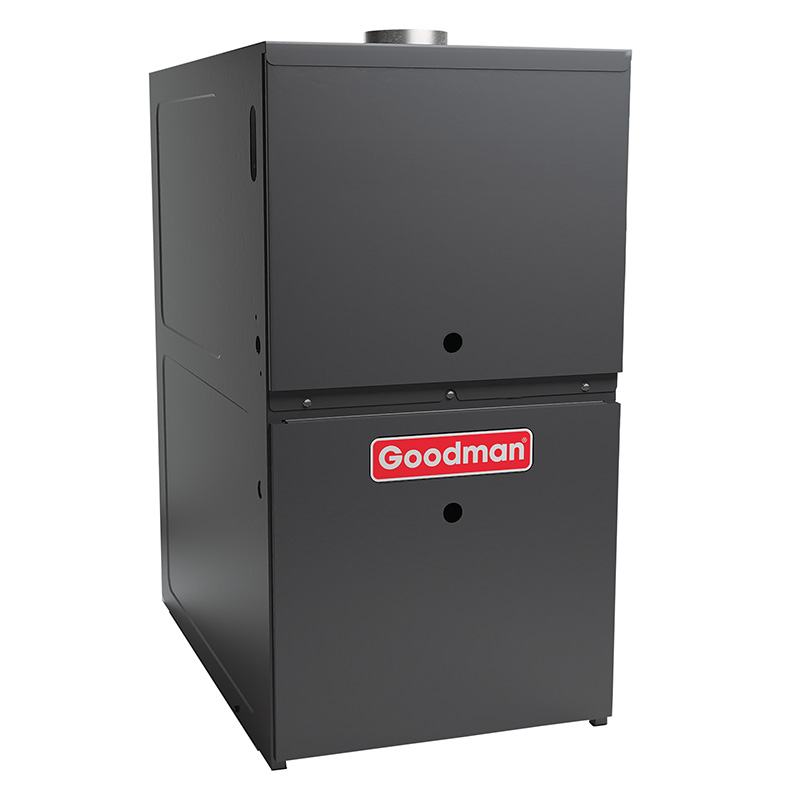
Goodman 80000 BTU 80% Efficiency Two Stage Gas Furnace | Variable-Speed ECM Upflow / Horizontal | R32 (GRVT800805CN)
View on AC Direct see your lowest price →Check current price on AC Direct →
Key features
- 80,000 BTU two-stage burner reduces short cycling and improves comfort in moderate climates
- 80% AFUE non-condensing design uses standard metal flue venting, no PVC or condensate drain required
- Variable-speed ECM blower motor cuts blower electricity use versus standard PSC motors
- Upflow and horizontal installation configurations suit most residential duct layouts
- Two-stage operation lowers operating noise and extends heat exchanger life versus single-stage units
- Priced roughly 15 to 25 percent below comparable Carrier, Trane, and Lennox models
About this system
The Goodman GRVT800805CN is an 80,000 BTU, 80% AFUE two-stage gas furnace built for upflow or horizontal installation in homes that need honest, mid-tier heating performance without the premium price tag of a Trane or Lennox. The two-stage burner runs at a lower fire rate most of the time and only steps up to full capacity during the coldest stretches, which smooths out temperature swings and reduces the on-off cycling that shortens heat exchangers over time. The variable-speed ECM blower motor pairs with that staged burner to move air quietly and efficiently, pulling significantly less electricity than a standard PSC motor across a heating season.
An 80% AFUE rating means twenty cents of every fuel dollar goes up the flue. That is the federal minimum for most northern climates and an honest, code-compliant choice, but not a standout efficiency number. Homeowners in mild to moderate climates where gas is inexpensive will find the lower equipment cost offsets the efficiency gap versus a 96% unit. In cold climates with high gas rates, a 96% condensing furnace typically pays back the price difference in under five years. The R-32 refrigerant designation in the model name is unusual for a furnace-only unit and likely reflects a matched-system labeling convention rather than a refrigerant inside this specific cabinet. Confirm with your installer what coil or air handler this unit is matched with before purchase.
This furnace suits replacement projects in existing duct systems where upflow or horizontal orientation is already established, and where the homeowner wants a step above a basic single-stage unit without moving to a high-efficiency condensing furnace requiring PVC venting and a condensate drain. It is a practical pick for budget-conscious buyers in moderate climates who are comfortable trading some long-term efficiency and brand reliability for a lower upfront cost.
The GRVT800805CN delivers genuine two-stage comfort and a quiet ECM blower at a price point that undercuts the major premium brands by a meaningful margin. Trade-offs are real: 80% AFUE is entry-level efficiency, and Goodman's documented track record shows repair costs climbing after year seven and compressor and coil longevity that falls short of premium competitors. Install quality is the single biggest variable in how long this furnace performs, so choosing a skilled, experienced contractor matters more here than with higher-tolerance brands.
Overall score is the average of the five ratings above.
What we like
- Two-stage burner improves temperature consistency over single-stage units at minimal added cost
- Variable-speed ECM motor runs quietly and draws less electricity than standard blower motors
- Non-condensing design simplifies installation with standard metal venting and no condensate management
- Upfront equipment cost is 15 to 25 percent below Carrier, Trane, and Lennox equivalents
- Widely available through HVAC distributors, making parts and service accessible in most markets
Trade-offs
- 80% AFUE is the federal minimum threshold, not a competitive efficiency figure, and higher gas bills will accumulate over time versus 96% units
- Goodman's ConsumerAffairs rating averages around 2.5 out of 5, with recurring reports of repair costs rising noticeably after year seven
- Dual-run capacitors are the most frequently reported failure point, and while repairs are typically low-cost, they indicate a component quality gap versus premium brands
- Performance and longevity are heavily dependent on install quality, meaning a poor installation can shorten unit life significantly
What homeowners and pros say about Goodman
Homeowners who choose Goodman furnaces most often point to the upfront savings as the deciding factor, and that sentiment is consistent with Google dealer review scores that average around 3.8 out of 5, where affordability is the praise that appears most frequently. When the installation goes smoothly and the system is properly commissioned, owners generally report years of trouble-free operation. The pattern that surfaces in aggregated owner feedback, including a ConsumerAffairs average hovering around 2.5 out of 5, is that repair costs start climbing more noticeably after roughly year seven. That rating channel skews toward dissatisfied owners, so it is not a pure representation of typical experience, but the year-seven inflection point is consistent enough across sources to take seriously.
HVAC technicians who work on Goodman equipment regularly tend to describe it as straightforward to service, with parts that are widely stocked and reasonably priced. The failure modes they see most often are dual-run capacitors, which are a quick and relatively inexpensive fix, and evaporator coil leaks that show up in a meaningful share of owner reports over time. On the furnace side specifically, the ECM blower motors and two-stage gas valves add some complexity compared to a basic single-stage unit, and technicians consistently emphasize that installation quality is the single largest factor in how long a Goodman system performs. A properly sized, correctly charged, and well-sealed installation will outperform a carelessly installed premium brand every time, and the reverse is equally true.
Sources: ConsumerAffairs Goodman owner reviews, AHRI Directory of Certified Product Performance, U.S. DOE appliance and equipment efficiency standards, Goodman product specification sheets.
How it compares
| Brand | Comparable model | SEER2 | Stage | Price position |
|---|---|---|---|---|
| Goodman | GRVT800805CN | N/A (furnace only) | Two-stage | Value pick |
| Carrier | Performance 80 (58TP080) | N/A (furnace only) | Two-stage | Moderately higher than this Goodman |
| Trane | S8X2 (80% Two-Stage) | N/A (furnace only) | Two-stage | Higher than this Goodman, closer to Carrier |
| Lennox | Merit ML180 (80% Two-Stage) | N/A (furnace only) | Two-stage | Noticeably higher than this Goodman |
Competitor rows are comparable single-stage units at similar efficiency; price is relative position, not a quote.
Questions about this system
Can I use my existing metal flue venting with this furnace, or do I need new venting?
Yes, the GRVT800805CN is a non-condensing 80% AFUE unit, so it vents with standard single- or double-wall metal pipe rather than PVC. If your existing flue is correctly sized for an 80,000 BTU appliance and in good condition, it can typically be reused. Have your installer confirm sizing and inspect for deterioration before reusing any existing venting.
What does the R-32 designation in the model number mean for a gas furnace?
R-32 in the model number reflects a system-level labeling convention Goodman uses to indicate compatibility with R-32 refrigerant coils and matched equipment, not a refrigerant inside the furnace cabinet itself. Gas furnaces do not contain refrigerant. Confirm with your distributor which coil or air handler this furnace is paired with in your planned system.
How does two-stage operation actually affect comfort in daily use?
Most of the time the furnace fires at its lower stage, which produces a longer, steadier heating cycle that keeps room temperatures more even and runs more quietly than a single-stage unit cycling on and off at full blast. The second stage engages automatically on the coldest days or when the thermostat calls for a fast recovery. Over a typical heating season you will spend the large majority of run hours in low stage.
What are the most common repairs owners report on Goodman furnaces like this one?
Dual-run capacitors on the blower motor are the most frequently cited failure, typically costing 300 to 600 dollars to repair including labor, and they tend to surface in years five through ten. Some owners also report draft inducer motor wear over time. Repair frequency tends to increase noticeably after roughly year seven based on aggregated owner feedback, so budgeting for at least one service call in that window is reasonable.
Is the ECM variable-speed blower worth paying extra for over a standard PSC blower model?
For most homeowners, yes. ECM motors draw substantially less electricity during the long fan-only and low-speed heating runs that make up most of a blower's operating hours, which adds up over a heating season. They also ramp speed gradually, which reduces the blast of air you feel at startup and tends to improve filter loading and humidity distribution. The payback period depends on your local electricity rate and how many hours the system runs annually.
Specifications
| Furnace output | 80000 BTU |
| Furnace efficiency | 80% AFUE |
| Configuration | Upflow |
| Refrigerant | R-32 |
| Model | GRVT800805CN |