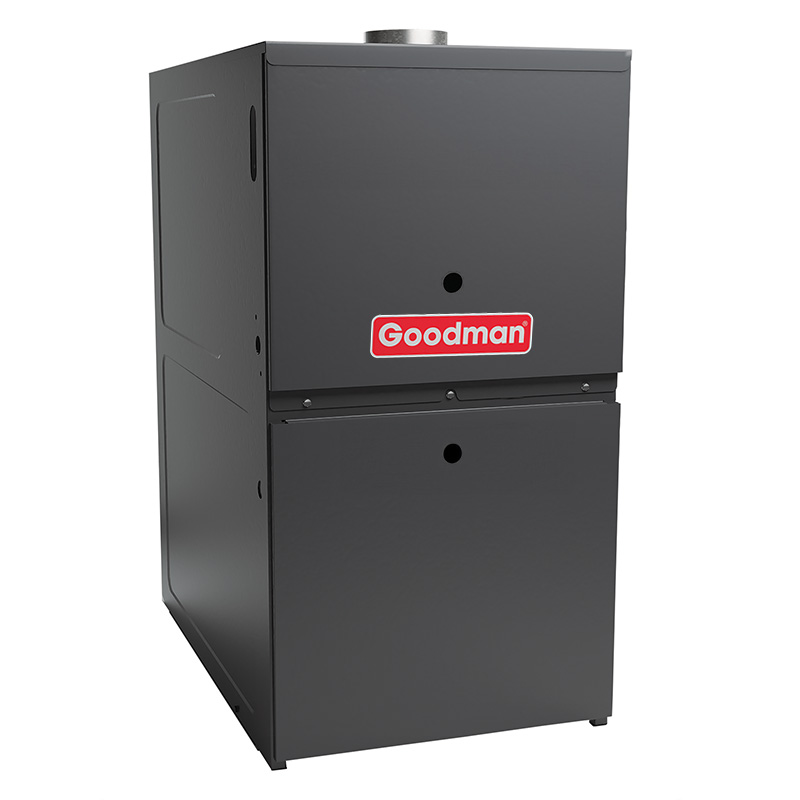
Goodman 100000 BTU 80% Efficiency Two Stage Gas Furnace | Variable-Speed ECM Downflow | Low NOx For California | R32 (GDVT801005CX)
View on AC Direct see your lowest price →Check current price on AC Direct →
Key features
- 100,000 BTU output with two-stage gas valve for low and high firing rates
- 80% AFUE efficiency rating, meeting federal minimum standards for most U.S. regions
- Variable-speed ECM blower motor reduces electricity use and improves airflow consistency
- Downflow configuration for installations above crawl spaces or in closets with floor-level ducts
- Low NOx certified for compliance with California and other strict air-quality regulations
- Designed to pair with Goodman or compatible split systems as part of a whole-home HVAC setup
About this system
The Goodman GDVT801005CX is a 100,000 BTU, 80% AFUE two-stage gas furnace built in a downflow configuration, which means supply air exits through the bottom of the unit. That orientation suits homes where the furnace sits on the main floor above a crawl space or basement slab, or in a closet with floor-level ductwork. The two-stage gas valve lets the unit run at a lower heat output on mild days and step up to full capacity only when temperatures demand it, which tends to reduce short-cycling, lower fuel bills compared to a comparable single-stage unit, and improve overall comfort. The variable-speed ECM blower motor complements that by running at the precise airflow needed rather than snapping on full-blast, which also cuts electricity draw and helps with humidity control.
This model carries Low NOx certification, which is required for installation in California and other air-quality-regulated jurisdictions. If you are replacing a furnace in the California Air Resources Board regulated counties, this matters more than it might seem: a non-certified unit cannot legally be installed regardless of price. The R-32 refrigerant designation on this furnace record is worth clarifying with your contractor, as gas furnaces do not use refrigerant directly; that field likely reflects a bundle or system pairing designation rather than a furnace-level spec. The GDVT801005CX is best suited to mid-to-large homes in climates with genuine cold-season heating loads, where a homeowner wants meaningful comfort and efficiency upgrades over a basic single-stage unit without paying the premium that Trane, Lennox, or Carrier charge for comparable feature sets.
The GDVT801005CX delivers genuine two-stage and variable-speed features at a price point well below Trane, Carrier, or Lennox equivalents, making it a reasonable choice for budget-conscious homeowners who prioritize upfront savings. The efficiency tier is modest at 80% AFUE, and long-term ownership costs depend heavily on install quality and whether minor repairs like capacitor replacements stack up over time. It is a functional, code-compliant furnace, not a premium one.
Overall score is the average of the five ratings above.
What we like
- Two-stage firing reduces short-cycling and improves comfort on moderate-temperature days
- Variable-speed ECM motor lowers blower electricity consumption compared to standard PSC motors
- Low NOx certification allows legal installation in California and similarly regulated areas
- Priced roughly 15 to 25 percent below comparable Trane, Lennox, and Carrier units
- Downflow design fills a specific niche that is not universally available across all brands at this price
Trade-offs
- 80% AFUE is the lowest federally allowed efficiency tier; a 96% two-stage unit will save more on gas in colder climates over the system's life
- Goodman compressors and components average 10 to 14 years of service life, shorter than the 15 to 20 years documented for premium brands
- Dual-run capacitor failures are the most commonly reported issue, and while the fix is relatively inexpensive, repeated repairs add up after year 7
- Performance outcomes are unusually dependent on installer skill, meaning a poor installation can undercut the efficiency and reliability gains the two-stage design is meant to provide
What homeowners and pros say about Goodman
Homeowners who choose Goodman most often cite the upfront cost savings as the decisive factor, and at 15 to 25 percent below comparable Carrier, Trane, and Lennox units, that gap is real and measurable. On Google dealer reviews, Goodman equipment averages around 3.8 out of 5 across dealer locations, with affordability appearing consistently as the reason buyers are satisfied. The GDVT801005CX specifically earns some credit for including two-stage firing and a variable-speed ECM blower at a price point where single-stage, fixed-speed equipment is more common. HVAC technicians, however, are quick to note that Goodman’s performance ceiling is strongly tied to installation quality. A poorly sized or improperly commissioned unit will undercut everything the two-stage design is meant to deliver, and Goodman’s tolerance for installation shortcuts is generally considered lower than that of premium brands with tighter factory tolerances.
On the reliability side, the picture is more mixed. ConsumerAffairs scores Goodman at roughly 2.5 out of 5, a channel that skews toward frustrated owners, but the recurring theme of repair costs climbing after year 7 is consistent enough to take seriously. The most commonly documented failure on Goodman equipment is the dual-run capacitor, which typically runs 300 to 600 dollars to fix and is not catastrophic on its own. More consequential are evaporator coil leaks, which appear in a meaningful share of owner reports, and a compressor or major-component lifespan that tends to average 10 to 14 years rather than the 15 to 20 years owners of Trane or Lennox systems often report. For the GDVT801005CX specifically, partnering it with an experienced installer who will properly commission the two-stage operation and variable-speed motor is likely the single most important factor in whether the unit performs as intended over its expected service life.
Sources: ConsumerAffairs Goodman owner reviews, AHRI Directory of Certified Product Performance, U.S. DOE appliance and equipment efficiency standards, Goodman product specification sheets.
How it compares
| Brand | Comparable model | SEER2 | Stage | Price position |
|---|---|---|---|---|
| Goodman | GDVT801005CX | N/A (furnace only) | Two-stage | Value pick |
| Carrier | Performance 80 (58TP Series) | N/A (furnace only) | Two-stage | Notably higher than Goodman, mid-tier brand premium |
| Trane | S9V2 (80% two-stage) | N/A (furnace only) | Two-stage | Higher than Goodman, reflecting Trane's longer documented component lifespan |
| Lennox | EL296V (80% two-stage) | N/A (furnace only) | Two-stage | Among the highest in this tier, reflecting Lennox's premium positioning and longer warranty options |
Competitor rows are comparable single-stage units at similar efficiency; price is relative position, not a quote.
Questions about this system
Why does this 100,000 BTU furnace only run at 80% AFUE? Is that a problem for California?
80% AFUE means 80 cents of every dollar of gas burned becomes usable heat; 20% exits as flue gases. California does not restrict furnace AFUE at the state level the way it does NOx emissions, but some local utility rebate programs require 90% or higher to qualify. If your home is well-insulated and the climate is mild, 80% is adequate; in severe cold, you will pay more in gas over time compared to a high-efficiency unit.
What does downflow configuration mean, and how do I know if my home needs it?
A downflow furnace pulls return air from the top and pushes conditioned air out the bottom, distributing it through floor or lower-wall ducts below the unit. This suits homes where the furnace sits above the living space or on a main-floor platform over a crawl space. If your current furnace blows air downward or your ductwork connects at floor level, downflow is what you need; if your ducts are overhead, you likely need an upflow or horizontal unit instead.
The spec sheet mentions R-32 refrigerant. Does a gas furnace use refrigerant?
A gas furnace does not use refrigerant on its own. The R-32 designation on this listing most likely reflects a system-level pairing or bundle configuration rather than a component of the furnace itself. Confirm with your contractor which equipment in the system uses R-32, as it would be the air handler or cooling coil in a matched split system, not the furnace.
What should I expect for reliability and repair frequency with Goodman?
Goodman's documented weak points are dual-run capacitor failures (a common, relatively inexpensive repair in the 300 to 600 dollar range), evaporator coil leaks noted in a meaningful share of owner reports, and a compressor or component lifespan that averages 10 to 14 years versus 15 to 20 for premium brands. Consumer review sites like ConsumerAffairs score Goodman around 2.5 out of 5, with complaints clustering around repair costs after roughly the 7-year mark, while Google dealer reviews sit around 3.8 out of 5 with affordability as the most cited positive.
Does Goodman's warranty cover parts and labor for this furnace?
Goodman typically offers a 10-year parts warranty on registered units (shorter if not registered within the required window after installation) but does not include labor coverage, meaning you pay the technician's time on any warranty repair. Read the registration requirements carefully and register promptly after installation to secure the full term.
Specifications
| Furnace output | 100000 BTU |
| Configuration | Downflow |
| Refrigerant | R-32 |
| Model | GDVT801005CX |