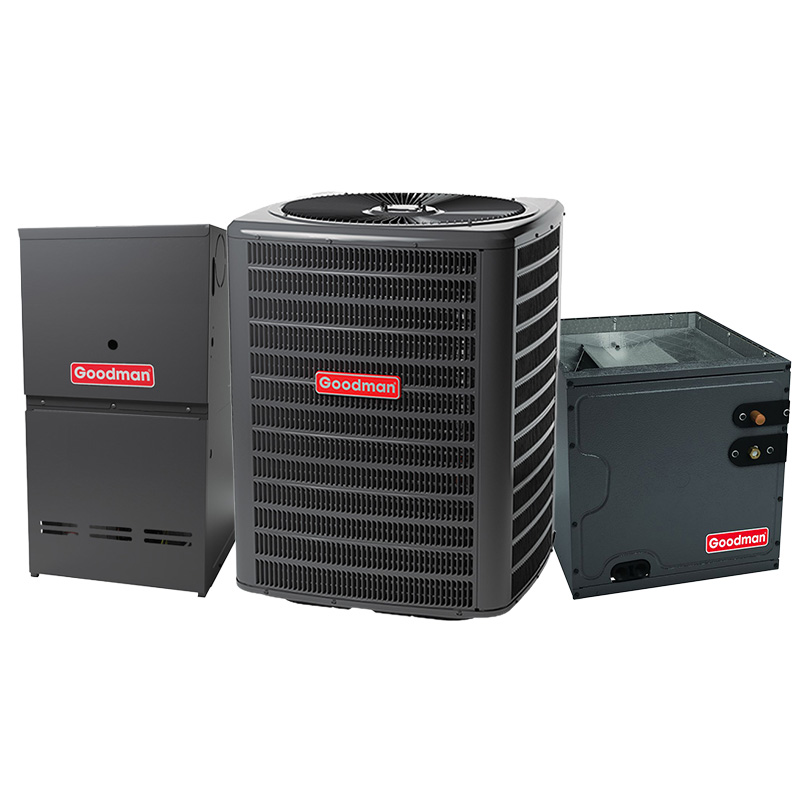
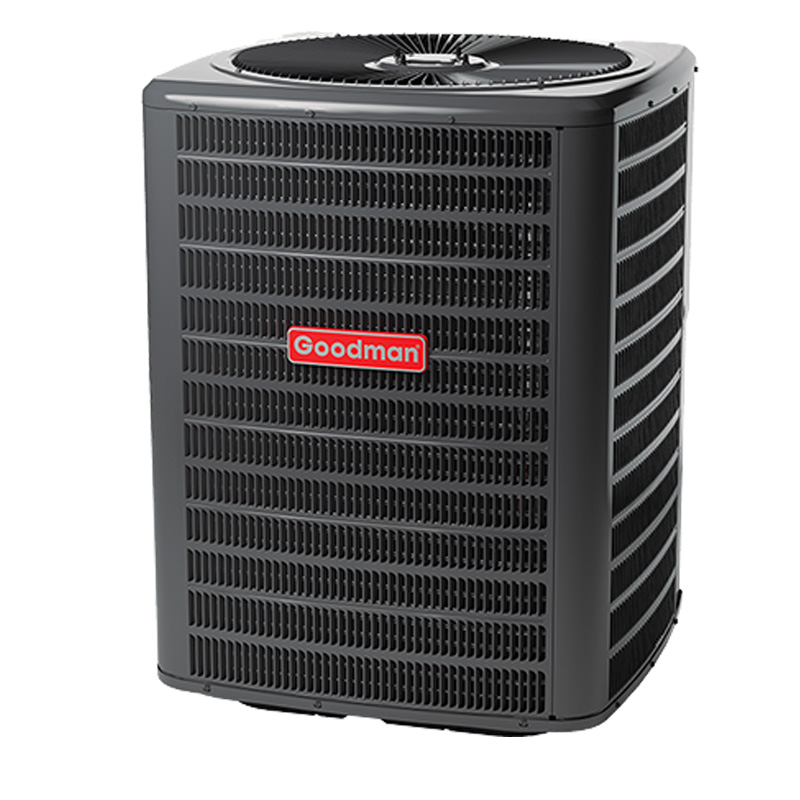
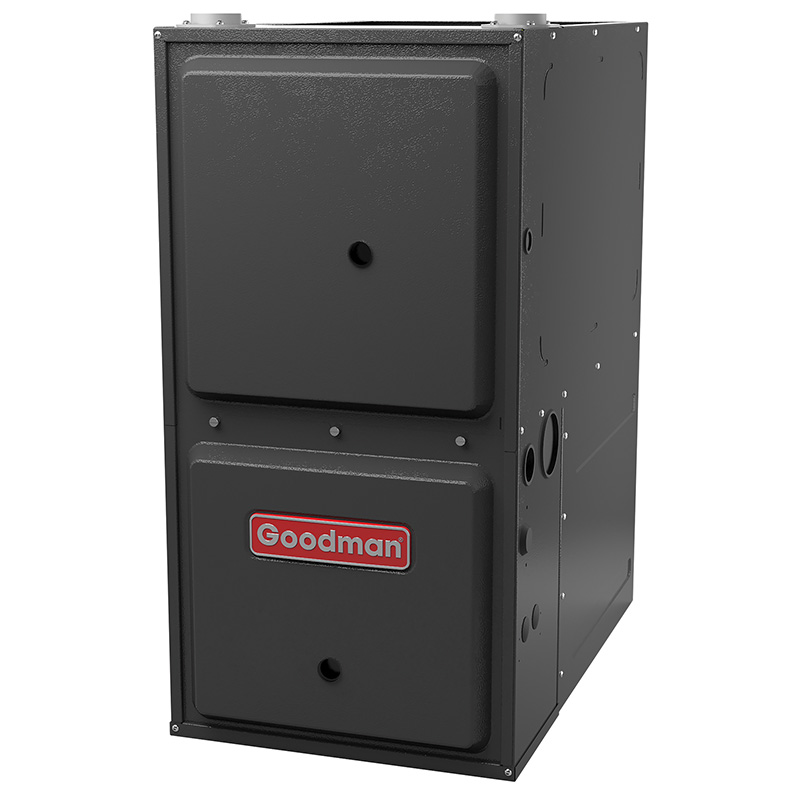
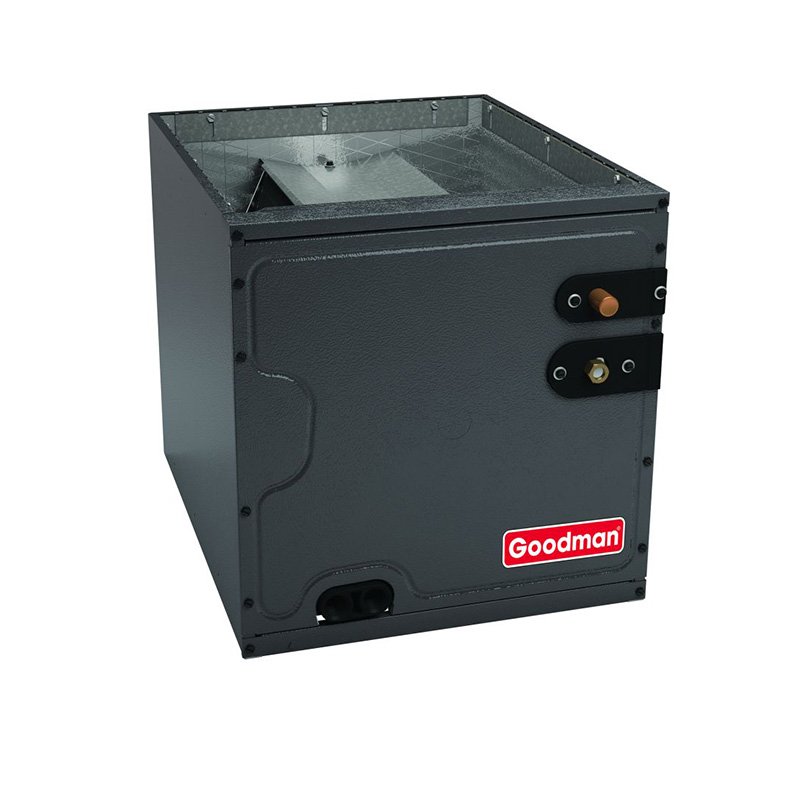
Goodman 3.5 Ton AC And 80000 BTU 80% AFUE Gas Furnace System | 15.2 SEER2 AC | Multi-Speed ECM Low NOx Furnace | Downflow | R32
View on AC Direct see your lowest price →Check current price on AC Direct →
Key features
- 3.5-ton cooling capacity with 15.2 SEER2 efficiency rating
- 80,000 BTU gas furnace at 80% AFUE with multi-speed ECM blower
- Downflow configuration for installations discharging air downward
- R-32 refrigerant with lower global warming potential than R-410A
- Low NOx burner design meets California and regional air-quality standards
- Matched system design intended to simplify AHJ permit and AHRI certification
About this system
This Goodman bundle pairs a 3.5-ton, 15.2 SEER2 central air conditioner with an 80,000 BTU, 80% AFUE gas furnace in a downflow configuration, making it a practical fit for homes where the air handler sits on the main floor above a crawl space or basement return, or in a utility closet that discharges air downward. The R-32 refrigerant charge is a forward-looking choice: R-32 has a lower global warming potential than the R-410A it replaces and is increasingly common in new residential equipment. At 15.2 SEER2, this system meets the federal minimum efficiency standards that took effect in 2023 for most U.S. climate zones, so you are getting a compliant but entry-level efficiency rating rather than a high-efficiency unit.
The furnace side runs at 80% AFUE, which means 80 cents of every dollar spent on gas becomes usable heat. That is the baseline for a single-stage or multi-speed 80% furnace and is noticeably less efficient than a 96% or 97% AFUE modulating unit. The multi-speed ECM blower motor does help reduce electricity consumption during fan operation compared to a standard PSC motor, and the Low NOx design meets stricter California and regional air-quality rules. Together, this package suits a homeowner replacing aging equipment in a mid-sized house who wants a code-compliant, properly sized system at a lower upfront price and can accept slightly higher operating costs versus a higher-AFUE or higher-SEER2 setup.
This Goodman bundle is a reasonable entry-level replacement system for homeowners who need a code-compliant, properly sized setup without spending premium-brand money. The efficiency and reliability ceilings are real, and long-term performance will depend heavily on installer quality and how well the refrigerant charge is set at startup. Buyers willing to accept that trade-off and budget for possible capacitor or coil service after year 7 will find fair value here.
Overall score is the average of the five ratings above.
What we like
- Priced 15 to 25 percent below comparable Trane, Lennox, and Carrier bundles
- R-32 refrigerant is more environmentally responsible than R-410A and increasingly well-supported by technicians
- Multi-speed ECM motor lowers blower electricity use compared to a basic PSC motor
- Low NOx burner satisfies strict California and regional air-quality regulations
- Matched factory bundle simplifies AHRI ratings documentation for permits
Trade-offs
- 80% AFUE is the efficiency floor, not a high-efficiency rating; homeowners in cold climates pay noticeably more in gas bills than with a 95%+ furnace
- 15.2 SEER2 meets current minimums but sits at the bottom of the efficiency range, so cooling operating costs will be higher than mid- or high-efficiency alternatives
- Documented failure modes include dual-run capacitor failures, evaporator coil leaks, and compressor lifespans that average 10 to 14 years versus 15 to 20 years for premium brands
- ConsumerAffairs feedback averages about 2.5 out of 5, with repair costs climbing after roughly year 7 as a recurring theme
What homeowners and pros say about Goodman
Homeowners and installers tend to split along predictable lines when discussing Goodman. On Google dealer review pages, the brand averages around 3.8 out of 5 across hundreds of reviews per location, and affordability is consistently the most cited reason for choosing it. Buyers who paired a good installation with regular filter changes and annual tune-ups report years of trouble-free operation. The picture on ConsumerAffairs is less flattering, averaging about 2.5 out of 5 on a channel that skews toward people reporting problems, and the recurring thread there is that repair costs accelerate after roughly year 7. That pattern aligns with the documented failure modes technicians see in the field: dual-run capacitors are the most common call, usually inexpensive to fix, but evaporator coil leaks and compressor replacements are more disruptive and more expensive when they arrive.
HVAC professionals who work on Goodman equipment regularly point out that the brand’s reputation is inseparable from install quality. A properly sized system with a carefully set refrigerant charge and sealed ductwork can perform well into its second decade; a rushed install with a marginal charge is where the early refrigerant-leak complaints originate. For this specific 3.5-ton, 15.2 SEER2, 80% AFUE downflow bundle, that reality is front and center. The compressor lifespan averaging 10 to 14 years versus the 15 to 20 years seen in premium brands is the most significant long-term trade-off, and it is worth factoring into the true cost of ownership before deciding whether the lower purchase price represents genuine savings over a 15-year horizon.
Sources: ConsumerAffairs Goodman owner reviews, AHRI Directory of Certified Product Performance, U.S. DOE appliance and equipment efficiency standards, Goodman product specification sheets.
What it costs to run
At 15.2 SEER2, cooling this 3.5-ton system for a typical 1200-hour cooling season at the U.S. average electricity rate of $0.17/kWh works out to roughly $564 per year in cooling, about $75 less per year than a minimum-efficiency 13.4 SEER2 unit of the same size. Your real cost depends on your climate and local rate.
Method: (42,000 BTU/hr ÷ 15.2 SEER2) × 1200 hours ÷ 1000 × $0.17/kWh. Rate source: U.S. EIA average; cooling hours: moderate-climate estimate.
How it compares
| Brand | Comparable model | SEER2 | Stage | Price position |
|---|---|---|---|---|
| Goodman | GSXH5 / GCVC8 80% Downflow Bundle (this system) | 15.2 | Single-stage / Multi-speed | Value pick |
| Carrier | Performance 14 / 58TP (80% AFUE) Bundle | 15.2 | Single-stage | Approximately 15 to 20 percent more than this Goodman bundle |
| Trane | XR15 / S8X1 (80% AFUE) Bundle | 15.0–15.5 | Single-stage | Approximately 18 to 25 percent more than this Goodman bundle |
| Lennox | Merit ML15 / ML180 (80% AFUE) Bundle | 15.2 | Single-stage | Approximately 20 to 28 percent more than this Goodman bundle |
Competitor rows are comparable single-stage units at similar efficiency; price is relative position, not a quote.
Questions about this system
Is 15.2 SEER2 going to cost me a lot more to run than a higher-efficiency unit?
Compared to a 17 or 18 SEER2 system, you will pay modestly more each cooling season, with the exact difference depending on your local electricity rate and how many cooling hours your climate accumulates. In a high-cooling-load region like the Southeast, that gap becomes more meaningful over 10-plus years. The 15.2 SEER2 rating meets the current federal minimum, so it is compliant but not optimized for lowest operating cost.
Why does this furnace have an 80% AFUE rating instead of a higher one, and does that matter for my area?
80% AFUE is the baseline efficiency tier for gas furnaces and is code-legal in most U.S. climate zones, though some northern states and localities require 90% or higher. If you heat your home heavily from October through April, a 95% to 97% AFUE furnace can meaningfully cut your gas bill over time; the higher upfront cost often pays back in colder climates within several years.
What are the most common repairs I should expect with this Goodman system?
Based on documented owner and technician feedback, dual-run capacitors are the most frequently reported failure and are typically a quick, low-cost fix in the 300 to 600 dollar range. Evaporator coil leaks appear in a notable share of owner reports, and compressors on Goodman units tend to average 10 to 14 years before replacement is needed, shorter than the 15 to 20 years more commonly reported for premium brands.
My house uses a downflow configuration. Does this system actually require that, or can it be installed upflow too?
This bundle is configured specifically for downflow installation, meaning the furnace discharges heated air downward through the plenum beneath the unit. Using a downflow-configured furnace in an upflow application requires a factory-configured upflow unit instead; mixing configurations can create safety, warranty, and performance issues. Confirm your existing duct layout with your installer before ordering.
R-32 is listed as the refrigerant. Will my existing technicians be able to service it, and is R-32 harder to handle than R-410A?
R-32 is classified as a mildly flammable refrigerant (A2L), which requires technicians to follow updated handling procedures and use compatible recovery equipment. Most licensed HVAC contractors are already certified or are actively getting certified to handle A2L refrigerants, since R-32 and other A2Ls are now being adopted across the industry. Ask your installer specifically about their R-32 certification before the job begins.
Specifications
| Cooling capacity | 3.5 Ton |
| Efficiency | 15.2 SEER2 |
| Furnace output | 80000 BTU |
| Furnace efficiency | 80% AFUE |
| Configuration | Downflow |
| Refrigerant | R-32 |