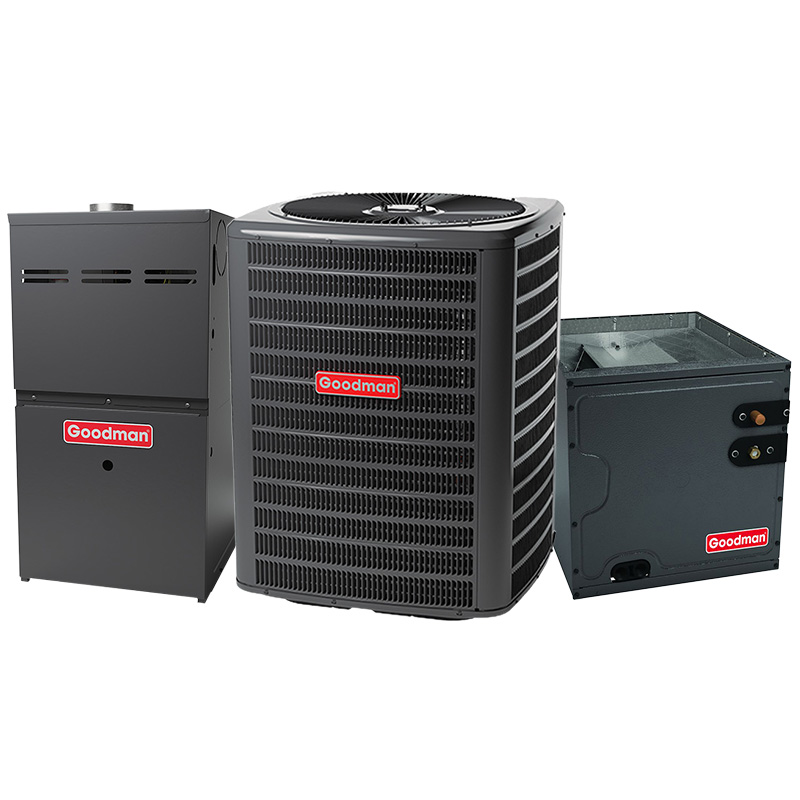
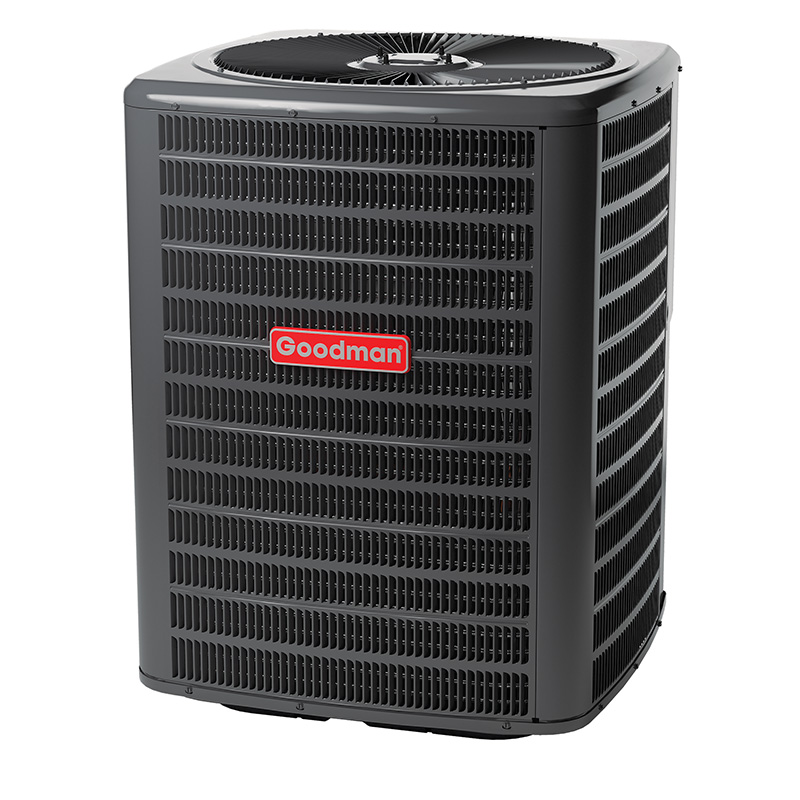
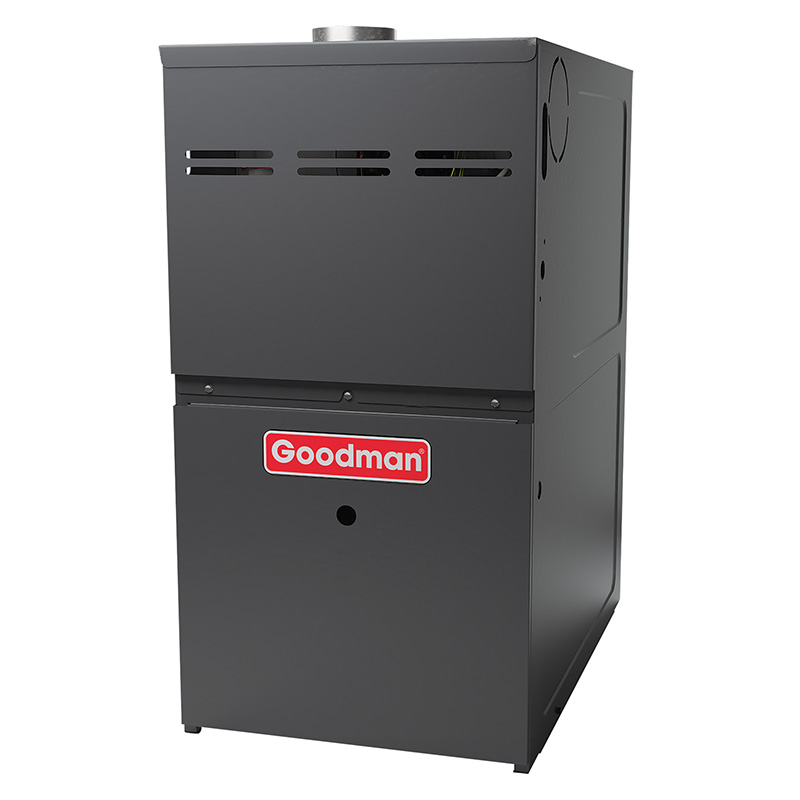
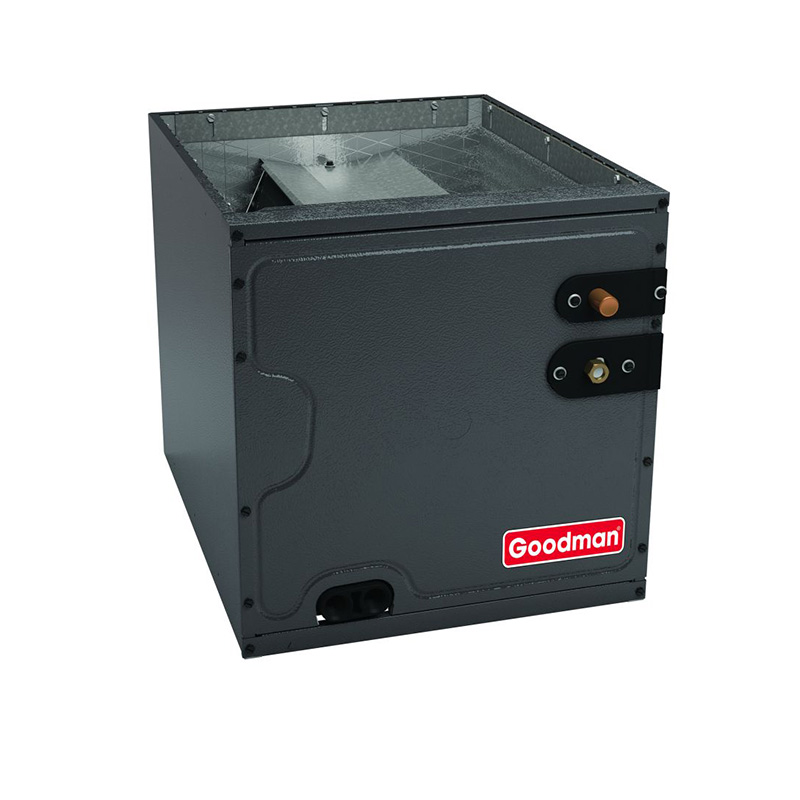
Goodman 2 Ton AC And 40000 BTU 80% AFUE Gas Furnace System | 14.5 SEER2 AC | Multi-Speed ECM Low NOx Furnace | Upflow | R32
View on AC Direct see your lowest price →Check current price on AC Direct →
Key features
- 14.5 SEER2 cooling efficiency meets federal minimums for most northern U.S. regions
- 40,000 BTU 80% AFUE gas furnace suited for smaller homes with moderate heating loads
- Multi-speed ECM blower motor reduces electricity use and improves airflow consistency
- Upflow cabinet configuration compatible with basement and ground-level closet installations
- R-32 refrigerant with lower global warming potential than legacy R-410A
- Low NOx burner design meets California and other strict air-quality standards
About this system
The Goodman 2-ton, 14.5 SEER2 AC and 40,000 BTU 80% AFUE gas furnace bundle is built for smaller homes and tight budgets in mild to moderately cold climates. The 2-ton cooling capacity suits spaces roughly between 900 and 1,400 square feet, depending on insulation and local climate, and the 40,000 BTU furnace output is appropriate for those same smaller footprints where a full 60,000 or 80,000 BTU unit would short-cycle. The upflow configuration means warm air exits the top of the cabinet, which works well when the unit sits in a basement or ground-level closet with ductwork running up through the home.
On the efficiency side, 14.5 SEER2 clears the federal minimum for most northern U.S. regions and falls just below the 15 SEER2 threshold required in the Southwest and Southeast, so confirm local code before purchasing. The 80% AFUE furnace is the baseline efficiency tier, meaning one-fifth of the fuel burned goes out the flue. That is acceptable where gas prices are low or heating hours are limited, but homeowners in cold climates should weigh the long-term fuel cost against a 96% AFUE option. The multi-speed ECM blower motor improves airflow consistency and humidity management compared to a single-speed PSC motor, and it consumes less electricity doing so. R-32 refrigerant is a newer, lower-global-warming-potential option that is easier to handle in the event of a charge issue, though technicians in some markets may have less field experience with it.
This Goodman bundle delivers functional, code-compliant heating and cooling at a price point that is hard to match from premium brands, but buyers should go in with clear eyes: long-term reliability depends heavily on installer quality, and repair costs can accumulate after year seven. It is a reasonable fit for budget-conscious homeowners who prioritize upfront savings and plan to stay on top of annual maintenance.
Overall score is the average of the five ratings above.
What we like
- Purchase price typically 15 to 25 percent lower than comparable Carrier, Trane, or Lennox systems
- Multi-speed ECM motor improves comfort and humidity control over basic single-speed units
- Low NOx burner meets strict California SCAQMD and similar regional emissions rules
- R-32 refrigerant is more environmentally responsible than R-410A and simpler to recover
- Upflow design integrates cleanly with the most common residential ductwork layouts
Trade-offs
- 80% AFUE is the least efficient gas furnace tier, raising long-term fuel costs in colder climates
- Dual-run capacitors are a documented early failure point, typically requiring a 300 to 600 dollar service call
- Compressor lifespan averages 10 to 14 years, shorter than the 15 to 20 years reported for premium brands
- A minority of owners report refrigerant or evaporator coil leaks, outcomes that are sensitive to install precision
What homeowners and pros say about Goodman
Among homeowners, Goodman’s reputation lands in a predictable place: strong praise for the upfront price, more mixed feelings once equipment ages past the seven-year mark. On ConsumerAffairs, Goodman scores around 2.5 out of 5, a channel where dissatisfied owners are overrepresented, and the recurring theme is repair bills that start to add up in the later years of ownership. Google dealer reviews tell a more balanced story, averaging around 3.8 out of 5 across hundreds of reviews per location, where affordability is cited most often as the reason buyers chose the brand. Neither score reflects a premium ownership experience, but neither condemns the brand outright.
HVAC technicians who work on Goodman equipment regularly tend to share a consistent observation: the brand performs reliably when it is installed correctly and maintained annually, and it falls short when it is not. The documented failure points are worth knowing going in. Dual-run capacitors are the most common service call, usually a quick fix in the 300 to 600 dollar range but annoying in the middle of a heat wave. Evaporator coil leaks appear in a meaningful share of owner reports. Compressor lifespan on Goodman units tends to average 10 to 14 years, noticeably shorter than the 15 to 20 years technicians associate with premium brands. A minority of first-year owners also report refrigerant issues, which most pros attribute to installer error or an improper initial charge rather than a factory defect. The takeaway is straightforward: the savings are real, the risk is manageable with good installation, and the long-term cost of ownership depends heavily on who puts it in and how well you maintain it.
Sources: ConsumerAffairs Goodman owner reviews, AHRI Directory of Certified Product Performance, U.S. DOE appliance and equipment efficiency standards, Goodman product specification sheets.
What it costs to run
At 14.5 SEER2, cooling this 2-ton system for a typical 1200-hour cooling season at the U.S. average electricity rate of $0.17/kWh works out to roughly $338 per year in cooling, about $27 less per year than a minimum-efficiency 13.4 SEER2 unit of the same size. Your real cost depends on your climate and local rate.
Method: (24,000 BTU/hr ÷ 14.5 SEER2) × 1200 hours ÷ 1000 × $0.17/kWh. Rate source: U.S. EIA average; cooling hours: moderate-climate estimate.
How it compares
| Brand | Comparable model | SEER2 | Stage | Price position |
|---|---|---|---|---|
| Goodman | GLXS-MB / GMVM / this bundle | 14.5 | Single-stage | Value pick |
| Carrier | Comfort 14 (24ACC4) with 58MCA furnace | 14.5 | Single-stage | Typically 20 to 30 percent more than this Goodman bundle |
| Trane | XR14c with S8B1 furnace | 14.5 | Single-stage | Typically 25 to 35 percent more than this Goodman bundle |
| Lennox | Merit ML14XC1 with ML180 furnace | 14.5 | Single-stage | Typically 20 to 30 percent more than this Goodman bundle |
Competitor rows are comparable single-stage units at similar efficiency; price is relative position, not a quote.
Questions about this system
Is 14.5 SEER2 legal to install in my state?
14.5 SEER2 meets the federal minimum for northern U.S. states but falls below the 15 SEER2 floor required in the Southeast and Southwest regions as defined by DOE regional standards. Check your state and local requirements before ordering, because an undersized-efficiency unit may fail inspection.
Will this furnace work in a very cold climate, say Minnesota or Wisconsin?
The 40,000 BTU output is modest, suited for smaller, well-insulated homes. The larger concern in a cold climate is the 80% AFUE rating: at current gas prices in the Upper Midwest, upgrading to a 96% AFUE condensing furnace can cut heating bills noticeably over a 10-to-15-year span. If your heating load is significant, a higher-efficiency furnace is worth pricing out.
What is the warranty on this Goodman system?
Goodman typically offers a 10-year parts limited warranty when the equipment is registered within a set window after installation, and a lifetime heat exchanger warranty on the furnace. The compressor often carries a separate 10-year limited warranty. Read the registration terms carefully, because failure to register within the deadline usually drops coverage to five years.
My technician mentioned R-32 is unfamiliar to him. Should I be worried?
R-32 is newer to the U.S. residential market, and some technicians have less field experience with it than with R-410A. It requires slightly different handling procedures due to its mild flammability classification. Confirm that your installing contractor is trained and equipped to work with A2L refrigerants before proceeding.
How often do the capacitors fail, and what does that cost?
Dual-run capacitors are the most frequently reported repair on Goodman AC units, often showing up after several years of operation. The repair itself is typically straightforward and falls in the 300 to 600 dollar range including labor. Keeping a service agreement in place means this failure is usually caught before it takes out the compressor.
Specifications
| Cooling capacity | 2 Ton |
| Efficiency | 14.5 SEER2 |
| Furnace output | 40000 BTU |
| Furnace efficiency | 80% AFUE |
| Configuration | Upflow |
| Refrigerant | R-32 |