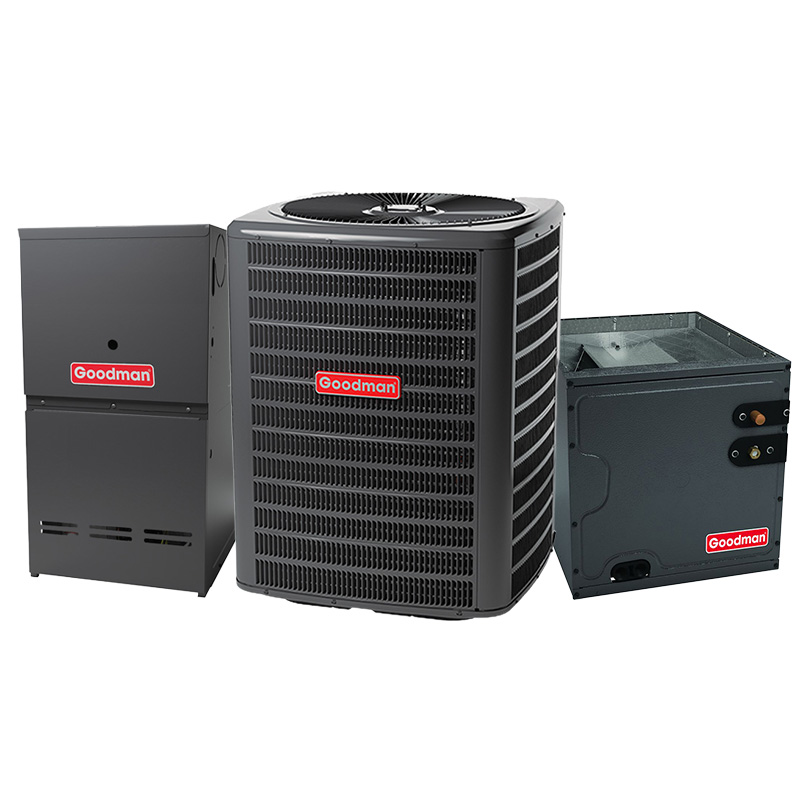
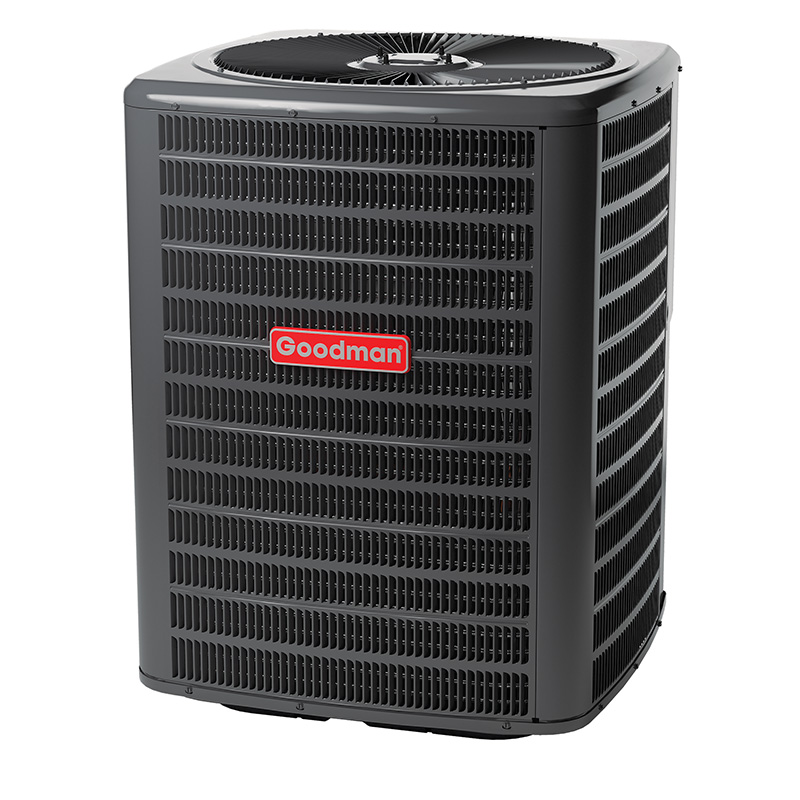
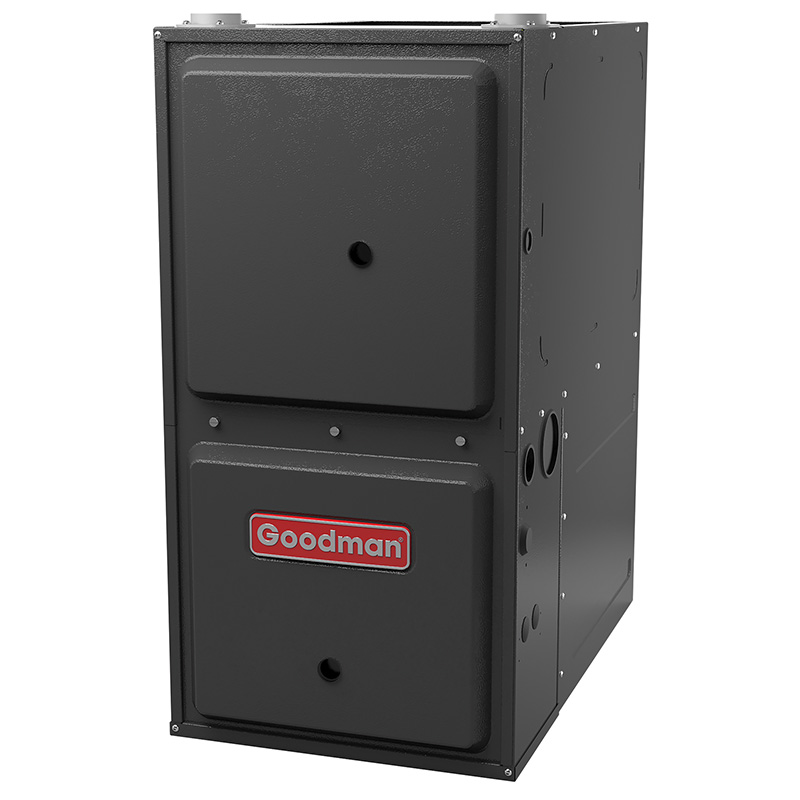
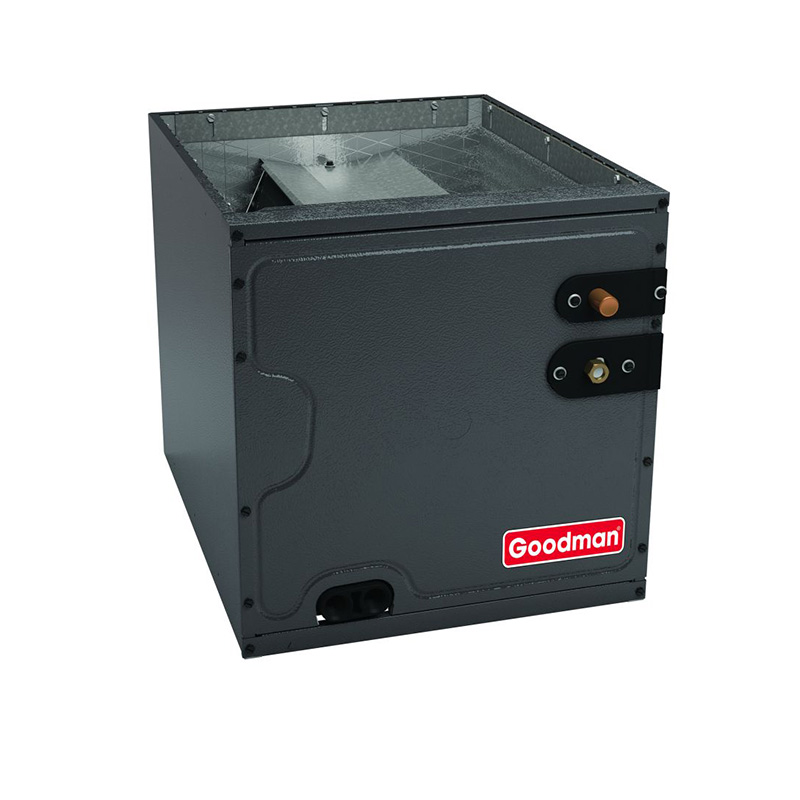
Goodman 3 Ton AC And 80000 BTU 80% AFUE Gas Furnace System | 15.2 SEER2 AC | Multi-Speed ECM Low NOx Furnace | Downflow | R32
View on AC Direct see your lowest price →Check current price on AC Direct →
Key features
- 3-ton cooling capacity rated at 15.2 SEER2 under current DOE test standards
- 80,000 BTU output at 80% AFUE — heats living space, 20% of fuel energy exits as exhaust
- Downflow configuration only — supply air exits the bottom of the air handler
- Multi-speed ECM blower motor reduces blower electrical draw versus standard PSC motors
- R-32 refrigerant — lower global-warming potential than R-410A, increasingly standard
- Single-stage cooling compressor — full capacity on or off, no variable modulation
About this system
This Goodman bundle pairs a 3-ton, 15.2 SEER2 split-system air conditioner with an 80,000 BTU, 80% AFUE gas furnace in a downflow configuration, making it a practical fit for homes where the air handler sits in a closet or utility room above the living space and supply air is directed downward. The R-32 refrigerant charge is a meaningful forward-looking detail: R-32 has a lower global-warming potential than R-410A and is increasingly the industry standard, so replacement refrigerant should remain available and reasonably priced for the life of the system. The multi-speed ECM blower motor in the furnace section reduces blower electricity consumption compared with a standard PSC motor and helps maintain more even airflow across the duct system.
At 15.2 SEER2, this system clears the federal minimum efficiency thresholds that took effect in 2023 but does not reach the mid- or high-efficiency tier occupied by 17 to 20 SEER2 equipment. That is an honest trade-off: you get meaningful energy savings over an older 13 SEER system, without paying the premium for variable-speed compressor technology. The 80% AFUE furnace is similarly an entry-to-mid-grade efficiency choice, well-suited for mild to moderate heating climates where natural gas prices are not extreme. Homeowners in cold northern climates should weigh whether a 96% AFUE furnace would recover its price premium through fuel savings. The downflow orientation limits this system to specific installation types, so confirm your existing duct configuration before purchasing.
This Goodman combo delivers solid, code-compliant efficiency at a price point that is hard to match from premium brands, making it a reasonable choice for budget-conscious buyers in moderate climates. The trade-offs are real: single-stage cooling, entry-level furnace efficiency, and a brand track record that shows higher-than-average repair frequency after year seven. Install quality will do more to determine how long this system runs well than almost any spec on the sheet.
Overall score is the average of the five ratings above.
What we like
- Priced 15 to 25 percent below comparable Trane, Lennox, and Carrier equipment
- 15.2 SEER2 meets current federal minimums and beats older 13 SEER systems noticeably in operating costs
- R-32 refrigerant is forward-compatible and environmentally preferable to R-410A
- Multi-speed ECM blower improves comfort and lowers fan energy versus a PSC motor
- Wide parts availability means capacitor and minor repairs are typically quick and affordable
Trade-offs
- Single-stage compressor cycles fully on and off, which is less comfortable and efficient than two-stage or variable-speed alternatives
- 80% AFUE furnace leaves 20% of fuel energy unused — a meaningful cost in colder climates with high gas rates
- ConsumerAffairs reviews average about 2.5 out of 5, with repair costs climbing after roughly year seven as a recurring theme
- Documented failure modes include dual-run capacitor failures, evaporator coil leaks, and compressor lifespans that average 10 to 14 years versus 15 to 20 for premium brands
What homeowners and pros say about Goodman
Homeowners who purchased Goodman equipment and left reviews on Google dealer pages give the brand roughly 3.8 out of 5 stars across several hundred reviews per location, with affordability cited most often as the reason they chose it. On ConsumerAffairs, the brand scores around 2.5 out of 5, a channel that skews toward dissatisfied owners, and the pattern that surfaces repeatedly is repair costs accumulating after year seven or eight of ownership. Neither score is unusual for a value-tier brand: the equipment is priced to move, and some of that savings is recouped over time in more frequent service calls.
HVAC technicians are consistent on one point: install quality matters more on Goodman equipment than on premium brands, because there is less margin for error in a system that is already built to a tighter cost target. The documented failure modes worth knowing about are dual-run capacitor failures (common, inexpensive to fix), evaporator coil leaks (reported in a meaningful share of owner reviews), and compressor lifespan that averages 10 to 14 years compared with 15 to 20 years for Trane, Carrier, and Lennox compressors. A small number of owners also report refrigerant leaks in the first year, which technicians attribute to installation or charge issues rather than factory problems. None of these are disqualifying for a buyer who understands the trade-offs and plans accordingly.
Sources: ConsumerAffairs Goodman owner reviews, AHRI Directory of Certified Product Performance, U.S. DOE appliance and equipment efficiency standards, Goodman product specification sheets.
What it costs to run
At 15.2 SEER2, cooling this 3-ton system for a typical 1200-hour cooling season at the U.S. average electricity rate of $0.17/kWh works out to roughly $483 per year in cooling, about $65 less per year than a minimum-efficiency 13.4 SEER2 unit of the same size. Your real cost depends on your climate and local rate.
Method: (36,000 BTU/hr ÷ 15.2 SEER2) × 1200 hours ÷ 1000 × $0.17/kWh. Rate source: U.S. EIA average; cooling hours: moderate-climate estimate.
How it compares
| Brand | Comparable model | SEER2 | Stage | Price position |
|---|---|---|---|---|
| Goodman | GSXH503610 / GCVC8 Downflow Bundle | 15.2 | Single-stage | Value pick |
| Carrier | Comfort 15 (24ACC6) with 80% Furnace | 15.2 | Single-stage | Typically 15 to 25 percent higher than Goodman for comparable capacity |
| Trane | XR15 (4TTR5) with S8X1 80% Furnace | 15.0–15.5 | Single-stage | Typically 20 to 30 percent higher than Goodman for comparable capacity |
| Lennox | Merit 16 (ML16XC1) with 80% Merit Furnace | 15.5–16.0 | Single-stage | Typically 20 to 30 percent higher than Goodman for comparable capacity |
Competitor rows are comparable single-stage units at similar efficiency; price is relative position, not a quote.
Questions about this system
Why does this system use a downflow configuration and can I install it in a horizontal or upflow application?
Downflow means the blower pulls return air in at the top of the cabinet and discharges conditioned air out the bottom into the supply plenum below. This configuration is designed specifically for that orientation and is not interchangeable with upflow or horizontal equipment without purchasing a different cabinet. Confirm your existing duct layout before ordering.
What does switching to R-32 refrigerant mean for me as the homeowner?
R-32 has a global-warming potential roughly one-third that of R-410A and is being adopted broadly across the industry, so technicians and refrigerant supply should remain available throughout the system's life. It operates at slightly different pressures than R-410A, so any technician servicing the system should be familiar with R-32 handling procedures and use compatible recovery equipment.
How worried should I be about the dual-run capacitor failure that comes up in Goodman reviews?
Capacitor failures are the most commonly reported repair on Goodman AC units, but they are also one of the cheapest and quickest fixes in HVAC — typically 300 to 600 dollars including a service call. Keeping a service agreement or knowing a reliable local technician means this failure mode is an inconvenience rather than a crisis.
Is 80% AFUE good enough, or should I pay more for a 96% AFUE furnace?
The answer depends on your heating climate and local gas rates. In mild climates, the payback period on a 96% furnace can be 10 or more years, making 80% the practical choice. In cold northern climates where the furnace runs heavily from October through April, the 16-point efficiency gap translates to meaningful annual fuel savings that can recover the price premium in five to eight years.
A minority of Goodman owners report refrigerant leaks in the first year — is that a product defect or something else?
According to documented owner feedback, first-year refrigerant leaks are most commonly traced to install or charge issues rather than factory defects. Hiring a licensed, experienced contractor, having the refrigerant charge verified with a digital manifold, and pressure-testing all line set connections at startup are the most effective steps to avoid this problem.
Specifications
| Cooling capacity | 3 Ton |
| Efficiency | 15.2 SEER2 |
| Furnace output | 80000 BTU |
| Furnace efficiency | 80% AFUE |
| Configuration | Downflow |
| Refrigerant | R-32 |